

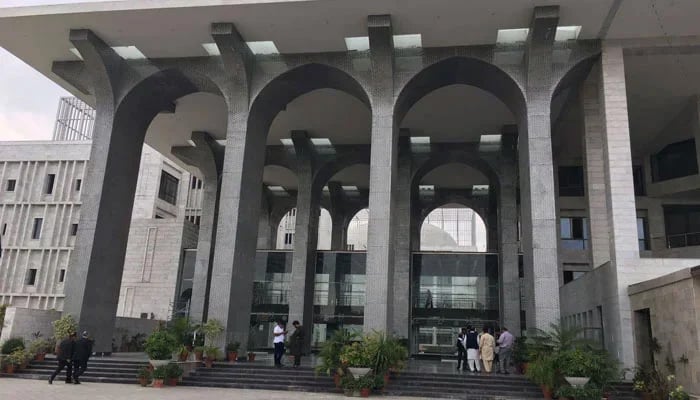
Endorsing the plea of two young Advocates Shahbaz Shah and Saadullah for ‘Free and Compulsory Education Act, 2012’ operational in federal government schools, Islamabad High Court issued directives to the people at the helm of affairs in ICT-PEIRA and other respondents to implement the law in in true letter and spirit.
Chief Justice of the Islamabad High Court Justice Aamer Farooq directed respondents to obtain data about deserving students from government and private schools within three months amid filing report in the court.

During last December, petitioner, Advocate Saadullah has made Secretaries of Federal Government, Ministry of Federal Education and Professional Training, Director General Federal Directorate of Education and Chairperson of the Private Education Institution Regulatory Authority (PEIRA) Islamabad as respondents. Issuing verdict in the matter, the IHC’ Chief Justice Aamer Farooq said in order, “Instant petition is disposed of with directions to the respondents to ensure compliance of the provisions of the Act of 2012 in letter and spirit, in this behalf, respondents shall obtain relevant date from all the governments and private schools, as the case may be and after scrutinizing the same, shall do the needful, in case compliance is not being made. The entire exercise shall be conducted within a period of three months from the date of receipt of this order and report shall be furnished after three months through Deputy Registrar (Judicial) of this court for perusal in chambers”.
It is pertinent to mention that the petition invoked jurisdiction of the IHC saying decision makers failed to implement ‘Free and Compulsory Education Act, 2012’ in true letter and spirit in federal government schools since pronouncement of the law. He came with the claim that lackluster performance has deprived thousands of underprivileged children education in Islamabad Capital Territory (ICT).
Advocate High Court Shahbaz Shah appeared before single-member bench of the Chief Justice Aamer Farooq on behalf of advocate Saadullah saying after passage of the law 13 years ago, federal government failed to provide free and compulsory education to all children of the age of five to sixteen years in schools, established by the federal government and local government in the ICT.
The Act provides that “every child, regardless of sex, nationality or race shall have a fundamental right to free and compulsory education in a neighbourhood school.” This includes all children including those with special educational needs between 5 to 16 years of age. He contended that despite the notification of the Act in 2015, no action has been taken thereunder and the law remains unimplemented. Advocate Shah apprised the bench that under Section 9 of the Act preschool education is to be provided which is not being done in any government-controlled school in the ICT.
Advocate Shahbaz Shah further contended that under Section 10 of the Act, it is the responsibility of the private schools to allocate 10 percent seats for the disadvantaged class of the society for admission which again is not being done. He urged the court to issue directives to respondents to ensure strict adherence to the Act’s provisions, including Sections 9, 10, 11, 14 and 22 and take punitive actions against any entity found violating its requirements.
He also sought the court directives to the Islamabad Capital Territory Private Educational Institutions Regulatory Authority (ICT-PERA) to enforce the provisions of The Right to Free and Compulsory Education Act, 2012, and ensure that all private schools in Islamabad provide free education to disadvantaged children as per the quota stipulated in the Act.
He also sought a competent monitoring committee to oversee the enforcement of the provisions of the law in order to ensure School Management Committees (SMCs) active role to force parents to send children to school. Shah further requested the SMCs should take measures in cases of non-compliance.