

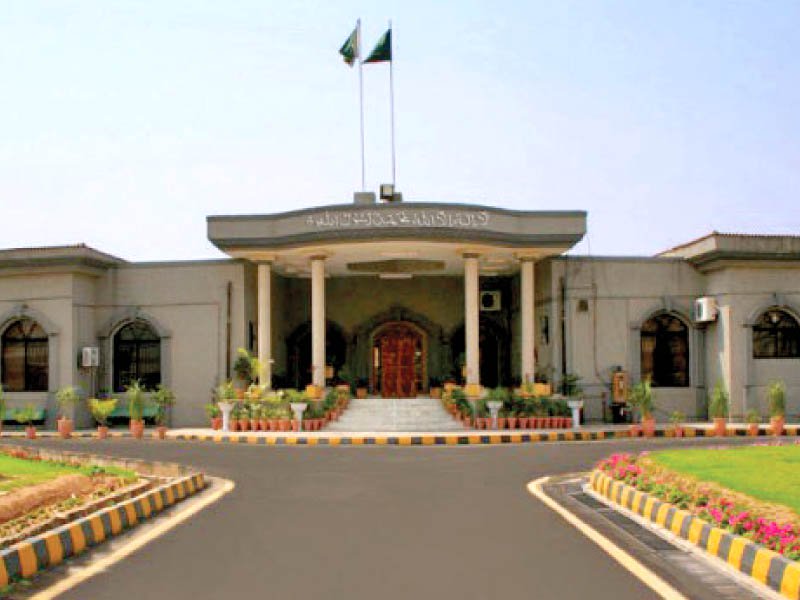
A single-member bench of the Islamabad High Court Justice Amir Farooq Monday issued restraining order to Election Commission of Pakistan from taking adverse action against Prime Minister Imran Khan and Federal Planning Minister Asad Umar over alleged violation of the election code of conduct.
In March 11, the ECP had issued notices to PM Imran Khan and other PTI officials for attending an election rally in Lower Dir in violation of the ECP rule of conduct. However, counsel for both the petitioners Senator & Barrister Syed Ali Zafar assailed the legality of the ECP’ Code of Conduct before the IHC saying the ECP under the Constitution has to abide by the law of the land.
Barrister Zafar submitted that under Article 187-A of the Election Act, 2017, all Parliamentarians, including those who hold public offices, are entitled to address gatherings during the elections as long as they comply with the safeguards provided in the law such as not to use public funds or declare any development projects etc. He further said that the public office holders, are entitled to address people in gatherings as it is part of their job.
Barrister Zafar pointed out that under the Election Act, 2017, the ECP is entitled to make a Code of Conduct in consultation with the other political parties, however, in making the Code of Conduct the ECP is not entitled to amend, change, add to or delete any provisions of the Election Act, 2017.
“It is only the Parliament which can change the provisions of the Election Act, 2017 or a Court of law which can declare a provision of the Election Act, 2017 as being contrary to the Constitution”, Barrister Zafar stated. The petition further pointed out that the ECP is neither the Parliament nor a Court of law and hence cannot declare a provision of the Election Act, 2017 to be contrary to the Constitution or to make it redundant.
Barrister Zafar said that in this case ECP has acted as a legislature and a Court by declaring that Section 187-A of the Election Act, 2017 as unconstitutional under the garb of amending para 16 in the Code of Conduct.
It is worth mentioning that during previous date of hearing of the matter, the Attorney General for Pakistan (AGP) has been served a notice who appeared and supported the case of the petitioners saying the ECP is not competent to annul the ordinance. Responding to the court queries, the AGP submitted the prime minister could not remain impartial while attending political activities. He was of the view during the proceedings that how can a star performer be separated in the parliamentary form of government saying, “It could not relate to our constitutional scheme.”
The court has also been apprised that the PM had given written instructions that he would pay for party expenses from his own pocket.
Responding to the court inquiry under which law did the ECP amend the code of conduct, the ECP counsel contended that helicopters and government machinery were being used in the election campaign. He added that code of conduct was violated under the K-P Local Government Act 2013.
To which the Judge observed if the election campaign was operated from the national treasury then it would have implications. Later, the bench sought reply from the ECP and arguments on legal points at the next hearing, and adjourned the case for April 06.