

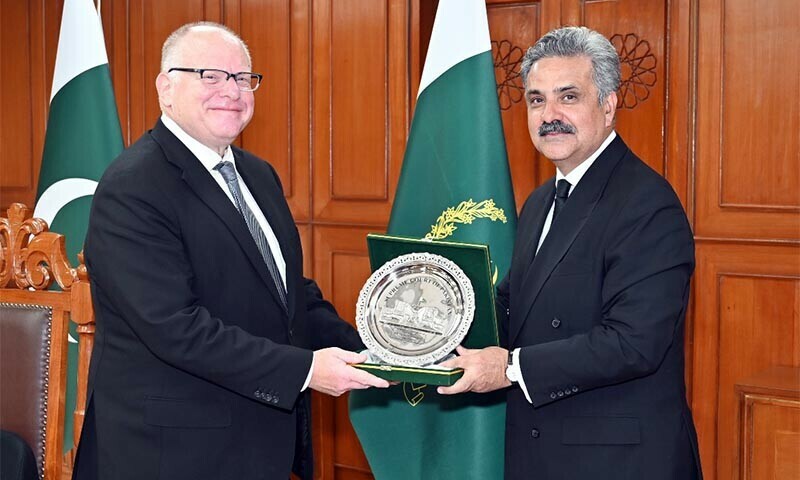
During its visit to Pakistan to review judicial and regulatory framework under the $7 billion bailout deal as a part of International Monetary Fund and World Bank usual scope of work, the Fund’s technical team met Chief Justice of Pakistan Yahya Afridi on Tuesday to discuss program implementation and property rights.
Law Minister Azam Nazir Tarar clarified that such meetings were considered part of the IMF and World Bank’s usual scope of work. The IMF team is visiting the country for a week-long scrutiny of the judicial and regulatory system as part of the ongoing $7bn Extended Fund Facility (EFF) to address governance and corruption vulnerabilities. It will examine six key governance-related sectors and institutions, according to a statement from the Ministry of Finance.
The CJP provided an overview of “the ongoing efforts to enhance judicial performance,” top court public relations office said in a press release. The CJP informed the mission that the “judiciary in Pakistan is independent, and being head of the institution, it is his responsibility to protect the independence,”. It has also been expressed in the press release the CJP Afridi also highlighted that the judiciary was not used to direct interactions with missions. CJP Afridi also stated he would be “quite guarded” when it came to his comments and views.
According to the statement, he also “highlighted key constitutional developments with respect to the Judicial Commission of Pakistan and reforms, including senior-level judicial appointments, judicial accountability, and the restructuring of the Judicial Commission of Pakistan (JCP)”.
He went on to elaborate on the “merits of integrating the judiciary and the parliamentary committee to ensure a more transparent and efficient judicial selection process.” The CJP Yahya also informed the delegation that the Supreme Court was in the “process of finalizing a critical agenda for the upcoming NJPMC meeting expected in the last week of February.”
“Discussions during the meeting also centered on judicial accountability and the mechanisms for addressing complaints against judges,” the report said, adding that the country’s chief justice also underscored on “the importance of a robust and fair accountability process” for the integrity and independence of the judiciary.
Meanwhile, the IMF team recognized the judiciary’s role “in maintaining legal and institutional stability,” expressing its appreciation for the ongoing reforms aimed at strengthening governance and accountability. “The discussion reaffirmed a shared commitment to enhancing judicial efficiency and upholding the rule of law as a cornerstone of economic and social progress,” the statement added.
While speaking to journalists after the meeting, the CJP Yahya Afridi said that a six-member team had also sought details regarding the program’s implementation and property rights. “I told the IMF that it has come to Pakistan at the best time,” he said, adding that the judges told the team about judicial reforms and the National Judicial Policy.
The CJP Afridi also said, “We have asked both the government and the opposition for an agenda for judicial reforms.” Additionally, CJP Afridi highlighted that the team also made “suggestions regarding the protection of property rights”. “I also talked about the National Judicial Policy-Making Committee — I told the delegation that we will make suggestions, we will create benches for early hearing in the high courts,” he stated.
Meanwhile, the delegation, according to the CJP, insisted that it wanted to protect foreign investment in the country. Moreover, the CJP Afridi said he also told the team that it was not the judges’ job to “disclose all the details”, underscoring that they had taken “an oath of independence of the judiciary under the Constitution”. “I told the delegation about the agenda of the National Judicial Policy Making Committee, I told the delegation that the subordinate judiciary is supervised by the high courts,” he added.
Separately, Minister for Law and Justice Azam Nazeer Tarar said that the rule of law was a component of the multilateral arrangements with organisations such as the IMF, World Bank, and the United Nations.
Meeting within domain of IMF, says Tarar
“They do interact regarding the rule of law,” law minister Tarar said while speaking to Geo News. “As far as the judicial autonomy is concerned […] it is purely a constitutional function,” he said. In response to a question regarding whether international bodies were used to create influence, the law minister said, “The Law and Justice Commission interacts with many international bodies. “This is within the domain of the IMF and World Bank,” he said.
Pakistan made a commitment with the IMF in October to strengthen institutional capacities to fight corruption, support inclusive growth, and provide a level playing field for businesses and investments.