

ISLAMABAD: Women’s place in judicial leadership is not secured by speeches alone. It takes professional development, fair access to opportunities and institutional support. That was the thread running through the inaugural Asia-Pacific Women Judges Network (APWJN) Convening in Bangkok, where Justice Ayesha A. Malik of the Supreme Court of Pakistan joined judges from across Asia and the Pacific to discuss how it can be built.
Justice Malik, a member of the Network’s Advisory Board, took part in the three-day Convening held in Bangkok, Thailand, from 16 to 18 November 2026. Supported by the United Nations Development Programme (UNDP) and the Asian Development Bank (ADB), the event brought together judges from Pakistan, Nepal, Bangladesh, Indonesia, Malaysia, the Philippines and Thailand to discuss judicial leadership, institutional development and regional cooperation.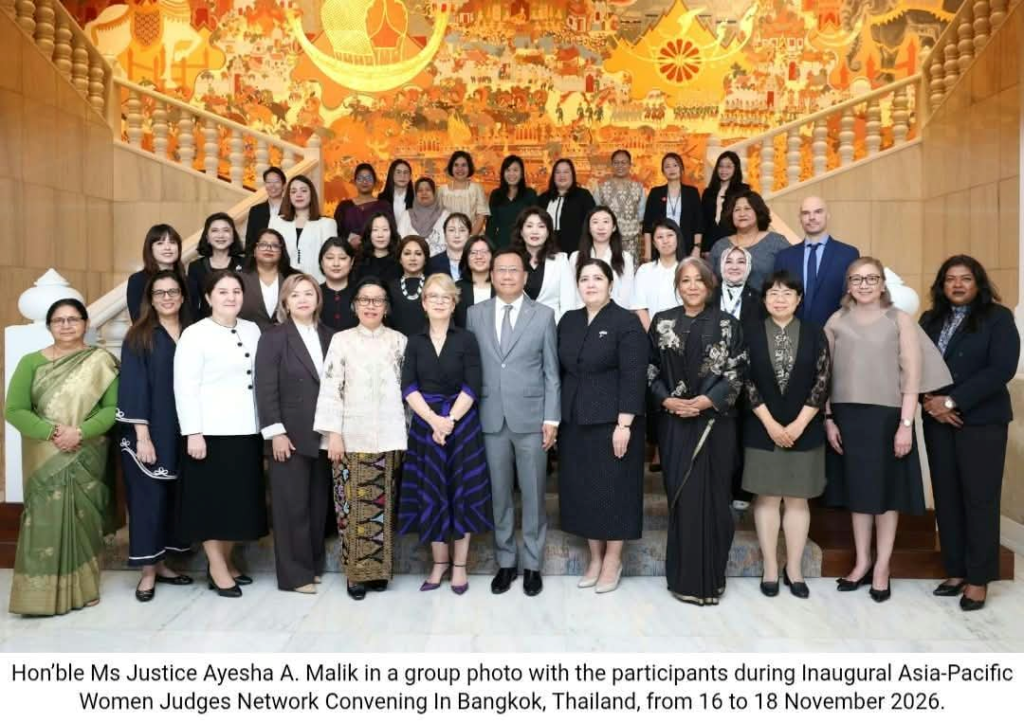 Justice Malik contributed to discussions on strengthening women’s participation in judicial leadership through professional development, fair access to opportunities and institutional support. She emphasised the importance of recognising leadership potential, developing a gender perspective and using comparative experience and evidence to strengthen institutional practices.
During her visit to the Supreme Court of Thailand, Justice Malik met with the Chief Justice, senior judges and former women Presidents of the Court. The discussions focused on judicial administration, institutional leadership, professional development and opportunities for greater cooperation and exchange between the judiciaries. Through her role on the Network’s Advisory Board, Justice Malik aims to strengthen opportunities for women judges in Pakistan by facilitating access to regional expertise, judicial education and leadership development. The focus is on building professional capacity, sharing effective institutional practices and enabling women judges to assume greater responsibilities in judicial administration and institutional development.