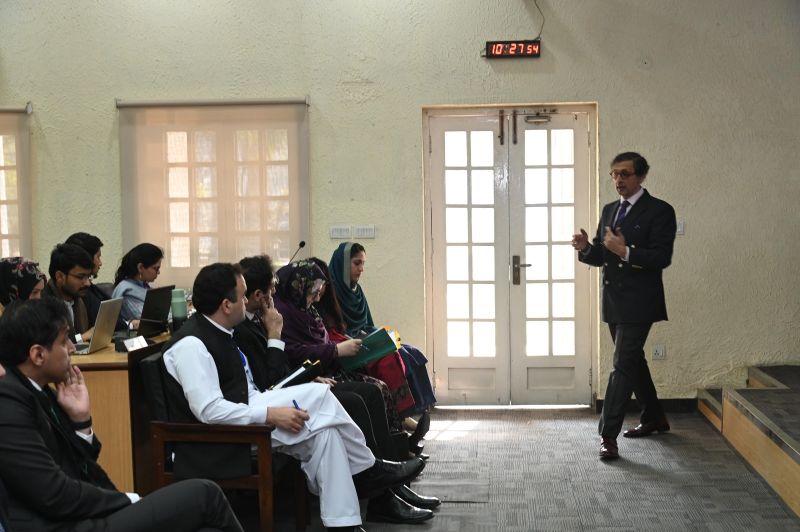
LAHORE : In a profound historical analysis, Justice Jawad Hassan of the Lahore High Court delivered a lecture at the Civil Services Academy, urging participants to view the Constitution not as a static document, but as a living organism that reflects the social, political, and cultural shifts of the Pakistani people.
Justice Hassan who is also member of the Board of Management of the Punjab Judicial Academy, meticulously detailed the ‘Aetiology’ or the underlying causes of various constitutional amendments, explaining how each change was a response to the shifting needs of the state.
Addressing the future leadership of Pakistan’s bureaucracy days ago, Justice Hassan explored the intricate ‘Legal Anthropology of the Pakistani Constitution,’ tracing the evolutionary arc from 1937 to the current 1973 framework. The session served as an intellectual deep-dive into the ‘Aetiology’ of constitutional amendments, framed through the lens of judicial precedents and the tension between legal Orthodoxy and Heterodoxy.
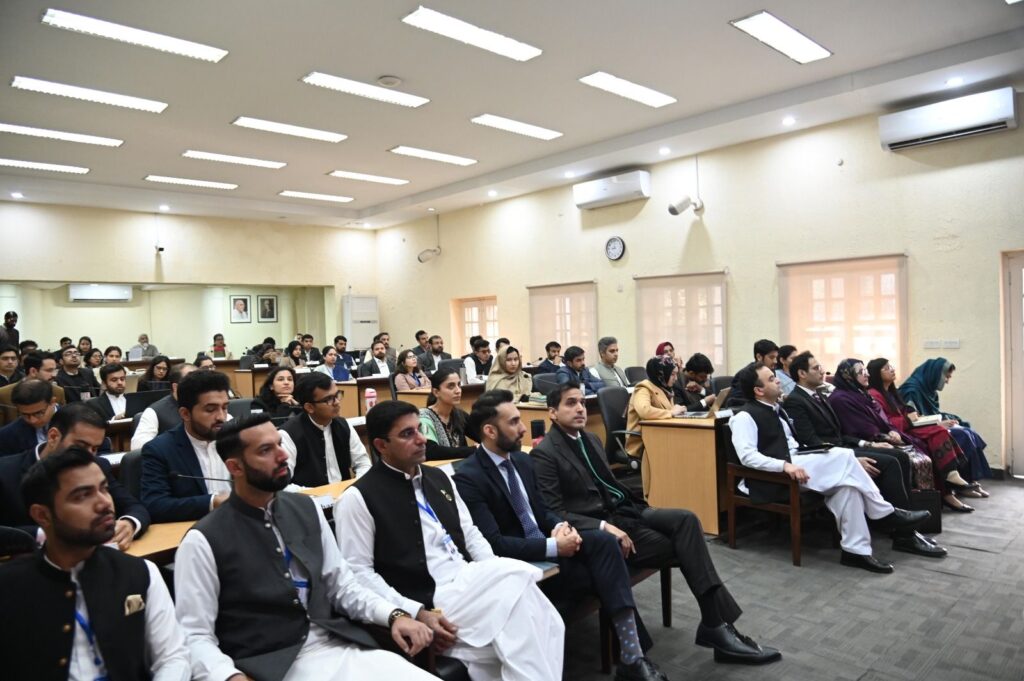
The lecture hall at the CSA was filled with the next generation of Pakistan Administrative Service (PAS) officers. The audience included as many as 55 Probationers (BS-17) of the 48th Specialized Training Programme (STP), 13 PAS Officers (BS-18) attending the Domain-Specific Mid-Career Management Course, more than 200 Probationers (BS-17) of the 54th Common Training Programme (CTP), who joined the session via video link from various regions.
Justice Hassan’s lecture went beyond mere dates, analyzing the ‘DNA’ of Pakistani law. He began with the Government of India Act 1935 (applied in 1937), explaining how it laid the structural foundations for the subsequent 1956, 1962, and 1973 Constitutions. A key highlight of the session was the discussion on the Judicial Anthology of the Superior Courts. Justice Hassan analyzed how precedents from the Supreme Court and High Courts have shaped the interpretation of the law.
He introduced the compelling dichotomy of Orthodoxy vs. Heterodoxy saying the orthodoxy is the traditional, strict adherence to established legal norms and the literal text of the Constitution. Whereas Heterodoxy is the innovative, progressive judicial thought that adapts to modern challenges, ensuring the law remains a tool for justice in a changing world. The session concluded with an interactive Q&A, where Justice Hassan urged the probationers to understand that the administration of the state (Civil Service) and the interpretation of the law (Judiciary) are two pillars of the same house.
The lecture has been hailed as an “intellectually enriching session” that provided the civil servants with the critical legal literacy required to navigate the complexities of governance while remaining steadfastly within the bounds of constitutional mandates.