
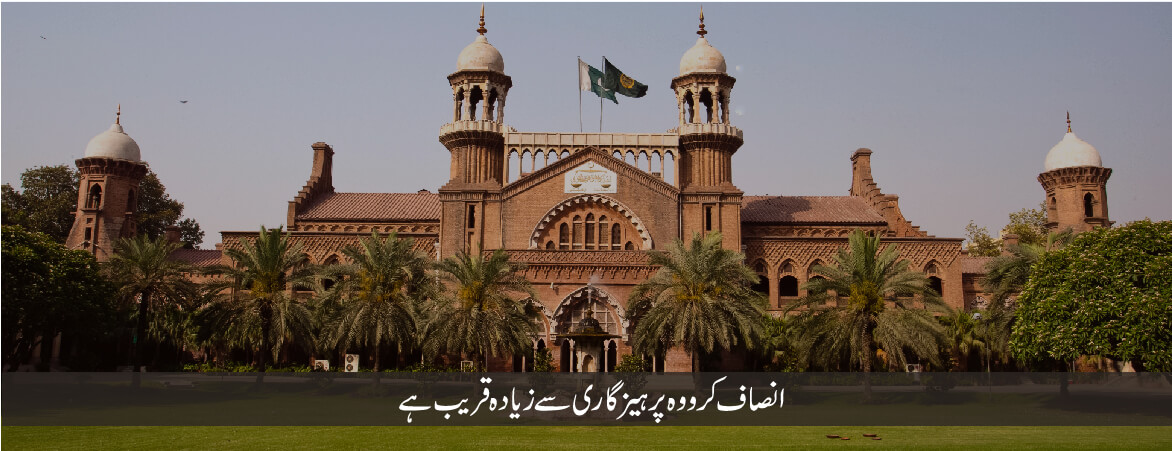
A plea moved the Lahore High Court (LHC) on Tuesday alleging that the federal government is eating up revenues which rightfully belong to local government.
The petitioner, a former chairman Narowal District Council and Local Government (LG) empowerment activist Ahmad Iqbal Chaudhry urged the LHC to set aside recently inserted Section 7E in the ‘Income Tax Ordinance 2001’ on the grounds that federal legislative authority has excessed its mandate in sheer violation of the constitutional provisions.
Advocates Umer Ijaz Gilani and Usama Khawar Ghumman filed the petition on behalf of Ahamad Iqbal Chaudhry making Secretaries Federal Revenue Division, Federal Ministry of Law & Justice, Chairman Federal Board of Revenue (FBR), Deputy Commissioner Narowal, Provincial Secretary Finance and Local Government Secretary as respondents.
Challenging Section 7E of the Income Tax Ordinance 2001, the counsels submitted even though tax levied under newly inserted Section has been cleverly disguised by the FBR as an ‘income tax’ saying “it is not a tax on income”.
The counsels further submitted that property taxes represent the single most important source of revenue of local governments all over the world. They further submitted “This is the first time that the FBR has intruded into the domain property taxes. Unless this intrusion is checked by the judiciary, the fiscal future of local government would be jeopardized, which would violate the object and purpose of Article 140A of the Constitution.
Federal government/ FBR eating up LG revenues; petitioner
They urged the court to strike down the legislation levying income tax on “deemed rental income” of properties. Earlier this year, the Federal Finance Act, 2022 inserted Section 7E in the Income Tax Ordinance, 2001. The new law mandates that every property which is not in the use of the owner, will be “deemed” by the FBR as a bearing a rent equivalent to 5% of the total market value to the property. This “deemed rental income” would be taxed at a rate of 20%.
In simple words, every property owner would have to pay a tax equivalent to 1% of the market value of his property to the federal government. Counsel for petitioner submitted that property tax has remained a provincial subject under all the various constitutions of Pakistan. Furthermore, the provinces have consistently allocated the revenues derived from property tax to the respective local governments where the said properties are situated.
The right of local governments to the revenue generated from property taxes has remained enshrined in law since the insertion of Section 7-E in the Urban Immoveable Property Act through Punjab Finance Ordinance, 1971.
This practice has been so consistently followed by all the provinces of Pakistan that it may now be said to have attained the status of a constitutional convention. Therefore, the encroachment by Federal Government in the domain of property tax is not only a violation of the rights of provinces, it also represents a violation of the rights of local governments.
The petitioner further asserted: “There is good rhyme and reason behind this allocation of legislative powers: it is the Local Government, not the federal government, which is best placed to provide property owners with the essential services required for adding value to their property, i.e., municipal services such as drinking water, sewerage, garbage disposal, streetlights, sidewalks, street pavements and maintenance of land records. Since it is the Local Government which is best placed to provides the services which add value to the properties, it is only logical that taxes on the value of immovable property should also be reserved for local government.
“Up until now, the same is the situation in Pakistan where the power to levy property taxes on immoveable property has been constitutionally reserved for provinces which, in turn, have assigned the said revenues to local governments.”, the petitioner added.
The petitioner claimed that the plea in hand is expected to be fixed for hearing on Wednesday before the bench of Justice Shahid Jamil Khan which is already hearing identical pleas in the matter.