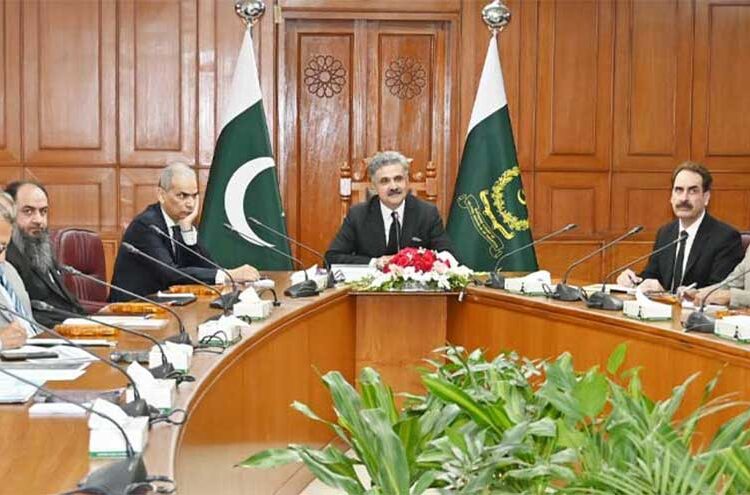
ISLAMABAD – The Apex Judicial Leadership on Friday propelled a major financial mobilization and an extensive institutional reform agenda, as Chief Justice of Pakistan (CJP) Mr. Justice Yahya Afridi chaired both the 55th meeting of the National Judicial (Policy Making) Committee (NJPMC) and the 46th meeting of the Law and Justice Commission of Pakistan (LJCP). The unified focus reiterated the resolve to significantly strengthen institutional capacity and accelerate access to justice.
During the 21st Governing Body meeting of the Access to Justice Development Fund (AJDF), the CJP was informed of an unprecedented financial surge. The AJDF disbursed a monumental over Rs. 1.4 billion for judicial infrastructure and court amenities between July 2024 and September 2025.
This recent capital injection dramatically eclipses the Fund’s activities since its inception in 2005, which saw only Rs. 904.7 million released for district judiciary infrastructure development over two decades. The recent disbursement included Rs. 1,462.3 million for infrastructure benefiting litigants, lawyers, and judicial officers, with an additional Rs. 151 million specifically released to Under-Developed Districts. The CJP specifically commended the LJCP Secretariat for the outstanding management of the Fund.
Institutional Safeguards and Statutory Reforms Endorsed
During the NJPMC session, the CJP directly addressed judicial integrity by proposing amendments to the Code of Conduct for Judges. These amendments seek to establish an institutional mechanism for responding to extraneous influence on judges across both superior and district tiers, a proposal unanimously endorsed by the Chief Justices of the High Courts.
Concurrently, the LJCP’s 46th session stressed the crucial importance of comprehensive legal reforms, prioritizing amendments in the Code of Criminal Procedure (CrPC) and Family Laws.
Key policy decisions and reforms finalized across the meetings include:
- Digital Evidence: The LJCP emphasized amending the Qanoon-e-Shahadat Order, 1984, to formally ensure the admissibility of evidence procured through modern devices and technologies.
- Accountability: The NJPMC deliberated on adopting Key Performance Indicators (KPIs) for judicial officers aligned with the World Justice Project’s Rule of Law Index.
- Recruitment and Training: The CJP proposed establishing independent Judicial Recruitment Directorates at each High Court and a comprehensive joint training model for judges focusing on technology integration.
- Enforced Disappearances: The Attorney General for Pakistan informed the forum the issue is near resolution following the recent amendment in Section 11EEEE of the Anti-Terrorism Act 1997, which mandates the production of a detained person before a Magistrate within twenty-four hours.
- Commercial Litigation: The Committee reviewed recommendations for a Commercial Litigation Corridor (CLC) and appreciated the Lahore High Court’s successful disposal of 922 cases by its Special Tax Benches in three weeks.
- Technology & AI: The NJPMC lauded the finalization of the Draft Ethical Guidelines for the Use of Generative AI in the Judiciary and directed the Ministry of Information Technology and Telecommunication to assess existing infrastructure before planning further digitization.
The Chief Justice of the Federal Shariat Court, all Chief Justices of the High Courts, the Attorney General for Pakistan, the Secretary of the Ministry of Law and Justice, and the Interim Chairperson of the National Commission on the Status of Women. Senior Advocates of the Supreme Court, including Khawaja Haris Ahmed, Kamran Murtaza, and Muhammad Munir Paracha, also attended this high-level meeting..