
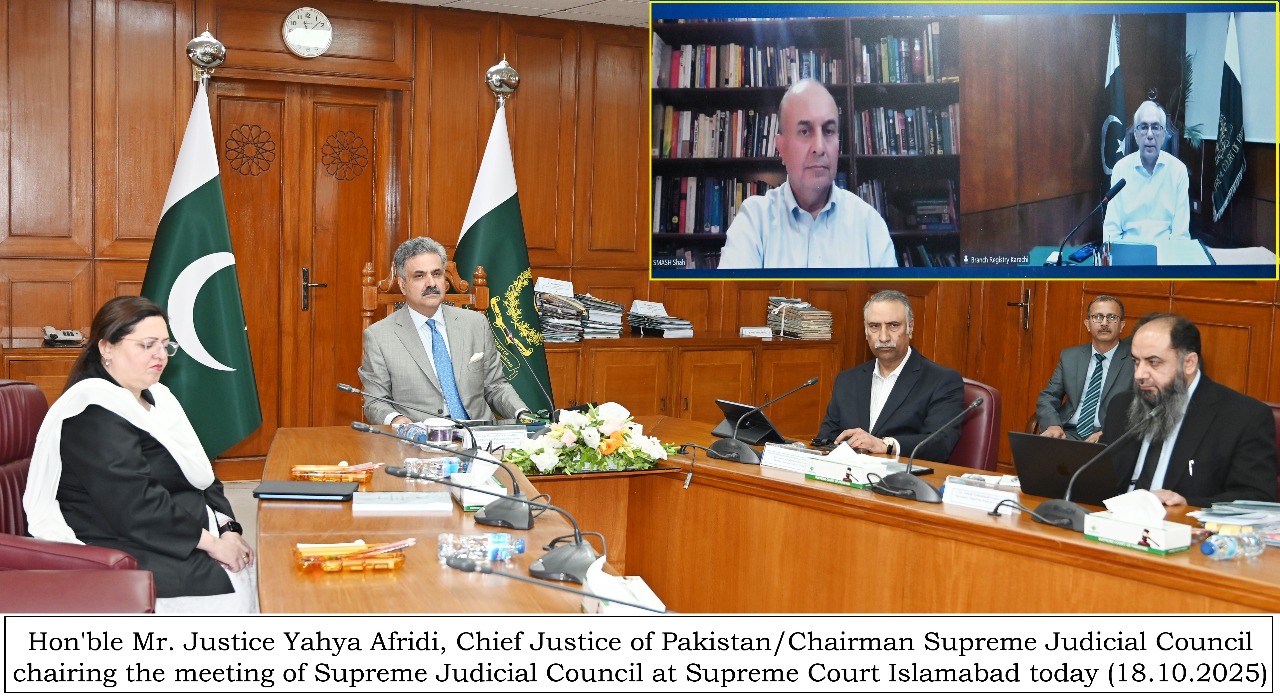
ISLAMABAD – Chief Justice of Pakistan Justice Yahya Afridi in capacity of chairman Supreme Judicial Council (SJC) on Saturday approved significant amendments to the Code of Conduct for Judges of the Supreme Court and High Courts.
The proposed amendments were initially discussed pursuant to a decision by the Council on July 12, 2025. Following thorough deliberation, the amendments were approved by a majority decision and have been directed to be notified in the official gazette, circulated to all Judges of the superior courts, and posted on the Supreme Court’s website, stated in a press release.
Key Amendments to the Code of Conduct
The document reveals several additions and substitutions to the Code, which was originally framed in 1965.
Restrictions on Public and Media Interaction (Article-V Substituted)
The substituted Article-V significantly restricts a judge’s engagement in public and media forums:
- A Judge “should not engage in any public controversy” through speech, writing, debate, or comment at any forum, especially on political questions.
- Judges “shall not have any interaction with the media,” particularly concerning issues that may create public debate or “adversely affect institutional collegiality and discipline”.
- If a public allegation is made against a Judge, they may present the matter in writing to a Committee comprising the Chief Justice of Pakistan and four Senior Judges of Supreme Court of Pakistan for an appropriate institutional response.
- Judges are prohibited from publicly discussing any judicial or administrative matter or making public any communication related to their personal or official matters.
Dealing with Undue Influence (Article-XV Added)
A new Article-XV addresses a judge’s response to attempts at undue influence:
- Judges are expected to remain independent and firm against any internal or external influence, relying on their “intellectual capacity and moral integrity”.
- If no immediate legal powers are available, a judge must resort to an institutional response.
- A judge of a High Court must immediately inform, in writing, the Chief Justice of the relevant High Court, the Chief Justice of Pakistan, and four senior most Judges of the Supreme Court through respective Registrars.
- For a Supreme Court Judge, the information must immediately go in writing to the Chief Justice of Pakistan and four senior most Judges of Supreme Court through the Registrar.
- The Chief Justice of the High Court must place the report before a three-Judge Committee within two days, with a decision expected within a fortnight. If the High Court Chief Justice or Committee fails to respond, the Chief Justice of Pakistan along with four Senior Judges of Supreme Court shall take up the matter.
Additional Ethical Constraints (Articles XII, XIII, and XIV)
The Council also included three additional Articles based on decisions from October 4, 2003, and approved for inclusion on October 18, 2025:
- Article-XII: Superior Court Judges must abstain from presiding or attending social, cultural, political, and diplomatic functions.
- Article-XIII: Soliciting invitations to conferences/meetings from foreign/international agencies is considered misconduct. Invitations received personally must be routed through the concerned Chief Justice.
- Article-XIV: A superior Court Judge must not accept a dinner/reception invitation hosted in their honour from an individual member of the Bar.
Complaint Review Activity
The SJC also proceeded with its constitutional duties under Article 209 of the Constitution.
- The Council initially examined 67 complaints. 65 were unanimously decided to be filed. One was unanimously deferred, and one was decided by majority decision to be processed further.
- The Council was then re-constituted with the inclusion of Hon’ble Mr. Justice S.M. Attique Shah, Chief Justice, Peshawar High Court, as the Chief Justice, Islamabad High Court, showed inability to attend for certain agenda matters.
- The re-constituted Council reviewed an additional seven complaints. Five were unanimously decided to be filed, and two were decided by majority decision to be processed further.
Following the review of these 74 complaints, the total number of pending cases requiring initial consideration stands at 87. The SJC has attended to 155 cases since October 2024.