
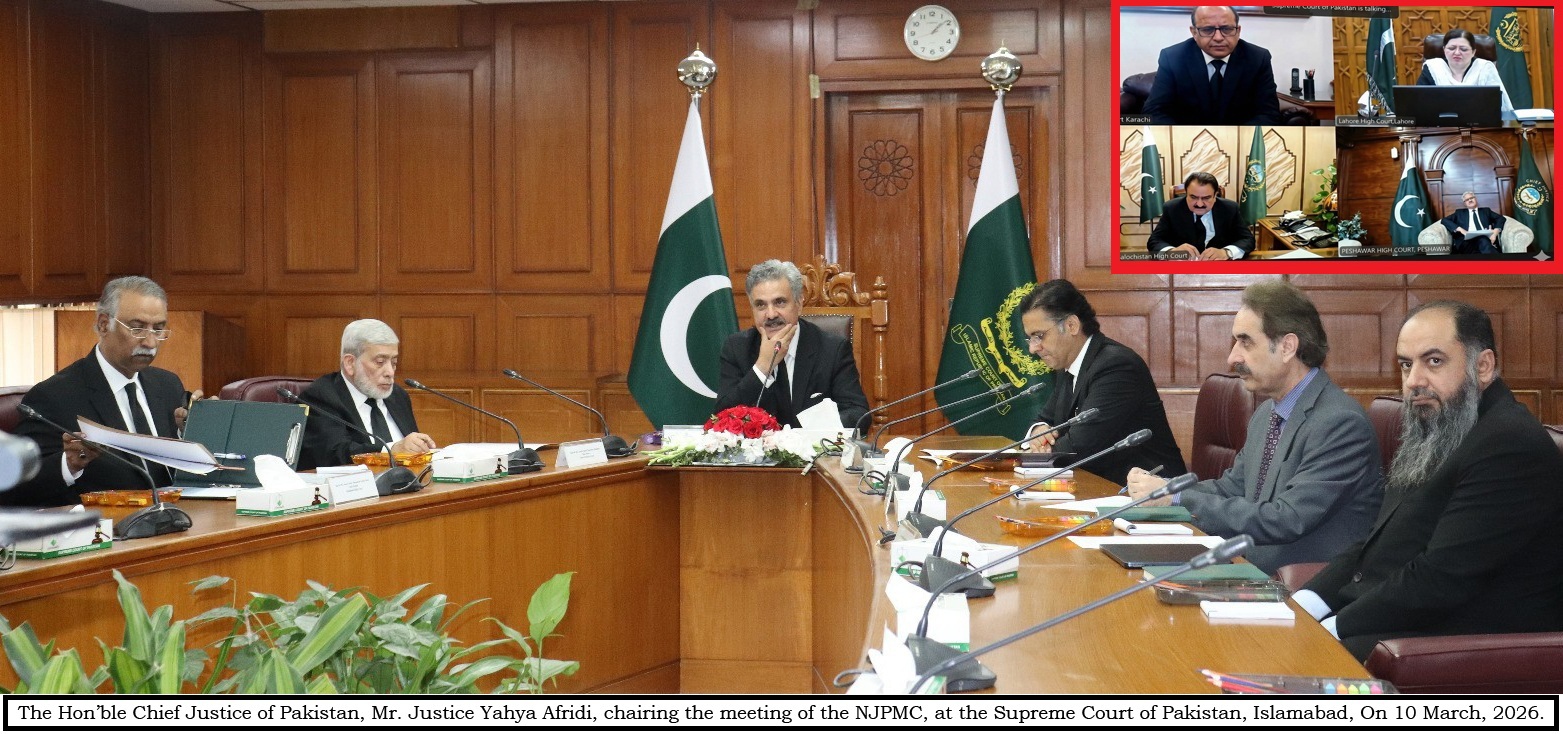
ISLAMABAD: The National Judicial (Policy Making) Committee (NJPMC) convened an emergent virtual meeting under the chairmanship of the Chief Justice of Pakistan Justice Yahya Afridi at the Supreme Court on Wednesday, approving a sweeping Judicial Austerity and Energy Conservation Strategy aimed at reducing institutional expenditure while safeguarding uninterrupted access to justice nationwide.
The high-level session was attended by the Chief Justices of the Federal Shariat Court, Lahore High Court, Islamabad High Court, Peshawar High Court, High Court of Sindh, and High Court of Balochistan. The Attorney General for Pakistan participated on special invitation.
Background and Rationale
The strategy comes in direct response to anticipated disruptions in petroleum supply and mounting global energy costs. The Committee, acknowledging that the justice sector must lead by example during periods of economic and energy uncertainty, resolved to institutionalise a series of cost-reduction measures across all tiers of the judiciary – without compromising judicial functions or litigants’ rights.
Key Measures Approved
Four-Day Working Week
With immediate effect and until further orders, the Federal Shariat Court and all High Courts shall observe a four-day working week, Monday through Thursday. Courts may, however, take internal governance measures to ensure continuity of urgent judicial and administrative functions on Fridays and Saturdays.
District Courts shall similarly operate at full capacity from Monday to Thursday, while respective High Courts shall maintain bare-minimum human resource presence on Fridays and Saturdays, calibrated against workload and performance benchmarks.
POL Ceiling Reduced
The monthly Petroleum, Oil and Lubricants (POL) allocation for judges of the Federal Shariat Court and High Courts stands reduced by 50 percent. Judicial Officers shall face a 25 percent reduction in their POL ceiling.
Protocol and Security Rationalised
No additional protocol or security vehicles shall be deployed during movement within designated high-security zones, with route security to be ensured by the concerned quarters as per established protocols. Judges and judicial officers serving in Khyber Pakhtunkhwa and Balochistan are exempted from security rationalisation given prevailing ground conditions.
Video-Link Hearings Promoted
Litigants and counsel are to be actively encouraged to participate in court proceedings through video-link facilities – including through the premises of High Courts and District Courts – wherever feasible, to reduce commuting and associated energy consumption.
Rotational Staff Attendance
The Federal Shariat Court and High Courts shall implement rotational attendance arrangements for administrative staff wherever practicable, to minimise commuting and lower operational energy costs while maintaining essential court functions.
NJPMC’s Institutional Position
In adopting these measures, the NJPMC underscored the judiciary’s commitment to prudent governance, environmental responsibility, and solidarity with the broader national effort to conserve public resources. The Committee reaffirmed that the reforms are institutional in character and do not prejudice the delivery of justice or the rights of litigants to access courts.
All measures shall remain operative until further orders of the Committee.
——
— Report based on official NJPMC communiqué issued from the Supreme Court of Pakistan.