
In bid to eridicate menace of extermism and terrorism from Pakistan all the decision makers are on one page as the federal government Saturday approved a reinvigorated and re-energised national counter-terrorism campaign, Operation Azm-e-Istehkam.
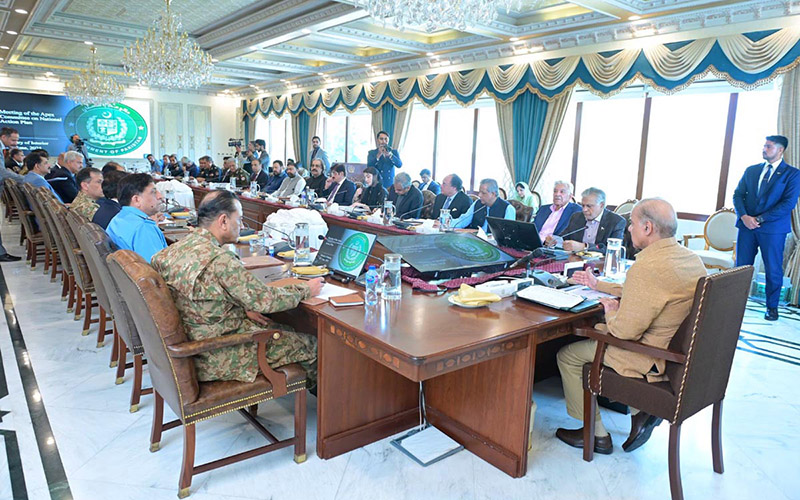
The campaign was launched with the consensus of all stakeholders, including the provinces, Gilgit-Baltistan and Azad Jammu and Kashmir, during a meeting of the Central Apex Committee on the National Action Plan (NAP), chaired by Prime Minister Shehbaz Sharif.
“Azm-i-Istehkam will integrate and synergise multiple lines of effort to combat the menaces of extremism and terrorism in a comprehensive and decisive manner,” the Prime Minister’s Office (PMO) said in a press release.
The 20-point NAP for countering terrorism and extremism had been chalked out by the National Counter Terrorism Authority in consultation with stakeholders and approved on December 24, 2014, by Parliament. The decision came following a deadly terrorist attack on the Army Public School in Peshawar.
Pakistan has witnessed an uptick in terror activities in the past year, especially in Khyber Pakhtunkhwa and Balochistan after the banned militant Tehreek-i-Taliban Pakistan ended its ceasefire with the government in November 2022.
According to an annual security report issued by the Centre for Research and Security Studies, Pakistan witnessed 1,524 violence-related fatalities and 1,463 injuries from 789 terror attacks and counter-terror operations in 2023 — marking a record six-year high.
The PMO said the forum conducted a comprehensive review of the ongoing counter-terrorism campaign and assessed the country’s internal security situation.
“The forum reiterated that the fight against extremism and terrorism is Pakistan’s war and is absolutely essential for the nation’s survival and well-being. The forum resolved that no one will be allowed to challenge the writ of the state without any exception,” it added.
The progress on NAP’s multi-domain tenets was scrutinised, with particular emphasis on identifying shortcomings in its implementation for addressing them as top priority.
The necessity for a comprehensive and reinvigorated counter-terrorism strategy, founded on “complete national consensus and system-wide synergy”, was underscored.
The PMO said that in the politico-diplomatic domain, efforts would be intensified to curtail the operational space for terrorists through regional cooperation.
The renewed and full-blown kinetic efforts of the armed forces would be augmented by full support from all law enforcement agencies, empowered by effective legislation to address legal voids that hindered the effective prosecution of terrorism-related cases and award of exemplary punishments to them, the press release said.
It added that the campaign would be duly complemented by socioeconomic measures aimed at addressing the genuine concerns of the people and creating an environment that discouraged extremist tendencies.
Furthermore, the information space would be leveraged to promote a “unified national narrative in support of the campaign”. The forum also reviewed measures to ensure foolproof security for Chinese nationals in Pakistan.
Following the prime minister’s approval, new standard operating procedures were issued to relevant departments, which would enhance mechanisms for providing comprehensive security to Chinese citizens in Pakistan.
The committee meeting was attended by Deputy Prime Minister and Foreign Minister Ishaq Dar, Defence Minister Khawaja Asif, Interior Minister Mohsin Naqvi, Finance Minister Muhammad Aurangzeb, Law Minister Azam Nazeer Tarar, Information Minister Attaullah Tarar and others.
Additionally, the chief ministers of all provinces and GB, the services chiefs, and chief secretaries of the provinces along with other senior civilian, military and law enforcement agency officers were also present.
Combatting terrorism requires whole-of-govt approach: PM Shehbaz
Earlier, the premier said while addressing the committee that combatting terrorism in the country was not solely one institution’s job and required a whole-of-government approach.
PM Shehbaz said the issue of terrorism had intensely surrounded Pakistan for the last 2.5 decades and was a very complicated matter involving crime, drugs, smuggling, extremism and religious terrorism.
He said the rule of law and stability were important for growth and development in the country, adding that establishing the state’s writ was his and the committee members’ collective responsibility.
“A soft state can never gain the trust of investors,” PM Shehbaz said, adding that a strong and healthy economy could not be envisioned in an unstable state gripped by terrorism.
“The responsibility of the fight against terrorism is the collective duty and the primary obligation of all state institutions. It’s not about you and me, it’s about us, we have to trample it together.”
He said some provinces had made great progress regarding the issue.
“[However], it is my belief that we have all too easily left this matter to our armed forces … and the provinces and governments are completely absolved from this [responsibility].
“This is that dangerous practice that has become a custom in the past years that this is the army’s job and its officers have to do this,” the prime minister said.
The premier said that undoubtedly the various provincial police forces, citizenry and politicians had given sacrifices in the fight but on the whole, “the prevailing display of our action that has come out is that the army has to do this [fight against terrorism] and it is their matter to deal with.”
PM Shehbaz said this was not the way and would not eliminate terrorism from the country, adding that the provinces had the responsibility for the Counter Terrorism Departments.
“We can not even hope for strong stability without a complete system or a whole-of-the-government approach. This does not only refer to all agencies and ministries but the federal and provincial governments and all institutions.”
The premier hoped that the provinces would fully play their role in combatting terrorism.
He said the political and religious leadership needed to be mentally clear in the fight against terrorism that this battle was “our own for our survival and we are not fighting someone else’s battle”.
The premier said the issue needed to be acknowledged above and beyond any political conflicts and needed to be acted upon with consensus and mutual consultation.
“We will have to take responsibility for this. To leave it to just one state institution will be a great mistake.”
The prime minister said the fight would also require other measures beyond the kinetic such as public awareness, dialogue, countering narratives and strengthening law enforcement agencies.