
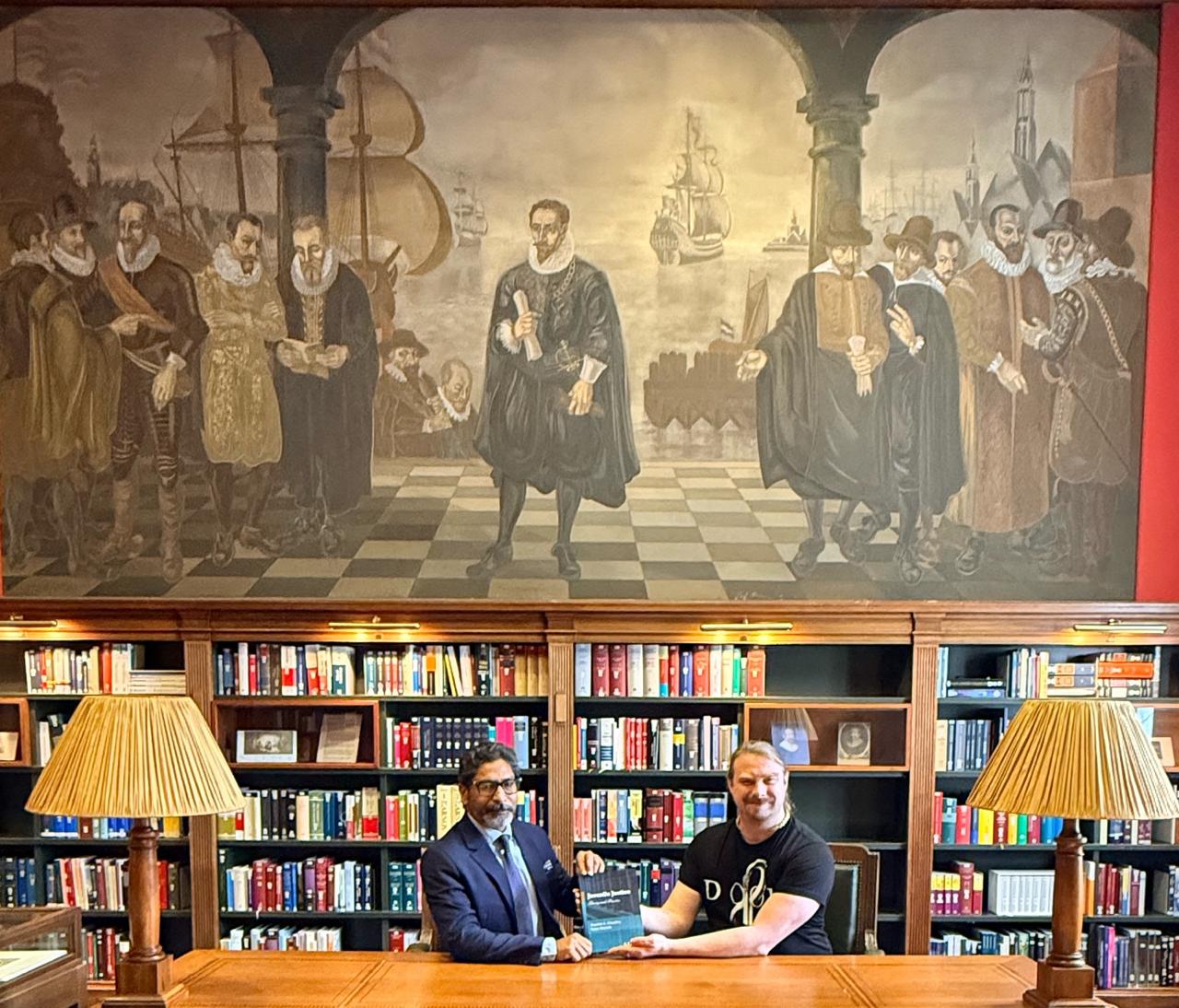
THE HAGUE : Pakistani legal scholarship has secured a prestigious milestone as jurist, advocate, and author Sharafat A. Chaudhry visited the historic Peace Palace at The Hague, marking the induction of his acclaimed work, Juvenile Justice: Theory and Practice, into the Peace Palace Library – one of the world’s foremost repositories of international law.
The visit to the seat of the International Court of Justice (ICJ) was facilitated through the diplomatic support of the Embassy of Pakistan in the Netherlands, underscoring a broader commitment to promoting Pakistani intellectual and legal contributions on the global stage.
A Book Born from the Law It Describes
What lends this recognition its particular weight is the unique authority the book carries. Sharafat A. Chaudhry is the principal drafter of the Juvenile Justice System Act (JJSA), 2018 – landmark legislation he developed through an inclusive consultative process spanning 2014 to 2018. The book is, therefore, not merely a commentary on Pakistan’s child justice framework – it is a firsthand account by the architect of that framework. Co-authored with Rabia Mustafa, Director of Research and Publications at the School for Law and Development (SLD), the book is published by SLD and brings together legislative draftsmanship, field-based training, socio-legal research, and academic scholarship into a single, cohesive intellectual project. The JJSA 2018 marked a decisive shift in Pakistan’s treatment of child offenders – institutionalizing diversion, rehabilitation, and child-sensitive procedures in alignment with the Convention on the Rights of the Child and international human rights norms.
Reception at the Peace Palace
The Chief Librarian of the Peace Palace Library formally received the publication, expressing appreciation for the author’s contribution to the institution’s globally respected archives. The library’s acquisition of the work reflects growing international interest in legal perspectives surrounding the rights and protection of youth.During a detailed briefing, the Chief Librarian outlined the Netherlands’ approach to juvenile justice – one that emphasizes tailored rehabilitation and resocialization for offenders up to the age of 23. The exchange highlighted the resonance of Chaudhry’s work with Dutch legal principles, particularly in their shared alignment with international frameworks such as the UN Convention on the Rights of the Child (CRC). The Chief Librarian noted that the book’s treatment of rehabilitative justice and specialized court systems offers a compelling comparative perspective – one that closely mirrors the Netherlands’ own “adolescent criminal law” framework. The professional dialogue that followed touched on how different jurisdictions implement diversion and rehabilitation strategies to reduce recidivism, a timely conversation as nations worldwide reassess punitive approaches to youth in conflict with the law.
Scope and Interdisciplinary Depth
Rather than treating juvenile justice in isolation, the book situates Pakistan’s framework within its broader constitutional, legislative, and institutional ecosystem, drawing on international instruments – including the CRC and CEDAW – while remaining attentive to the specificities of Pakistan’s federal and provincial legal architecture. Co-author Mustafa’s background in applied linguistics, educational planning, and socio-legal research lends the book an important interdisciplinary dimension, with sections addressing child psychology, communication in justice settings, and the pedagogical dimensions of judicial training. The result is a work that transcends conventional legal commentary, engaging deeply with the human and social dimensions of justice. Together, the authors have trained thousands of judges, prosecutors, police officers, lawyers, and government officials across Pakistan – accumulated field knowledge that gives the text a texture and groundedness that purely academic treatments of the subject often lack.
A Resource for Pakistan and the World
There is a persistent gap in Pakistan’s legal literature between statutory texts and their operationalization. Juvenile Justice: Theory and Practice bridges that gap – bringing together drafting history, doctrinal analysis, procedural guidance, and reflective practice to equip justice actors with tools that go well beyond what bare legislation can provide. The book also speaks to a global audience: jurisdictions grappling with juvenile justice reform – particularly those seeking to align domestic frameworks with international children’s rights standards – will find in the authors’ approach a model of how law reform can be conducted with rigour, inclusivity, and genuine commitment to the child’s best interest. Juvenile Justice: Theory and Practice is now permanently housed within one of the world’s most prestigious centers for international law documentation, where it will serve as a scholarly resource for the ICJ and legal researchers across the globe.
A Proud Moment for Pakistani Legal Scholarship
The induction marks a proud milestone for Chaudhry and the wider Pakistani legal community, bridging domestic legislative insights with the international academic discourse at the very heart of global justice. With over two decades in legal reform, justice-sector governance, and legislative drafting, Chaudhry has shaped more than sixty Acts, Bills, and Rules spanning child protection, gender-based violence, trafficking, disability rights, and regulatory law. The Embassy of Pakistan’s role in coordinating the visit is a testament to the diplomatic value placed on showcasing Pakistan’s intellectual contributions and a reminder that the country’s legal reform journey deserves recognition well beyond its own borders.