
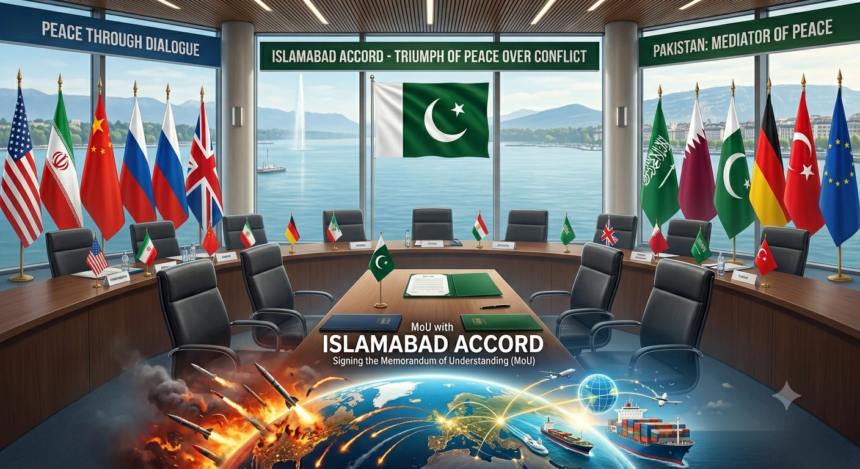
As the world awaits the anticipated signing of a Memorandum of Understanding (MoU) between the United States and Iran in Geneva, international attention is increasingly focused on the country that reportedly played a central role in bringing the two adversaries to the negotiating table: Pakistan.

If finalized, the agreement expected to be known as the Islamabad Accord – may emerge as one of the most significant diplomatic breakthroughs of recent years, demonstrating the power of dialogue over confrontation and diplomacy over war. The recent US-Iran confrontation brought the world alarmingly close to a wider regional conflict. Military exchanges, retaliatory threats, and growing instability in the Persian Gulf generated fears that the crisis could spiral into a devastating war involving multiple states and non-state actors. Strategic analysts warned that continued escalation could disrupt global energy markets, undermine international trade, and trigger consequences extending far beyond the Middle East. The danger was not limited to the immediate parties. A prolonged conflict would have affected economies across Asia, Europe, Africa, and the Americas. Rising tensions threatened energy supplies, investor confidence, and international shipping routes. At a time when the global economy is already facing multiple challenges, another major conflict in the Gulf was a risk the world could ill afford.
Against this backdrop, Pakistan reportedly chose the path of diplomacy, restraint, and constructive engagement. Rather than seeking publicity, Islamabad focused on confidence-building, communication, and dialogue. Through sustained diplomatic efforts, Pakistan is understood to have facilitated contact between Washington and Tehran and provided a neutral environment for engagement between the two sides. These efforts gradually transformed hostility into communication, communication into dialogue, and dialogue into negotiation. If the anticipated agreement is eventually concluded, it will underscore the importance of patient diplomacy in resolving even the most difficult international disputes. The leadership of Prime Minister deserves recognition for maintaining active diplomatic outreach throughout the crisis. Equally significant was the role played by Pakistan’s military leadership under the Field Marshal, the Ministry of Foreign Affairs, security institutions, and the broader diplomatic team, all of whom reportedly worked behind the scenes to encourage restraint and peaceful engagement. Diplomacy often succeeds quietly. The most successful negotiations are frequently those that prevent wars before they begin. If the anticipated Geneva understanding becomes a reality, Pakistan’s role will be remembered as a notable example of preventive diplomacy at a critical moment in international affairs. Reports and public statements suggest that both Washington and Tehran greatly acknowledged Pakistan’s constructive mediating efforts in facilitating communication and creating an atmosphere conducive to negotiations. Such recognition reflects confidence in Pakistan’s ability to act as a credible and responsible intermediary in complex international disputes. One of the most remarkable aspects of the initiative has been the broad international appreciation of Pakistan’s reported role as the principal mediator. Major world capitals reportedly welcomed Islamabad’s efforts to reduce tensions and promote dialogue. From Beijing and Moscow to London, Paris, Brussels, Edinburgh, Riyadh, Doha, Abu Dhabi, and Ankara, Pakistan’s diplomatic engagement was viewed as a constructive contribution to international peace and stability.
The economic stakes of the crisis were enormous. The Strait of Hormuz remains one of the most strategically important maritime corridors in the world, carrying a substantial share of global oil exports. Any disruption to navigation through this waterway would have produced serious consequences for global energy markets and international commerce.
The willingness of both the United States and Iran to engage through channels facilitated by Pakistan reflects a significant degree of trust in Islamabad’s neutrality and diplomatic credibility. Such confidence is earned through consistency, balance, and a demonstrated commitment to peaceful dispute resolution. Particularly noteworthy was the support reportedly expressed by Gulf states, including Saudi Arabia, Qatar, the United Arab Emirates, Oman, Bahrain, and Kuwait. These countries had much at stake. Any prolonged conflict would have threatened regional stability, disrupted energy exports, weakened investor confidence, and negatively affected economic growth across the Gulf region. Their support for diplomatic efforts reflected a shared understanding that peace remains the foundation of prosperity. The economic stakes of the crisis were enormous. The Strait of Hormuz remains one of the most strategically important maritime corridors in the world, carrying a substantial share of global oil exports. Any disruption to navigation through this waterway would have produced serious consequences for global energy markets and international commerce. As tensions escalated, concerns grew regarding interruptions to energy supplies and international shipping. Insurance premiums increase d, energy prices became volatile, and fears of supply shortages spread across financial markets. A prolonged conflict could have intensified inflationary pressures and slowed economic growth around the world. The humanitarian consequences were equally alarming. Modern wars inevitably affect civilians. Loss of life, displacement, destruction of infrastructure, and long-term economic hardship are among the tragic realities that accompany armed conflict. Diplomacy therefore prevented not merely a strategic crisis but potentially a humanitarian catastrophe. According to diplomatic assessments, the anticipated Geneva MoU may include several important confidence-building measures. These reportedly include commitments to avoid further military escalation, establish direct communication channels during future crises, and continue structured diplomatic engagement through regular consultations and working groups. The agreement may also contain provisions relating to maritime security, freedom of navigation, and the uninterrupted flow of international trade through the Strait of Hormuz. Additional elements may include discussions on sanctions relief, economic cooperation, regional security arrangements, and mechanisms for addressing disputes through dialogue rather than force. Perhaps the most significant long-term outcome could be the creation of a framework for future discussions on nuclear-related issues. While any comprehensive settlement would require extensive negotiations and broader international participation, the establishment of a structured dialogue process would itself represent a major diplomatic achievement.
History repeatedly demonstrates that durable peace is built through negotiation rather than confrontation. Many of the world’s most successful peace initiatives began with modest confidence-building measures that gradually evolved into broader frameworks for cooperation and stability. The diplomatic success attributed to Pakistan carries implications far beyond the immediate crisis. It demonstrates that middle powers can play meaningful roles in international peace-building when they act with credibility, neutrality, and strategic vision. Pakistan’s conduct throughout the crisis reflects an understanding that influence in the modern world is measured not only by military strength but also by the ability to facilitate dialogue and bridge divisions.
The crisis also revealed an important geopolitical reality. Many traditional allies of the United States appeared reluctant to become directly involved in another large-scale military confrontation. Increasingly, the international community recognizes that military force alone cannot resolve complex regional disputes. Diplomatic engagement and negotiated settlements remain the most effective means of achieving sustainable peace. A successful Islamabad Accord could contribute to broader stability across the Middle East. Reduced tensions between Washington and Tehran would likely improve prospects for peace throughout the region and create opportunities for addressing other longstanding conflicts.
The suffering of innocent civilians in Palestine and Lebanon continues to be a matter of profound concern for the international community. A reduction in regional tensions could create greater diplomatic space for peaceful solutions and stronger adherence to international humanitarian law. Similarly, Iran may find this an appropriate moment to reassess certain aspects of its regional engagement and relationships with non-state actors operating across the Middle East. Long-term regional stability requires mutual respect for sovereignty, non-interference, and a commitment to peaceful coexistence. The future of the region must be built upon cooperation rather than confrontation.
For Pakistan, the benefits of peace extend beyond diplomatic recognition. Regional stability and the eventual normalization of economic relations with Iran could unlock significant opportunities in trade, energy cooperation, transit connectivity, and regional integration. Pakistan’s strategic location positions it as a natural bridge linking South Asia, Central Asia, and the Middle East. Successful mediation also enhances Pakistan’s international standing. Countries that contribute to peace earn diplomatic credibility, strategic influence, and international respect. Such achievements strengthen investor confidence, improve foreign partnerships, and create new opportunities for economic engagement.
Nevertheless, diplomacy does not end with the signing of an agreement. The true challenge lies in implementation. Confidence-building measures, monitoring mechanisms, regular dialogue, and sustained political commitment will be essential to ensuring that any understanding achieves its intended objectives. Pakistan should continue supporting dialogue, facilitating communication where necessary, and encouraging all parties to remain committed to peaceful dispute resolution. The credibility earned through successful mediation must be preserved through consistency, neutrality, and principled diplomacy. As the world awaits the anticipated conclusion of the Islamabad Accord, there is reason for cautious optimism. If finalized, the agreement will stand as powerful evidence that diplomacy remains humanity’s most effective instrument for preventing conflict and promoting peace.
At a time when geopolitical tensions threaten international stability, Pakistan has demonstrated that constructive engagement, strategic patience, and responsible leadership can still produce meaningful results. If the Islamabad Accord succeeds in transforming confrontation into cooperation, it will symbolize not only a diplomatic achievement for Pakistan but also a victory for international peace, regional stability, and global economic security. The true measure of the Islamabad Accord will not be the ceremony surrounding its signing but the wars it prevents, the lives it saves, the stability it creates, and the hope it offers for future generations. By that standard, it may prove to be one of the most consequential diplomatic initiatives of our time and a defining moment in Pakistan’s diplomatic history.
——
Hafiz Ehsaan Ahmad Khokhar – the author is a Constitutional and International Law Expert – Can be contacted at: hafizahsaan73@gmail.com Cell: 0300-8487161