

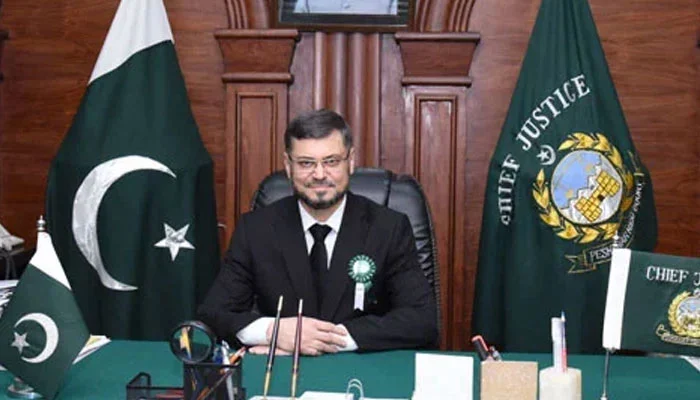
While addressing to Chief Justice of Pakistan (CJP) Qazi Faez Isa on Wednesday through a letter, Peshawar High Court Chief Justice Muhammad Ibrahim Khan expressed concern over non-consideration for the elevation of judges to the Supreme Court from Khyber-Pakhtunkhwa province.
“I hope this letter finds you in good health and high spirits. I am writing to your Lordship with a heavy heart and a sense of disillusionment in relation to prima facie arbitrariness, discrimination and favouritism in the appointment of judges in the Supreme Court of Pakistan. It is with utmost respect for your esteemed position and the principles of fairness and meritocracy that our judicial system purports to uphold, that I bring this matter to your attention,” Justice Ibrahim wrote.
He said that there were four vacancies in the Supreme Court but only one vacancy was filled by appointing his brother Honourable Judge Justice Naeem Akhtar Afghan of Balochistan High Court the then Chief Justice Balochistan High Court.
“It was a profound disappointment when I learnt that only one judge and that too from your own province, was appointed in the Supreme Court despite the fact that there were four vacancies. I am genuinely happy for my brother Mr Justice Naeem Akhtar Afghan but why my candidacy was not considered notwithstanding my seniority, eligibility and availability of vacancies in the Supreme Court,” he added.
Justice Ibrahim said that he is the second senior most chief justice among the chief justices of all high courts in Pakistan. “I am also a member of the Judicial Commission of Pakistan (JCP) and Supreme Judicial Council of Pakistan. I had legitimate expectation that my candidature would be at least included in the list for consideration to be appointed as a Judge of the Supreme Court of Pakistan. Had I not been found fit to be appointed as Judge of Supreme Court after due process by the Judicial Commission of Pakistan, I would have happily accepted the JCP’s decision,” he added.
He expressed the belief that considering the substantial backlog, the CJP might feel inclined or even obligated to promptly fill the vacancies, particularly given the sentiment among the countrymen that they are being deprived of swift justice.
“The taxpayers, who pay for our salaries, expect that vacancies are filled immediately so that the court may operate at full strength and dispense justice. There is a duty to act diligently. This decision of solitary appointment has left me perplexed and seeking genuine answers. I have been thinking about possible reasons for not filling the vacancies but no logical and persuasive reason could come to mind,” he added.
Justice Ibrahim mentioned that he had been faithfully serving for 31 years, characterised by steadfast commitment, dedication, and numerous contributions that, in his opinion, not only benefited the community but also upheld the highest standards of the judicial system.
“Throughout my service, I have endeavoured to embody the virtues of integrity, impartiality, and a steadfast commitment to justice, principles I believed would naturally pave the way for recognition and career advancement based on merit. I have been deciding high-profile cases amidst peculiar law and order situation and political turmoil in our motherland wherein my commitment to uphold the rule of law and supremacy of constitution has been unshakable and unyielding,” the top judge wrote.
“My dedication to serve the masses and uproot injustice in each and every form, whatsoever, has been a source of personal pride and a testament to my commitment to the values, we hold dear in our profession. Similarly, it is yet a distinction that, while referring to my 31 years’ judicial career wherein, I can safely hold my integrity before Almighty Allah that I have only performed to the best of my conscious, within the legal premise and without any fear or favour.”
Chief Justice PHC expressed his “surprise and deep concern” over the decision to not even consider his candidacy for elevation, particularly in light of his dedication, performance, and contributions to the judiciary.
“I appreciate that decisions of appointing judges in the superior courts are complex and multifaceted, involving considerations that may not always be apparent to all. Nevertheless, in the spirit of transparency, the norms of fairness, and the continued trust in our judicial system, I take the honour to question as to what prompted the solitary elevation of my brother Justice Naeem Akhtar Afghan when three vacancies were and are still vacant where as none other was considered,” he said.
Justice Ibrahim said that it is also mind-boggling that presently, there are three honourable judges in the Supreme Court of Pakistan from Balochistan whereas from the Khyber-Pakhtunkhwa, there are only two. “Therefore, while comparing the two provinces on any analogy whatsoever, desirably there would be one more vacancy for the province of Khyber-Pakhtunkhwa. It seems that allocation of seats of Hon’ble Judges in Supreme Court is out of proportion giving rise to a genuine discontentment in provinces especially Khyber-Pakhtunkhwa which, in size as well as in terms of portfolio of cases, has enormously swelled after merger of the erstwhile FATA.”
“Unfortunately, I lack the personal connections that often play a role in such elevations. This lack of advocacy or lobbying on my behalf should not be a deterrent to recognising the merit and the commitment that I have demonstrated towards upholding justice. And it is with this faith that I am constrained by my conscience to pen down the facts before your lordship, the Hon’ble Judges and my Supreme Institution before I lay off the robes. It isn’t a far cry as I am deeply contented within my heart and whatever is destined for me by Allah the Almighty shall be a blessing.”
He stated that his purpose in writing the letter was not to directly challenge the decision made, but rather to seek clarification and assurance that the principles of merit, fairness, and equality of opportunity are being maintained.
“I am confident that your Lordship would not hold it against me as you have been vocal in raising voice against arbitrariness, discrimination and favouritism through letters one of which I have cited above. I am fully committed to my constitutional duty. with the hope that my efforts and contributions will be recognised and rewarded by Allah Almighty in this world and thereafter, Insha’Allah,” he concluded.