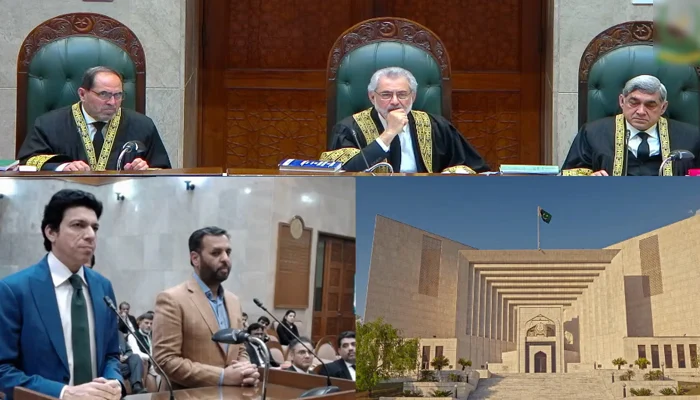
After accepting unconditional apology of Senator Faisal Vawda and Muttahida Qaumi Movement-Pakistan (MQM-P) lawmaker Mustafa Kamal Friday the top court withdrew contempt of court notice issued to them.
Vawda, on Wednesday, tendered an unconditional apology to the Suprme Court in the contempt case, saying that he has left himself on the mercy of the apex court. Kamal had, earlier this month, also sought an unconditional apology for his remarks against the judiciary.
According to the court’s order, read by Chief Justice of Pakistan (CJP) Qazi Faez Isa, both the parliamentarians had realised that the words they used were inappropriate.
“They have now withdrawn their statement and tendered an unconditional apology to the court,” read the order, adding that the court withdrew the show-cause notices issued to the politicians in view of their reflection on the matter.
During the hearing, the Chief Justice observed, “In Article 66 — freedom of speech to speak in the Parliament — of the Constitution, you can stand up and speak in the Parliament.”
CJP Isa asked both the politicians to “be careful in the future” when mentioning the judiciary. “We respect you and hope you respect us. Demeaning each other will harm the public,” said the CJP.
Chief Justice told Vawda and Kamal that Article 66 protects lawmakers from speaking in the Parliament and not outside it.
The court’s decision comes more than a month after it had issued contempt of court notices to both politicians on May 17 after they had done hard-hitting press conferences against the judiciary in Islamabad in May, with Vawda saying that no allegations could be levelled without evidence and Kamal sought to establish ethical standards for the judges as justice could “only be bought”.
Their statements had come after six Islamabad High Court (IHC) judges wrote a letter to Supreme Judicial Council (SJC) members, pointing out the intelligence agency’s meddling in judicial affairs. The politicos also pointed out the dual citizenship of an IHC judge.
Shortly after their tirade, the SC sprung into action against the leaders and took suo motu notice.
“We, however, expect that they stand by their statements submitted in courts because if there is further transgression, a simple apology may then not be acceptable to this court,” stated the order.
The order further stated: “Even if we assumed that the documents that have been filed are replies to the notices, the said television channels have justified their broadcast of the said press conferences, despite the fact that during the hearing, Faisal Siddiqui conceded that the contents of one of the press conference did prima facie constitute contempt.”
Thus, it added, the defences taken are: (a) that a television channel is not responsible for whatever it broadcasts if the same has been said by another, (b) that to constitute contempt, there must be malintent, and (c) that this is their right and duty to do so.
The court said that the explanation, in its considered opinion, is not prima facie justifiable and that it is “now constrained to issue show-cause notices who have submitted the reply”.
“Since the remaining channels have not issued any reply to the notices, we are also issuing contempt notices to them as to why they should not be proceeded against for contempt of court,” it added.
The court stated that it had, during the hearing, inquired whether the TV channels had aired any apology, but it had not.
“The same news conferences were either rebroadcast or portions from the broadcast.
Undoubtedly being commercial enterprises, the channels make money by their broadcast, therefore, along with their replies, they should also include whether the press conferences were preceded by advertisements, the number thereof and the amount earned therefrom, and the same upon conclusion of the same press conference.”
Contempt of court to TV channels
Faisal Siddiqui said that it was the constitutional duty of the channels to show the press conferences live. If this document is accepted as a reply, the channels have tried to justify the contemptuous broadcast. In retrospect, the TV channels’ response is not reasonable. Contempt of court notices have been issued to TV channels, the order stated.