

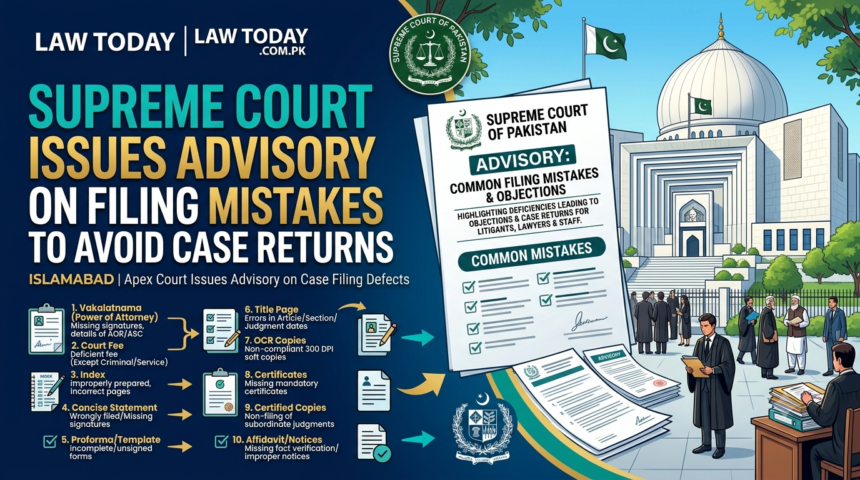
ISLAMABAD: Apex court Thursday issued an advisory highlighting common mistakes that cause inconvenience to litigants, lawyers, and office staff while pointing out common objections frequently raised by the Office during scrutiny of cases filed before the Supreme Court of Pakistan.
It has been expressed in the advisory that due to these deficiencies, cases are often returned for removal of objections.
Power of Attorney (Vakalatnama) in Civil Cases
The advisory notes that the name, enrolment number, contact number, email address, and signatures of the Advocate-on-Record (AOR) and Advocate Supreme Court (ASC) are often not mentioned. In several instances, the Power of Attorney is not signed by the executant(s), and in cases involving firms, companies, or private entities, the requisite Board Resolution authorizing the executant is not attached. Full names, email addresses, and contact numbers of the executant(s) are frequently missing as well.
In the case of a Special Power of Attorney, the document is either not filed or not executed on behalf of all concerned parties. In criminal cases where the petitioner is an under-trial or convicted person, the Power of Attorney must be duly attested by the Jail Authorities, and the prescribed Jail Proforma must also be attached in cases of imprisonment.
Court Fee
Except in criminal and service matters, the advisory points out that court fee is often deficient. All cases must be filed with the prescribed court fee strictly in accordance with the Third Schedule (Part I & Part II) of the Supreme Court Rules, 2025, and errors are frequently noted in the calculation of court fee under the relevant case category.
Index
Objections are commonly raised because the Index is not properly prepared with correct serial numbers, proper description of each document, and accurate and corresponding page numbers. The Index is often not signed by the Advocate-on-Record, and page numbers mentioned in the Index frequently do not correspond with the actual paging of the file.
Concise Statement
In civil cases, the Concise Statement is often not signed by the ASC and AOR or by the litigant-in-person, and is not filed in accordance with Order XIX, Rule 4 of the Supreme Court Rules, 2025. In criminal cases, a Concise Statement is sometimes wrongly filed even though it is not required under Order XXIII, Rule 13 of the Supreme Court Rules, 2025 — while the prescribed Proforma, which is mandatory in criminal cases, is often not filed.
Category / Template Proforma
The advisory notes that the Category/Template Proforma is frequently not properly filled in accordance with the official category list for civil, criminal, and service cases, with required fields or columns left incomplete. The Proforma is often not signed by the ASC and AOR or by the petitioner-in-person, and in criminal cases, the Criminal Template Proforma is often missing or unsigned.
Title/Subject Page
Errors are also noted where the relevant Article/Section under which a case is filed is not correctly mentioned on the subject page, and the impugned case number and/or the date of the impugned judgment/order are incorrectly stated.
Limitation Stamp, Legibility, and OCR Copies
The limitation stamp is frequently not affixed on the impugned judgment/order, particularly in service matters. Dim or illegible documents are often filed without clear copies, and applications seeking exemption from filing clear copies are frequently vague, without specifying the exact page numbers of the affected documents.
The advisory further states that a coloured, OCR-enabled scanned/soft copy at 300 DPI is mandatory at the time of filing of each case and application, and that discrepancies are often found between the soft copy and the original hard copy filed before the Court.
Missing Certificates
Several mandatory certificates are frequently missing from filings, including certification that the petition is the first one filed against the impugned judgment/order, that all clear and legible copies of documents have been reproduced word-for-word and are true and correct, and that the OCR-enabled scanned/soft copy at 300 DPI is complete and in conformity with the original record. These certificates are also often left unsigned by the Advocate-on-Record.
Certified Copies, Affidavits, and Notices
In civil appeals, certified copies of judgments and orders passed by all subordinate forums are required to be filed, and appeals are frequently returned for non-filing of such certified copies. In civil petitions and civil appeals, an affidavit verifying the facts of the case by at least one petitioner is mandatory and is often not filed.
On notices, the advisory notes that notices are not always issued or sent to all respondents named in the title of the case, and complete and correct postal addresses of respondents are often missing. In criminal cases, notices are not always properly addressed or sent to State representatives, including the concerned Prosecutor/Advocate General, and proof of dispatch or service of notice is often not attached with the petition. In direct civil appeals, it is often not mentioned in the notice that a copy of the memo of appeal has been sent to all respondents, while in Criminal Original Petitions (contempt matters), the statement of allegations is often not sent to the respondents along with the notice.
Paper Books
The advisory reiterates that in paper books, all clear and legible copies of documents must be placed along with the original copies, and where a better copy of a document is filed, it must bear the same page number as the original document of which the better copy was prepared.
Final Checklist Before Filing
The advisory concludes with a final checklist for verification before filing, requiring that: the court fee is correct; limitation is within time; the Index is accurate and signed; all signatures are complete; certificates at the end of the case are attached; the certified copy of the impugned judgment bears the limitation stamp; the affidavit of fact by any one petitioner is attached (in civil petitions and civil appeals); certified copies of all lower forums are attached (in civil appeals); notices have been issued to all respondents; the OCR-enabled scan/soft copy (300 DPI) is attached with cases/applications; and all documents are clear and legible.