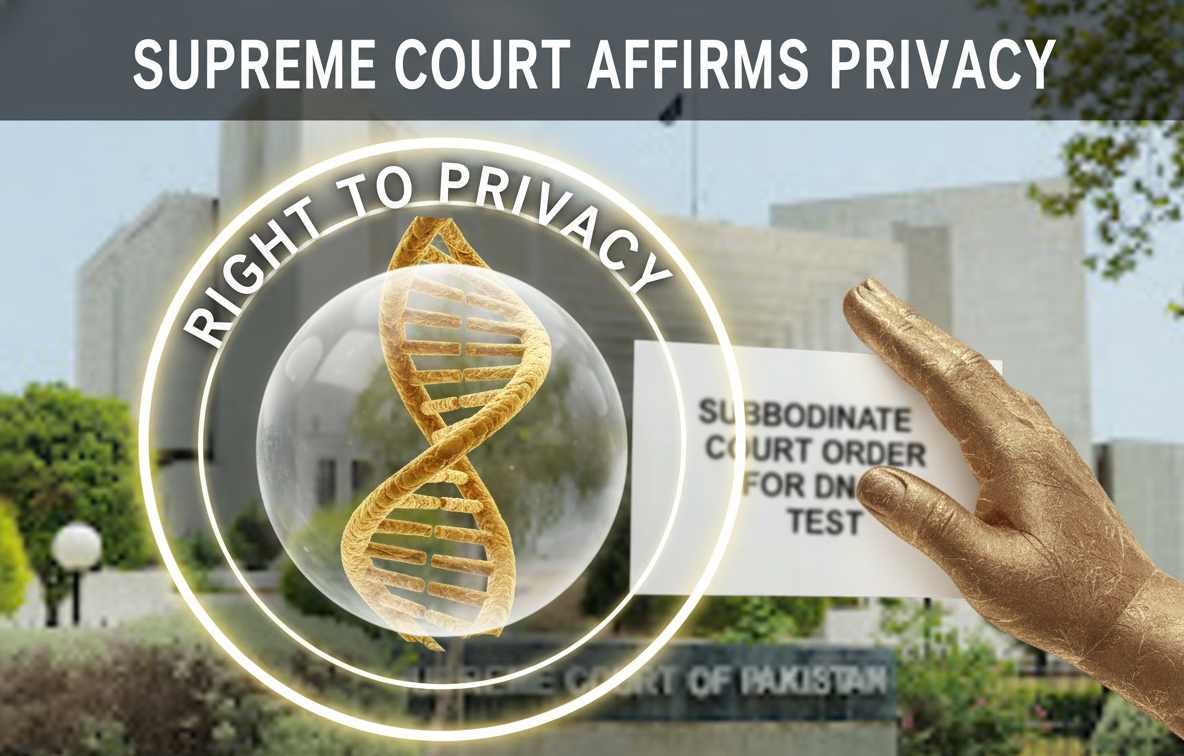
ISLAMABAD: Affirming the right to privacy, the Supreme Court has set aside a subordinate court’s order that sought to compel a petitioner to undergo a DNA test for parentage confirmation. The top court ruled that the judicial system has a fundamental duty to protect individuals from such undue intrusion into their private lives.
“The unnecessary public challenge to the paternity of a person inherently results in societal embarrassment, humiliation, and severe psychological stigma,” observed Justice Muhammad Hashim Khan Kakar while accepting an appeal filed by petitioner Khalid Hameed.
On Nov 3, 2022, a special judge of the Anti-Corruption Court, Pakpattan, had ordered the respective circle officer to conduct DNA tests of the petitioner and one Mohammad Haneef, holding that the real dispute in an inheritance matter centred on the petitioner’s paternity.
The directive was challenged through a revision petition before the Lahore High Court, which rejected the plea on Dec 6, 2022.
The controversy involved several respondents allegedly involved in forgery and corruption pertaining to a material alteration of the petitioner’s parentage in educational records, purportedly to deprive him of his rightful inheritance.
The Supreme Court said challenges to paternity must not be taken lightly, as compelling a DNA test without adequate grounds inherently casts serious aspersions on the character and moral integrity of the mother — a course the top court has previously declared impermissible.
Such judicial directives, when lacking proper legal basis, amount to an unwarranted intrusion into the sanctity of family life and a woman’s reputation, which should never be tolerated under the guise of legal process, observed Justice Kakar, who was heading a two-judge bench.
“This protection extends to personal data, communications, family life, and all facets of the personal sphere against unwarranted interference by the state or private entities,” the six-page judgement said.
Justice Kakar observed that any demand for a DNA test, particularly to determine parentage, encroaches upon fundamental privacy rights, as genetic information contains comprehensive data about lineage and physical characteristics. These fundamental rights, the judgement said, safeguard bodily integrity and ensure an individual’s autonomy to refuse unsolicited medical procedures.
The right conferred under Article 14 does not concern any premises, home or office, but the person — the man or woman wherever he or she may be, Justice Kakar underscored. He said that obtaining someone’s DNA without due process fundamentally violates rights to privacy, autonomy, and liberty, as it involves extracting extremely sensitive personal information.
While intrinsically linked to the rights to existence and autonomy, the right to privacy has evolved into an independent fundamental guarantee under Article 14, representing the ultimate honour of the human person and the essence of individuality, the judgement stated. It protects a zone of choice and self-determination, enabling individuals to make intimate decisions without fear of surveillance or unauthorised disclosure.
“The inviolability of privacy is directly linked with the dignity of man,” Justice Kakar remarked, adding that preserving human dignity requires safeguarding privacy from invasion and unlawful intrusion. The judgement warned that such encroachment carries the serious risk of misuse or unauthorised dissemination of an individual’s genetic blueprint, potentially causing grave personal and professional harm.
The right to liberty under Article 9, it said, goes beyond protection from physical detention and encompasses freedom from arbitrary or purposeless restraints on personal autonomy that are inconsistent with public interest or statutory provisions.
A judicial order for DNA testing without consent or legal justification, therefore, is not a mere procedural flaw but one that causes profound adverse effects on an individual’s life and dignity.