
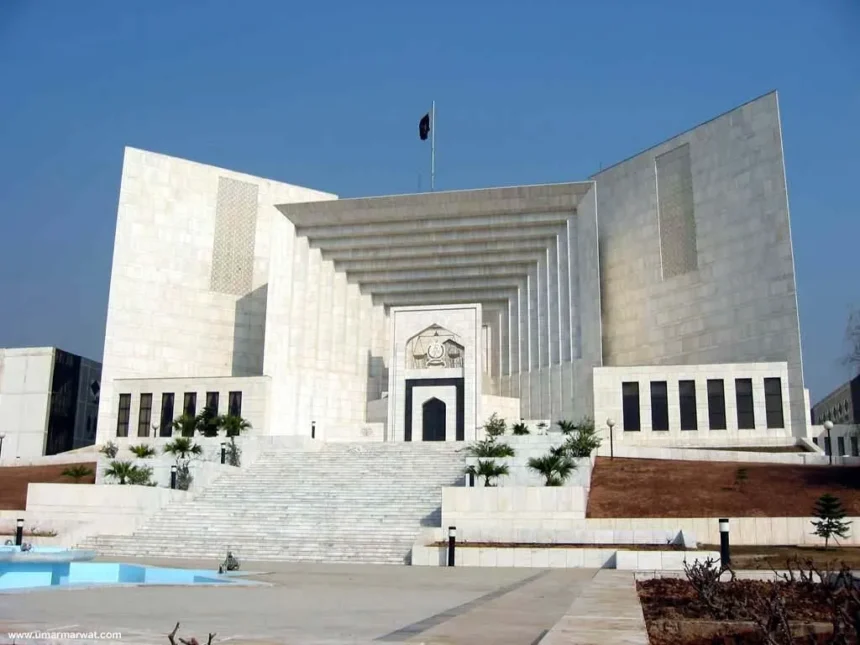
ISLAMABAD: While granting post-arrest bail to a foreign national booked under the Foreigners Act, 1946, for allegedly residing in Pakistan without a valid visa or residence permit, Supreme Court held that the statutory bar on bail invoked by the prosecution did not apply to the matter in hand.
A two-member bench comprising Justice Muhammad Hashim Khan Kakar and Justice Ishtiaq Ibrahim heard Criminal Petition No. 894/2026, filed by one Jalat Khan against an order of the Peshawar High Court, Mingora Bench (Dar-ul-Qaza), Swat, dated 11 May 2026, which had declined him post-arrest bail in a case registered under Section 14 of the Foreigners Act at Police Station Nawagai, District Bajaur.
According to the prosecution, the petitioner, a foreign national, was found residing within the jurisdiction of the local police station without a valid visa or residence permit and was booked accordingly. His counsel Jalal-ud-Din, submitted that the petitioner had contracted a valid marriage with a Pakistani woman, Tasleem Bibi, through a registered Nikah Nama solemnized in 1994, and that the couple had children from the marriage.
It was further submitted that the petitioner had applied for a Pakistan Origin Card (POC) on the strength of this marriage and had also approached the Peshawar High Court through a constitutional petition, remaining entitled to pursue domicile, national identity card, or citizenship registration under Section 10 of the Pakistan Citizenship Act, 1951.
The State, represented by AAG Bashar Naveed, opposed the bail plea, arguing that marriage to a Pakistani citizen does not automatically confer citizenship or exempt a foreign national from the regulatory regime of the Foreigners Act, and that the offence remained a continuing one so long as the petitioner stayed in Pakistan without lawful authority.
Writing for the bench, Justice Kakar examined the scheme of Section 14 of the Act, distinguishing between Section 14(1), which covers persons who overstay or violate conditions after lawfully entering Pakistan and carries a maximum sentence of three years, and Section 14(2), which applies strictly to persons who knowingly enter Pakistan illegally and carries a sentence of up to ten years.
The Court noted that the bail embargo under Section 14A applies only to offences punishable under Section 14(2). Since the FIR contained no allegation that the petitioner had knowingly entered Pakistan illegally, and the case rested entirely on his continued presence amid unresolved administrative processes, the Court held that the accusation fell under Section 14(1), placing it outside the prohibitory clause of Section 497 Cr.P.C., where bail is ordinarily the rule rather than the exception.
The judgment also addressed the broader legal position of foreign husbands of Pakistani women, noting that Section 10 of the Citizenship Act, 1951, historically provided a path to citizenship for foreign wives of Pakistani men but lacked a reciprocal provision for foreign husbands.
The Court referred to a Federal Shariat Court ruling that had declared this disparity discriminatory and violative of constitutional guarantees of gender equality, though an appeal against that judgment remains pending before the Shariat Appellate Bench of the Supreme Court.
The bench also noted that the Peshawar High Court had already issued directions in separate writ petitions concerning the processing of the petitioner’s POC application and the citizenship status of his children.
The Court observed that penalizing a foreign husband through incarceration, while his status remains pending determination before administrative and judicial fora, effectively converts executive delays into punitive detention. Holding that the matter fell within the scope of “further inquiry” under Section 497(2) Cr.P.C., the Court set aside the High Court’s order, converted the petition into an appeal, and allowed it.
The petitioner was admitted to post-arrest bail on furnishing bail bonds of Rs. 20,000 with two sureties in the like amount, with the Court clarifying that its observations were tentative and would not prejudice the trial or any pending administrative proceedings concerning his citizenship or domicile status.