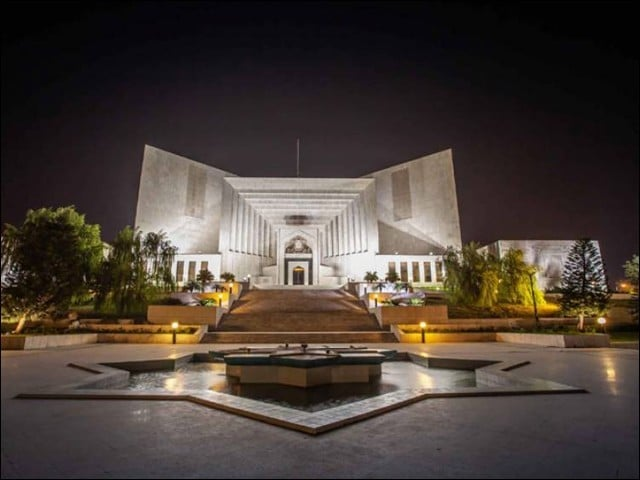
The Supreme Court Friday granted bail to former prime minister Imran Khan and Pakistan Tehreek-e-Insaf (PTI) leader Shah Mahmood Qureshi in the cypher case against surety bond of Rs100,000 each.
A three-member bench of the SC comprising acting Chief Justice Sardar Tariq Masood, Justice Athar Minallah and Justice Mansoor Ali Shah were hearing the bail applications. Imran Khan, the PTI’s founder, had approached the apex court for a bail relief in the case after the Islamabad High Court (IHC) rejected his post arrest bail application on October 27.
It is pertinent to note that the bail in cypher case will not result in the former premier being released from jail. Imran is currently under judicial remand in the £190 million case, and also under arrest in the Toshakhana case. The cypher case is related to a piece of paper that Imran had waved at a public rally last year ahead of a vote of confidence that he lost. The former premier, later naming the US, had claimed that the cypher was ‘evidence’ of an ‘international conspiracy’ to topple his government.
Daily Express Tribune reported that last week, on December 13, a special court established under the Official Secrets Act once again indicted former premier Imran Khan and ex-foreign minister Shah Mahmood Qureshi in the cypher case – dealing a fresh blow to ex-PTI chairman’s chances of contesting Pakistan’s general election in February. Judge Abul Hasnat Zulqarnain read out the two-page charge-sheet under the Official Secrets Act, outlining three distinct charges against the defendants.
The court ruled that both Imran, in his capacity as prime minister, and Shah Mehmood Qureshi, as foreign minister, breached the Official Secrets Act. The charge-sheet stated that both accused publicly flaunted a classified document during a rally on March 27, 2022, exploiting it for personal gain in a deliberate manner, highlighting that the unlawful actions harmed the nation’s reputation, security, and diplomatic affairs
The former premier and Qureshi were first indicted in the case on October 23, where both the PTI leaders had pleaded not guilty to the charges. However, on November 21, the IHC declared the trial “illegal” on grounds that the governemnt’s notification regarding holding the trial in-camera was without lawful authority. Four witnesses had recorded their statements in the case when the IHC scrapped the entire proceedings of the case, ordering the special court to start the trial afresh.
The written order
In its written order, the top court, while granting bail to Khan and Qureshi, said that there is no sufficient incriminating material available, at this stage, which could show that Imran Khan communicated the information contained in the cypher received from Washington to the public at large with the intention or calculation, directly or indirectly, in the interest or for the benefit of a foreign power nor the disclosed information relates to any of the defence installations or affairs, nor did he disclose any secret official code to the public at large.
“We, therefore, are of the tentative opinion that there are not reasonable grounds for believing, at this stage, that the petitioners have committed the offence punishable under clause (b) of Section 5(3) of the Act but rather that there are sufficient grounds for further inquiry into their guilt of the said offence, which is to be finally decided by the learned trial court after recording of the evidence of the parties. The discretion exercised by the High Court in declining bail to the petitioners is found to have been exercised perversely, that is, against the weight of the material available on record of the case, which warrants interference by this Court”, said the judgement, authored by Justice Syed Mansoor Ali Shah.
“The offences of wrongful communication of the official confidential information, etc., as defined in defined in clause (a) to (d) of Section 5(1) of the Official Secrets Act 1923 (“Act”) are generally punishable, under clause (b) of Section 5(3), with imprisonment for a term which may extend to two years, or with fine, or with both, and are bailable under clause (b) of Section 12(1) of the Act. It is only when an offence is committed in contravention of clause (a) of Section 5(1) and is intended or calculated to be, directly or indirectly, in the interest or for the benefit of a foreign power, or is in relation to any of the defense installations or affairs, or in relation to any secret official code, that it is punishable under clause (b) of Section 5(3) of the Act, with death or with imprisonment for a term which may extend to fourteen years. Such an offence is non-bailable and also falls within the prohibitory clause of Section 497(1) of the Code of Criminal Procedure 1898 (CRPC). In respect of such offences, other than the provisos to Section 497(1), bail is granted under Section 497 (2), CrPC, if it appears to Court at any stage of the investigation, inquiry or trial, as the case may be, that there are not reasonable grounds for believing that the accused has committed such an offence but rather that there are sufficient grounds for further inquiry into his guilt.”
The order said that the only question, therefore, before the court in the case is that whether there are not reasonable grounds for believing, at this stage, that the petitioners have committed the offence punishable under clause (b) of Section 5(3) of the Act but rather that there are sufficient grounds for further inquiry into their guilt of the said offence.
“In this regard, we are cognizant of the one of the elementary principles of the law of bail that to answer the said question, the Court cannot indulge in the exercise of a deeper appraisal of the material available on record of the case but is to determine it only tentatively by looking at such material,” the judgement said.
The order said that these petitions are converted into appeals and the same are allowed. “The bail applications of the petitioners are accepted subject to their furnishing of bail bonds in the sum of one million with two sureties each in the like amount to the satisfaction of the learned trial court,” it added. The court said that the observations made in this order are of tentative nature which shall not in any manner influence the trial court, and that this concession of bail may be cancelled, if the petitioners misuse it in any manner, including causing delay in the expeditious conclusion of the trial.
Today’s hearing
During today’s hearing, Justice Masood observed that the statement of a witness is taken on oath, but Azam Khan’s – ex-principal secretary of former premier Imran who is a key witness in the case – statement was taken without one. He then inquired if an investigation was conducted regarding Azam’s prolonged disappearance. Justice Minallah asked if the former principal secretary had gone on a “tour of the northern areas” too.
Referring to the National Security Council’s (NSC) meeting held over the matter during Shehbaz Sharif’s tenure as premier, Justice Masood inquired why the then-premier claimed that the cypher document was missing if during the meeting it was suggested that a demarche should be issued.
“Mashallah, the Islamabad High Court has already given a decision on the matter. The only job that appears to be remaining is providing [the accused] a noose” Justice Masood remarked, expressing his displeasure with the proceedings in the lower court. The acting chief justice then wondered how two NSC meetings were held on the issue if the cypher was missing.
Prosecutor Raja Rizwan Abbasi countered that a master copy of the document had been presented during the meetings. Referring to the statement of former ambassador to the US Asad Majeed, Justice Masood said his statement does not mention that another country had benefitted.
The acting CJ clarified that the court is not justifying making the secret cypher document public, but arguing that the matter pertains to law. Justice Mansoor Ali Shah then asked the prosecution to clarify the basis for adding the provisions of death penalty. Abbasi countered that the cypher being waved in a public rally was sensationalised in India. Justice Athar Minallah then countered the prosecutor’s argument and asked would the treatment by the state of Baloch long march protesters will not be sensationalised. “The enemy will benefit if bilateral relations are harmed,” said Abbasi.
Responding to the prosecution’s argument that publicising the contents of the cypher ‘benefitted enemy countries’, Justice Shah said the question of utmost importance here is which enemy country benefitted from the matter? Prosecutor Abbasi replied that the fiasco resulted in damaging Pakistan’s relations with the US. At this Justice Mansoor responded that, “You’re [still] not saying which country benefitted from it.”
“From the time of Hussain Shaheed Suharwardy, how many prime ministers have been hanged to death, how many jailed, and how many disqualified?” asked Justice Minallah, further questioning the prosecution if these actions also impacted Pakistan’s relations with other countries. “Your actions are making a mockery of this country,” Justice Mansoor Ali Shah said.
Following the arguments, prosecutor Abbasi stated that the matter before the apex court was related to the PTI leaders’ bail, adding that it was not related Article 184 (3). The Federal Investigation Agency’s (FIA) prosecutor Shah Khawar also questioned the legislation under which the SC had the right to hear the cypher matter. Responding to Abbasi, Justice Shah asked if his argument was that the apex court could not protect a person’s fundamental human rights? To Khawar, the judge replied that the SC even had authority under Article 187.