Categories Courts

SC Rejects Govt Plea for Military Court Verdicts in May 2023 Riot Cases

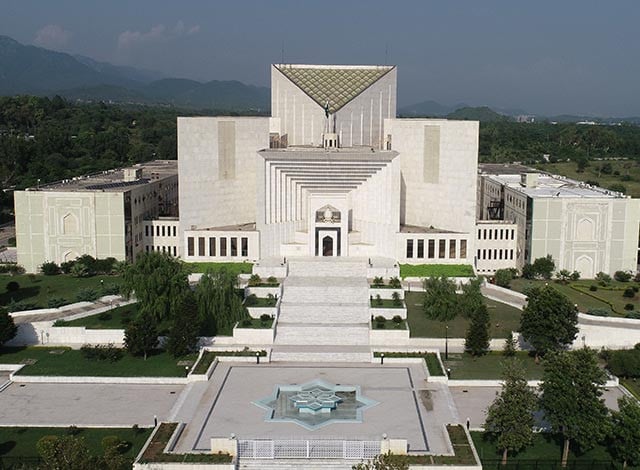
The Supreme Court on Monday rejected federation’s plea seeking permission for military courts to pronounce verdicts in cases involving civilians allegedly linked to the May 9, 2023 riots, observing that granting approval would imply recognition of the military courts’ authority.

Arab News reported the case pertains to the trial of more than 100 civilians for their alleged role in attacks on army installations during the violent protests that followed former prime minister Imran Khan’s arrest in a graft case on May 9, 2023.

On October 23 last year, a five-member SC bench had unanimously declared that trying the accused civilians in military courts violated the constitution, but on Dec. 13, 2023, another top court bench suspended the Oct. 23 ruling as it heard a set of 37 intra-court appeals against it.

In March this year, the top court conditionally allowed military courts to pronounce reserved verdicts in the May 09 cases, modifying its Dec. 13 injunction and ordering military courts to commence trials but barring them from convicting or acquitting any accused until a decision on intra-court appeals.

On Monday, a seven-member constitutional bench, led by Justice Aminuddin Khan, resumed hearing the appeals and rejected the government plea allowing the military courts to verdicts of trials of civilians, observing that giving permission to announce verdicts would mean recognizing the authority of military courts.

“We want to hear the case on a daily basis and announce a decision on it,” Justice Aminuddin remarked during the hearing.  In his remarks, Justice Jamal Khan Mandokhail urged lawyers of all petitioners to cooperate with the bench for an early verdict in the case.

The bench resumed hearing of the case on Tuesday, during which Additional Attorney-General (AAG) for Pakistan Amir Rehman requested the court for an adjournment, citing the unavailability of Ministry of Defense Khawaja Haris due to health issues. The court granted the request.

Several cases against Khan and his party related to the May 9, 2023 violence were registered by the government, which also cracked down on his supporters allegedly involved in the riots. Khan’s party has distanced itself from the protests and accused the country’s intelligence agencies of framing his party for the violence. The military denies the accusations.

The attacks took place a little over a year after Khan fell out with Pakistan’s powerful military, blaming the institution for colluding with his rivals to oust him from office in a parliamentary vote in April 2022, a charge denied by the military.

Khan, who remains a popular figure in Pakistan despite several court cases against him, has led a campaign of unprecedented defiance against the country’s powerful military. He has also accused the military of rigging the February 08 election in collusion with the election commission and his political rivals to keep him from returning to power. The military, election commission and Khan’s rivals deny the allegation.


Author

Khudayar Mohla, Managing Partner Mohla & Mohla, Founder of the Law Today Pakistan,

Managing Partner at Mohla & Mohla - Advocates and Legal Consultants, Islamabad, Founder of The Law Today Pakistan (TLTP) Newswire Service. Former President Press Association of Supreme Court of Pakistan with over two decades of coverage of defining judicial moments - including the dissolution and restoration of Chief Justice Iftikhar Muhammad Chaudhry, Asif Ali Zardari NAB cases, Syed Yousaf Raza Gillani contempt proceedings, Panama Papers case against Mian Nawaz Sharif, matters involving Imran Khan, and the high treason trial of former Army Chief and President Pervez Musharraf. He now practises law and teaches Jurisprudence, International Law, Civil and Criminal Law. Can be reached at: mohla@lawtoday.com.pk

More From Author

Leave a Reply

Your email address will not be published. Required fields are marked *

You May Also Like

FCC Super Tax verdict, Federal Constitutional Court Pakistan, Super Tax on high earners, Parliament taxing powers Pakistan, Section 4C Income Tax Ordinance, Super Tax legality Pakistan, Chief Justice Amin-ud-Din Khan, income tax law Pakistan, high income earners tax, oil and gas sector Super Tax, tax exemptions Pakistan, mudarabah Super Tax exemption, mutual funds tax exemption, unit trust funds Pakistan, retrospective taxation Pakistan, double taxation challenge, Supreme Court Super Tax case, High Courts Super Tax ruling, constitutional amendments Pakistan, 26th Constitutional Amendment, 27th Constitutional Amendment, revenue generation Pakistan, Rs310 billion revenue, Pakistan tax litigation, business community tax challenge, banks Super Tax Pakistan, corporate taxation Pakistan, federal budget Super Tax, economic stabilisation measures Pakistan, Operation Zarb-e-Azb levy, internally displaced persons fund, tax policy Pakistan, constitutional bench Pakistan, Khudayar Mohla

FCC Validates Parliament’s Legislative Competence To Levy Super Tax

ISLAMABAD: While dismissing all pleas challenging legality of the Super Tax on high-income earners, the…

Khudayar Mohla, Islamabad High Court, IHC, Islamabad Local Government elections, local government election petitions, Election Commission of Pakistan, ECP, presidential ordinance, Islamabad Capital Territory, ICT local government, Jamaat-e-Islami, JI, Mohammad Nasrullah Randhawa, Advocate Chaudhry Shoaib Ahmed, local bodies term, constitutional obligation, local government election delay, Islamabad LG polls, ICt Local Government Amendment Ordinance 2026, President Asif Ali Zardari, Articles 17, 32, 89, 140-A, election schedule withdrawal, court adjournment, bench unavailability, deferred hearing, joint petitions, Markazi Muslim League

IHC Adjourns Islamabad LG Election Pleas After Court Roster Cancelled

ISLAMABAD:  A scheduled hearing for the Islamabad Local Government (LG) election petitions was deferred Tuesday…

Khudayar Mohla, Section 4-C, Super Tax Pakistan, Income Tax Ordinance 2001, ITO 2001, Finance Act 2022–23, high-income taxpayers, Federal Board of Revenue, FBR Pakistan, Federal Constitutional Court, FCC Pakistan, government appeals, Hafiz Ahsaan Ahmad Khokhar, constitutional validity, judicial review Pakistan, taxation authority, double taxation, retrospective tax, separation of powers, Pakistan tax law, federal revenue

Levy of Super Tax Within Parliament’s Exclusive Taxing Power, Govt Lawyers Argue Before FCC

ISLAMABAD: A three-member bench of the Chief Justice Federal Constitutional Court Justice Amin-ud-Din Khan is…