Categories Courts

SC sets to hear case pertaining to IHC judges’ letter on April 30

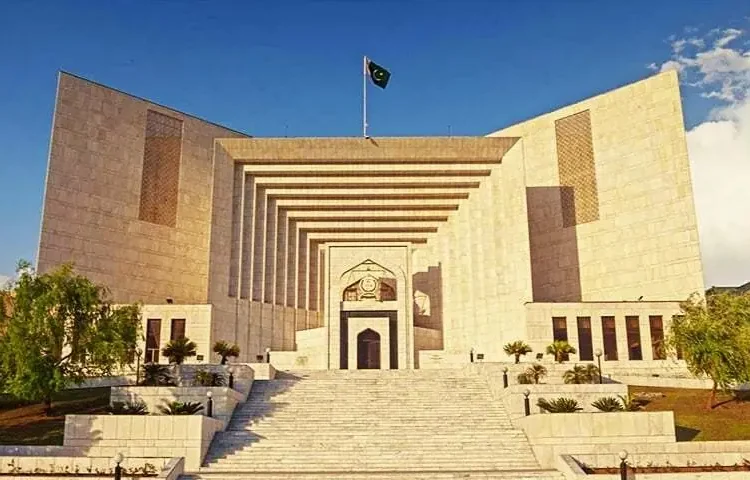
A six-member larger bench of the top court sets to adjudicate case pertaining to the letters of six judges of Islamabad High Court (IHC) for hearing on April 30. 

As  per cause list of the Supreme Court several pleas have been clubbed the top court will take up collectively during the week commencing from Monday as the matter has been fixed for hearing on Tuesday.  Chief Justice of Pakistan Qazi Faez Isa will preside over the hearing while Justice Mansoor Ali Shah, Justice Jamal Khan Mandokhail, Justice Athar Minallah, Justice Musarrat Hilali, and Justice Naeem Akhtar Afghan will also be part of the bench. The top court had conducted first hearing on April 3 in this suo moto case.

On March 25, six judges of the Islamabad High Court (IHC) wrote a letter to the Supreme Judicial Council regarding “interference of intelligence agencies in judicial matters”.   The six judges are Justice Mohsin Akhtar Kiyani, Justice Tariq Mehmood Jahangiri, Justice Babar Sattar, Justice Sardar Ejaz Ishaq Khan, Justice Arbab Muhammad Tahir, and Justice Saman Rafat Imtiaz.

IHC response to developments 

A full court meeting of the IHC this past week unanimously decided to give an institutional response to any meddling in courts’ affairs.  The meeting was held on Tuesday last with Chief Justice Aamer Farooq in the chair to finalise proposals before submission to the Supreme Court.  Earlier, the Islamabad High Court Chief Justice had sought suggestions from all judges, including those of district and sessions court, on how to tackle the matter.

Islamabad Bar stance 

The Islamabad High Court Bar Association filed a constitutional petition in the Supreme Court, seeking a transparent and fair investigation of the letter of six judges alleging interference in judicial affairs.  The petitioner prayed the apex court to take action against those found guilty of influencing the judiciary.

The petition stated that the issue raised by the judges was of serious nature. “If the apex court deems it necessary, it should refer the matter to the Supreme Judicial Council for review,” it demanded. The petitioner submitted that an independent judiciary was the protector of the Constitution and the sole source of justice. “No compromise on the independence of the judiciary is acceptable in any circumstances,” it affirmed.

How it began

On March 25, six judges of the Islamabad High Court wrote a letter to the Supreme Judicial Council regarding “interference of intelligence agencies in judicial matters”.  The Supreme Court earlier this month took suo moto notice and hinted at constituting a full court to hear the matter. Before that, the federal government set up a one-man inquiry commission which could not initiate any proceeding due to refusal of its head, former chief justice Tassaduq Hussain Jillani.

Author

Khudayar Mohla, Managing Partner Mohla & Mohla, Founder of the Law Today Pakistan,

Managing Partner at Mohla & Mohla - Advocates and Legal Consultants, Islamabad, Founder of The Law Today Pakistan (TLTP) Newswire Service. Former President Press Association of Supreme Court of Pakistan with over two decades of coverage of defining judicial moments - including the dissolution and restoration of Chief Justice Iftikhar Muhammad Chaudhry, Asif Ali Zardari NAB cases, Syed Yousaf Raza Gillani contempt proceedings, Panama Papers case against Mian Nawaz Sharif, matters involving Imran Khan, and the high treason trial of former Army Chief and President Pervez Musharraf. He now practises law and teaches Jurisprudence, International Law, Civil and Criminal Law. Can be reached at: mohla@lawtoday.com.pk

More From Author

Leave a Reply

Your email address will not be published. Required fields are marked *

You May Also Like

Lahore High Court, Justice Jawad Hassan, Christian Divorce Act 1869, Pakistan legal news, Shahroz Masih case, minority rights Pakistan, judicial separation Christian law, dissolution of marriage grounds, Section 22 desertion, Section 11 adultery co-respondent, Article 199 writ petition, Article 10-A fair trial, Article 20 religious freedom, Article 4 due process, Mianwali court verdict, substantial justice vs technicalities, irretrievable breakdown of marriage, Punjab Judicial Academy workshops, district judiciary sensitization, matrimonial relief for Christians, evidentiary rigor in divorce cases, legal journalism Pakistan., Khudayar Mohla

LHC Quashes Lower Court Orders on Christian Divorce, Remands the Matter for Re-Adjudication

RAWALPINDI: Justice Jawad Hassan of the Lahore High Court, Rawalpindi Bench, sets aside concurrent findings…

Khudayar Mohla,Supreme Court of Pakistan, witness box seating, witness dignity Pakistan courts, Article 14 Constitution Pakistan dignity of man, fair trial Article 10A Pakistan, witness protection laws Pakistan, courtroom reforms Pakistan judiciary, Qanun e Shahadat witness examination, Supreme Court directives judiciary Pakistan, witness rights Pakistan courts

SC Directs Courts Nationwide to Provide Seating for Witnesses During Testimony

ISLAMABAD: Emphasizing that justice must be administered with humanity and respect for individual dignity, the…

Khudayar Mohla,Islamabad High Court, IHC, Justice Mohsin Akhtar Kayani, Dr. Zeeshan Ashraf, IVY School of Law, IVY College of Management Sciences, Amicus Curiae, Haq Mehr, Dower Rights, Islamic Jurisprudence, Shariah Law, Limitation Act 1908, Article 104 Limitation Act, Article 227 Constitution of Pakistan, Women's Financial Rights, Widow Inheritance, West Pakistan Family Courts Act 1964, Surah An-Nisa, Law and Justice Commission of Pakistan, National Commission on the Status of Women, Matrimonial Financial Disputes, Pakistan Legal News, Legislative Reform.

IVY School of Law HoD’s Dr. Zeeshan Ashraf Convinces IHC to Overturn Dower Time-Bar

ISLAMABAD: In a precedent-setting 21-page judgment aimed at harmonizing statutory law with Islamic injunctions, the…