
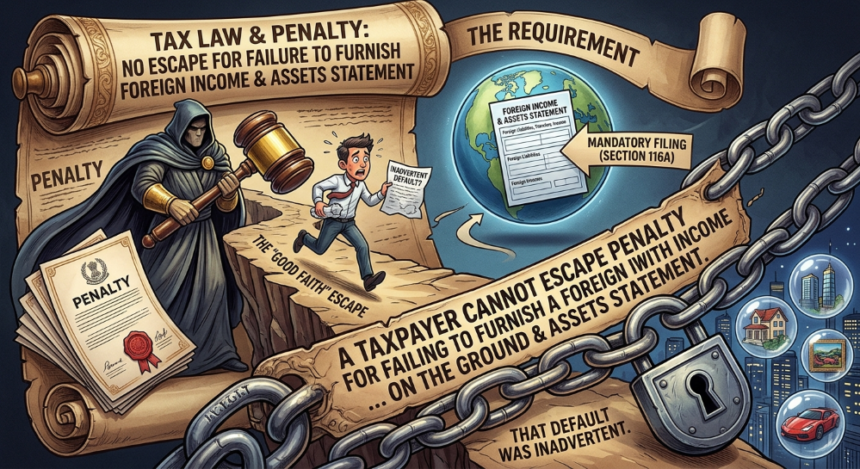
KARACHI: The Sindh High Court has ruled that a taxpayer cannot escape the penalty for failing to furnish a foreign income and assets statement by arguing that the default was inadvertent. It held that the department need not prove mens rea (guilty mind) for defaults committed after 1 July 2021.
A division bench of Justice Agha Faisal and Justice Dr. Shah Nawaz Memon dismissed two income tax reference applications filed by Farooq E Azam Cheema against the Commissioner Inland Revenue, LTO, Karachi. The hearing was held on 16 October 2026 and the judgment was announced on 19 October. Justice Dr. Memon is the author of this 9-page verdict.
The applicant, a resident individual, had declared foreign assets worth Rs153,194,266 in his wealth statements for tax years 2021 and 2022. However, he did not file the separate foreign income and assets statement required under Section 116A of the Income Tax Ordinance, 2001 with his returns. The tax department imposed a penalty of Rs3,063,885 for each year, being two percent of the value of the foreign assets. The Commissioner (Appeals) upheld the orders in July 2024.
The applicant’s counsel argued that mens rea is a prerequisite for penalty and that the 2021 Explanation to Section 182, which says mens rea need not be established, operates only prospectively and cannot reach these tax years. The department’s counsel said the Explanation applied. The bench accepted that the Explanation operates prospectively, following the Supreme Court’s larger-bench ruling in CIR v. Khadim Hussain. But it rejected the idea that the tax year decides which law applies. The offence, it said, is the failure to file the statement by the due date, and liability arises when the default occurs, not at the end of the tax year to which the statement relates.
The 2021 return was filed on 29 September 2021 and the 2022 return on 2 March 2023, both without the statement. The bench noted that both events came after the Explanation took effect, so no retrospective application was involved. The court stressed that the penalty does not follow automatically. The department must first show, on objective material, that the person was required to file the statement and did not do so on time. The taxpayer may then argue he was not in default, for example that he was not required to file, filed on time, or that no form had been prescribed. What he can no longer argue is that the default was inadvertent or in good faith.
The bench also rejected the argument that disclosing the assets in the wealth statement amounted to compliance, since Section 116A requires additional particulars such as foreign liabilities, transfers and foreign income. It distinguished the earlier ruling in Aameer Mustaaly Karachiwala, which concerned tax year 2019, when no form had been prescribed, and was decided before the Explanation was added. The court expressed no view on the quantum of the penalty, as that was not challenged.