
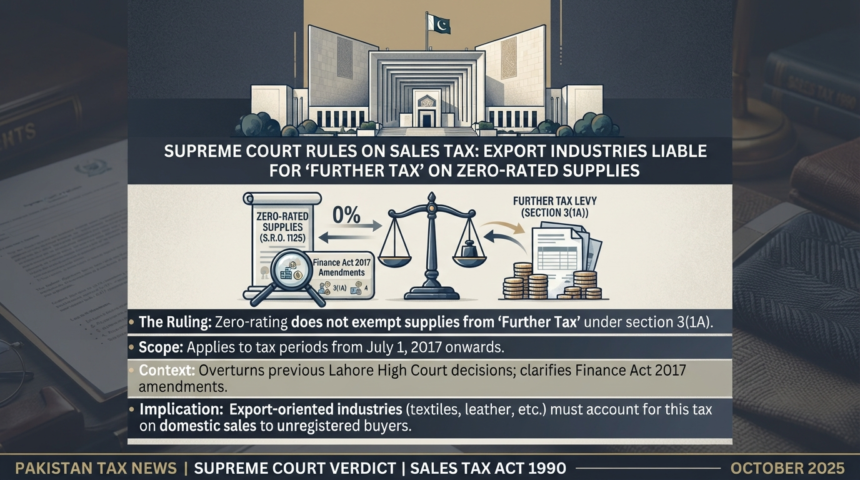
ISLAMABAD: For years, textile mills and other export-oriented industries have argued that a zero rate of sales tax puts their supplies beyond the reach of ‘further tax’. The Supreme Court has now ruled otherwise for periods from July 2017, handing the tax authorities a significant win in a dispute that spanned as many as 53 petitions.
A three-member bench headed by Chief Justice Yahya Afridi and comprising Justice Muhammad Shafi Siddiqui and Justice Miangul Hassan Aurangzeb held that zero-rating under S.R.O. 1125(I)/2011, as amended by S.R.O. 491(I)/2016, does not by itself exclude supplies to unregistered persons from further tax under section 3(1A) of the Sales Tax Act, 1990. Justice Muhammad Shafi Siddiqui authored the verdict.
The court allowed the petitions filed by the Commissioner Inland Revenue (CPLA 2496-L of 2024 and CPLAs 2571-L and 2587-L of 2025), converting them into appeals. It set aside the Lahore High Court’s judgments of October 2, 2024 and September 23, 2025 in Sales Tax References 7, 27 and 28 of 2022. The remaining petitions, filed by taxpayers from the textile, carpet, leather, sports and surgical goods sectors, were dismissed and leave to appeal was refused.
Finance Act 2017 changed the picture
The court said the outcome turned on amendments introduced by the Finance Act, 2017. Before then, section 4 carried a non-obstante clause overriding section 3 without exception. That was the basis on which the Lahore High Court in MKB Spinning Mills and the Supreme Court in Acro Spinning and Weaving Mills had favoured taxpayers.
The 2017 amendments added section 4 to the provisions covered by section 3(1A) and qualified section 4’s opening words with “except those of sub-section (1A).” The bench said the two changes must be read together, and that they bring zero-rated supplies within the scope of further tax, subject to the statute’s requirements and exceptions.
Zero-rated does not mean exempt
The court reiterated that the Sales Tax Act is an integrated value-added tax system. Zero-rating, it said, prescribes a rate of zero per cent but does not remove a supply from the category of taxable supplies. Further tax under section 3(1A) is a distinct levy on taxable supplies to unregistered persons.
The bench also noted that S.R.O. 491’s preamble refers to sections 3, 4, 8 and 71 but not to section 3(1A) or its proviso. By contrast, S.R.O. 648(I)/2013 and S.R.O. 585(I)/2017 were issued specifically under that proviso to exclude certain supplies from further tax. Absent such an exclusion, the court held, a zero rate alone cannot displace section 3(1A).
Earlier precedents distinguished
The court distinguished Hajvairy Steel Industries (2023 SCMR 681), where a special procedure under section 71 was held to prevail. That case involved periods from 2013 to 2016 and a procedure for steel melters with a final-discharge clause, and did not concern a zero-rating notification or the 2017 amendments. The bench also referred to Superior Textile Mills (PLD 2001 SC 600), which held that a special procedure cannot override substantive provisions of the Act.
It further noted that the Lahore High Court’s decision in T.U. Plastic Industry, which struck down an amendment to section 4(c) and S.R.O. 584(I)/2017, did not invalidate the separate amendments to section 3(1A) or to the opening words of section 4.
What it means
The ruling applies to tax periods commencing July 1, 2017, which covers the periods at issue (July 2017 to June 2019). The court cautioned that further tax is chargeable only where the requirements of section 3(1A) are met and the supplies are not covered by a valid exclusion under its proviso. That leaves room for taxpayers to contest individual assessments on those grounds.