

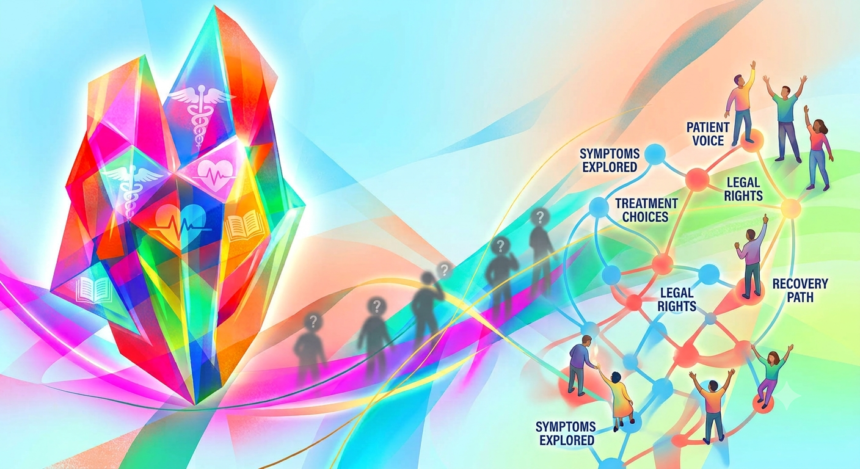
What happens when a person is suffering but doesn’t even know what is happening to them? What is more dangerous: mental illness itself or the silence surrounding it? If people do not know their rights, how can they stand up for themselves?
In Pakistan, mental health is often treated as a private struggle, but is it really just personal, or is it failure of the system? If the system hides information, then who is actually responsible for the suffering? Can a society progress while ignoring the mental pain of its own people? Is the right to information just a legal issue, or a core matter of psychological survival? Last but not the least, are Pakistan’s pre-existing laws ready to inform people, or will they keep people in the dark?
The deadliest silence is not the absence of sound, but the absence of knowledge where knowing means survival.
Pakistan is a country of quiet contradictions. Ironically, it already has laws like Article 19-A of the Constitution of Pakistan and the Right of Access to Information Act 2017. Article 19-A establishes the principle that every citizen has the right to access information, including healthcare. This right is then put into practice through the Right of Access to Information Act 2017, which can also be defined as “law in action”. In addition, at the provincial level, the Khyber Pakhtunkhwa Right to Information Act 2013 has been praised internationally for its progressive approach.
Yet, when millions of families are not made aware that children can experience anxiety or where to seek help ,these rights lose their meaning .The problem is not the absence of law, but the absence of implementation, especially in areas like mental health, where awareness can change the course of an entire life. As a psychology student nearing the completion of my undergraduate degree, I have spent years examining the human mind. The mind has extraordinary capacity for resilience but is equally vulnerable to neglect.
This can be understood through a simple example. Sara grew up in a home where her constant fear, silence, and withdrawal were dismissed as “good behavior”. No one recognized the signs of anxiety .No one told her family that children, too, can suffer mentally. Without guidance or support, her fears hardened over time. As she grew older, those unnoticed wounds shaped her personality. She struggled to trust, express and feel secure. What could have been understood and treated in childhood became a lifelong burden. It was not just her past that defined her, but also the silence about timely information and care.
The most gut-wrenching fact is that Sara’s case is not an isolated one. Millions of children and people of all ages are silently living through this invisible pain. This suffering is not only due to personal failure but due to a lack of awareness .Cases like Sara’s are not just personal tragedies; they reflect a deeper systemic gap. A problem that is not recognized is a problem that remains unresolved. Without awareness, there is no timely action, and without action, there is no change.
Psychology research makes it clear that uncertainty is not a neutral state; it is a psychological burden. When individuals are deprived of clear information, their ability to interpret, respond, and cope with their condition collapses. This is better explained by Martin Seligman’s theory of learned helplessness. He showed that when people are in situations where they lack control or information, they eventually stop trying to change their condition. In the mental health system, the same happens when individuals are not informed about symptoms, services, or available help. The absence of awareness creates a sense of helplessness that could have been prevented with proper information. But uncertainty does not just confuse people;it quietly consumes them.
Martin Dugas’s theory of intolerance of uncertainty explains that uncertainty is not just discomfort; it is a trigger for anxiety. Likewise, when the system fails to clearly inform people about symptoms, services, or support, uncertainty takes over. People start imagining worst-case scenarios, not because they are irrational, but because they are uninformed. In this silence, distress grows silently but steadily.
Mental health in Pakistan is in crisis, although it is often ignored. Pakistan did not share suicide data with the WHO until 2017, which shows how much mental health has been ignored at the national level. There are only about 500 psychiatrists for more than 200 million people. This shows an alarming shortage. Furthermore, mental illness carries a heavy weight of shame and stigma in Pakistani society. Stigma grows in silence and lack of information and control make it worse. Outdated laws, like the Lunacy Act of 1912, treated suffering like a crime. This is where right to information is very important .When people talk about mental illness, awareness increases; people feel more certain and in control to change their situations.
As a psychology student, I believe that students, researchers, advocates and citizens all have a crucial role at the intersection of law and mental health. We understand the science of suffering. And we understand the system that perpetuates it. The citizens of Pakistan deserve to know what mental health services exist in their public hospitals. They deserve this not as a privilege or a courtesy, but as a constitutional right already written into law. The right to information and the right to mental health are inseparably intertwined.
The philosophical foundation of both is the same: every human being deserves truth, dignity, and the ability to make informed decisions about their lives. In a country where an estimated one in four people live with some form of mental health condition, that conviction is not idealism. It is urgency. And it is long overdue. We are in desperate need of recognizing and acting upon this reality.