While hearing intra-court appeals seeking suspension of top court verdict that declared trial of civilian before military courts null and void, a 6-member bench of Supreme Court allowed military courts to proceed the trails saying final decisions would be conditional to the Supreme Court verdict in the matter.
The court announced its decision with a 5-1 majority. One of member of the bench Justice Ms. Musarrat Hilali opposed the majority decision. The SC ruled that the military courts will not pronounce final decisions on the trials underway. It allowed the military courts to proceed with the trials saying their final decisions would be conditional to the Supreme Court verdict.
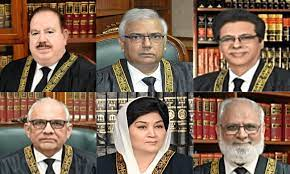
The 6-member larger bench of the Justice Sardar Tariq Masood announced the decision while hearing intra-court appeals in the matter. The bench also included Justice Aminuddin, Justice Hassan Azhar Rizvi, Justice Muhammad Ali Mazhar, Justice Musarrat Hilali and Justice Irfan Saadat.
As the court resumed hearing the intra-court appeals on its verdict against the trial of civilians in military courts, led the bench, Justice Sardar Tariq Masood, refused to step down from the bench over objections by one of the applicants.
Federal, provincial governments and Defence Ministry have invoked the jurisdiction of the court through filing intra-court appeals. The federal government has also urged the court to grant stay order in the matter seeking court directives to declare decision null and void.
Former Chief Justice of Pakistan Jawad S Khawaja is also among the applicants and had objected to the inclusion of Justice Masood in the bench hearing the case. He filed a petition before the court, challenging Justice Masood’s presence in the bench.
Former CJP Khawaja expressed reservations over Justice Masood’s prior opinion on the applications related to military courts. He proposed the formation of a fresh bench by the judges’ committee. The petition outlined that both Chief Justice of Pakistan Qazi Faez Isa and Justice Masood had recused themselves from a nine-member bench hearing these cases. Justice Masood’s previous opinion, signed on June 26, deemed the petitions against military courts inadmissible.
The hearing :
As the hearing commenced, Justice Masood refused to step down from the bench, citing the applicant’s own earlier decision that recusing from a bench was a judge’s prerogative. “Pardon me, but I do not step down from the bench,” Justice Masood insisted and rejected the former CJP’s objection. Advocate Latif Khosa ssubmitted they had an objection to the bench. Justice Masood asked if they had been issued notices. When the parties are issued notices, their objections will be heard.
Defense Ministry’s lawyer Khawaja Haris started presenting his arguments and read the court verdict. The entire section of a law has been declared invalid in two lines, Justice Masood remarked. The lawyer said these provisions were previously retained in the Supreme Court’s decisions.
An eight-member bench retained these provisions in the FB Ali case. In the latest decision, the provisions were declared null and void by the majority of 4-1, he further said, adding that these provisions were also maintained in the 21st Constitutional Amendment case.
The court also stopped Aitzaz Ahsan, Salman Akram Raja and Latif Khosa from delivering arguments, saying they had not been issued notices yet. Advocate Supreme Court Salman Akram Raja said if that was the case, then a stay order should not be issued. In the recent decision, the provisions were nullified by a majority of 4-1, Khawaja Haris argued, adding that civilians also include people like Indian spy Kulbhushan Yadav. The jurisdiction over civilians was already limited in the Army Act. The provisions related to civilian cannot be revoked, he maintained.
Justice Masood said they did not have the detailed decision of the Supreme Court yet, and asked what will happen to the civilians involved in Tuesday’s attack in Dera Ismail Khan in which soldiers were martyred. The court then asked if the trials were completed.
The Attorney General for Pakistan (AGP) submitted some suspects were charged, some were yet to be indicted, adding many of them may even be acquitted. Those who were sentenced will also not stay in jail for more than three years.
“How do you know that the sentence will be less than three years?’ Justice Mazhar asked. To this, the AGP replied that the duration of custody of an accused in a lesser sentence is also considered part of the sentence.
Justice Hilali asked why those about to be acquitted were not being granted bail. Khawaja Haris said if the trial was allowed to proceed, the time would not have been wasted. Even if the trial is nullified, the sentences will end, the AGP remarked.
Sardar Latif Khosa also opposed the issuance of a stay order. The judges ruling on the military courts are also from this Supreme Court, he remarked, and asked how a trial can resume when a detailed decision on the annulment of the trial has not been issued yet. Justice Masood asked why this appellate court was formed then. The provisions related to civilians were revoked, which should not have been done.
“Under what law should the trial of those who martyred your children be conducted?” Justice Masood asked. Raja said they will answer these questions satisfactorily when they’re given the opportunity to be heard. Basic human rights have been protected in the Constitution, he added.
The AGP requested for conditional permission to run trials of civilians in military courts. Justice Masood remarked that a law has been revoked, so how things can be removed from it and allowed. “What is the hurry in this case?” asked Justice Mazhar. The court then reserved its verdict on the decision to grant a stay on its prior order on military courts.
The judges then retreated to their chamber and Justice Masood said they will return in a while. Aitzaz Ahsan said a stay order cannot be issued on the filing of an appeal, just a notice is issued. The AGP said the suspects involved in the May 09 incidents could also be charged under the provisions of serious offences. The serious provisions were not applied because those culprits may be misguided but they were fellow citizens.
Lawyer Faisal Siddiqui said if a component of the decision is suspended, the AGP’s problem can be resolved. Salman Akram Raja said they could not be a part of an unconstitutional trial. Justice Hilali asked if the officer hearing the cases in military courts had the authority to grant bail or they were only authorized to issue a sentence.
Faisal Siddiqui suggested suspension of the part of the decision that is affecting the trial of terrorists. He also asked for sending the 103 suspects of the May 09 incidents back to the Anti -Terrorism Court. Aitzaz Ahsan said the incumbent Chief Justice has given his opinion that a fair trial cannot be conducted in military courts. Later, the larger bench issued notices to parties in the intra-court appeals and adjourned the proceedings till third week of January.