

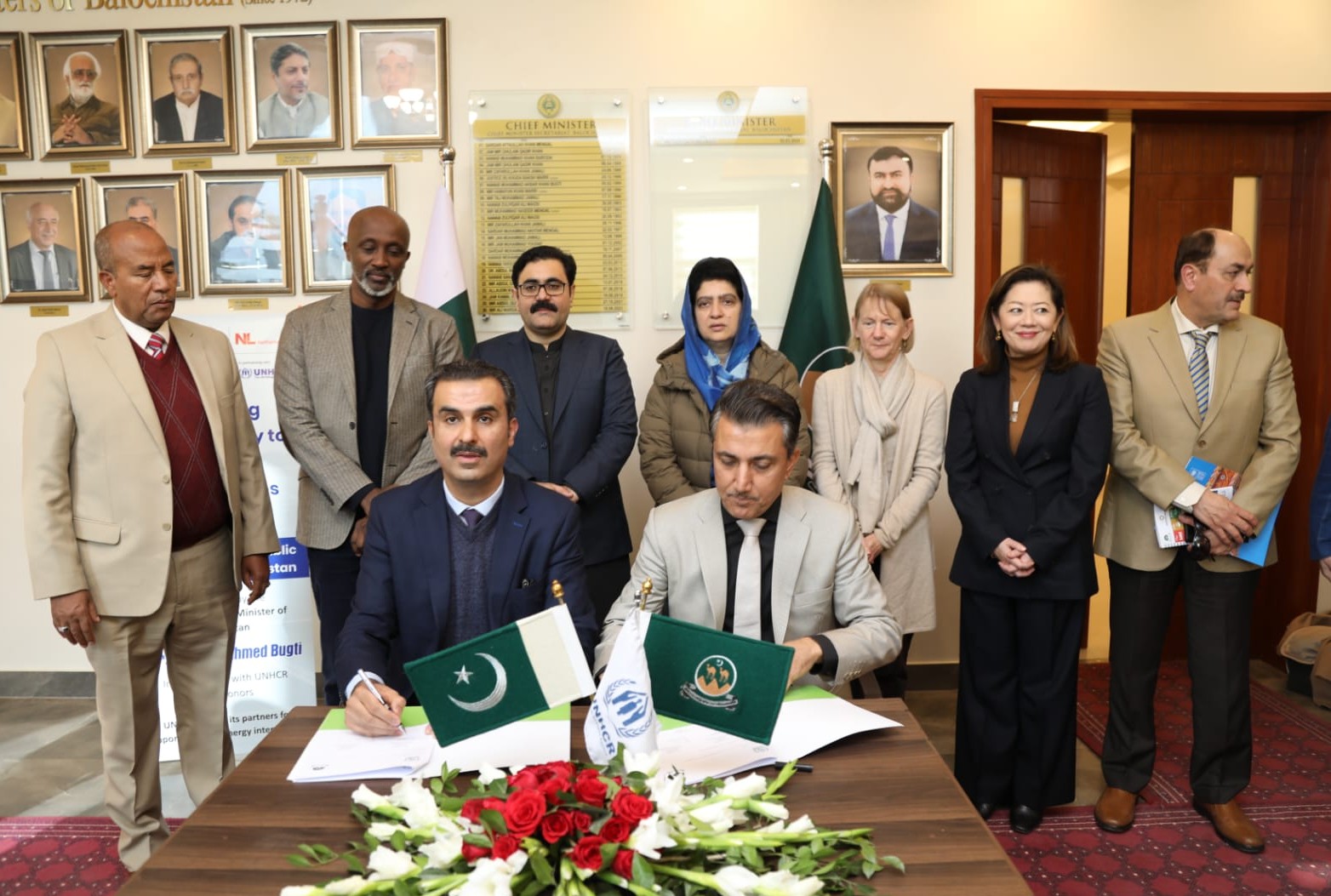
QUETTA: UNHCR, the UN Refugee Agency, Wednesday handed over 48 solar-powered public facilities valued at approximately PKR 1 billion (USD 3.5 million) to the Government of Balochistan. This landmark initiative delivers clean, reliable, and cost-efficient solar energy to key public institutions—including schools, universities, healthcare facilities, and technical training institutes—particularly in refugee-hosting districts.
Implemented during 2024–2025 with support from international donors including Global Affairs Canada, Germany’s Federal Ministry of Economic Cooperation and Development, the Korea International Cooperation Agency (KOICA), and the Kingdom of the Netherlands, the project addresses long-standing challenges of unreliable grid electricity, frequent power outages, and high operational costs from diesel generators.
Among the facilities solarized is the Bolan Medical Complex, supported by UNHCR’s private partner, LONGi Green Energy Technology Co. Ltd. The official handover ceremony took place at the Chief Minister’s Office in Quetta, attended by Chief Minister Sarfaraz Bugti, UN Resident Coordinator Mohamed Yahya, UNHCR Representative in Pakistan Ms. Philippa Candler, the Head of UNHCR Quetta Office, Mr. Tesfaye Bekele and senior government and UN officials.
By transitioning critical public facilities to renewable energy, the initiative ensures uninterrupted power supply, reduces reliance on the national grid, and significantly lowers recurring energy costs. These improvements are enabling institutions to deliver more consistent and higher-quality education and healthcare services across the province. UN Resident Coordinator Mohamed Yahya commended the project’s impact and acknowledged Pakistan’s 45-year commitment to hosting Afghan refugees. He emphasized the importance of continued solidarity with refugee communities alongside support for host populations.
UNHCR Representative Ms. Philippa Candler highlighted that reliable energy is essential for sustaining public services and strengthening institutions that serve both Afghan refugees and host communities. “As UNHCR, we deeply value this compassion and continue to encourage that the needs, dignity, and protection of refugees remain central, while we jointly strengthen services for all.” The solarized facilities will benefit nearly two million people annually—including students, teachers, healthcare workers, patients, refugees, and host community members. The initiative also contributes to climate action by reducing greenhouse gas emissions and dependence on fossil fuels, supporting provincial and national climate priorities in one of Pakistan’s most climate-vulnerable regions.