Categories Courts

Unraveling the NAB Amendments Case: A Comprehensive Guide
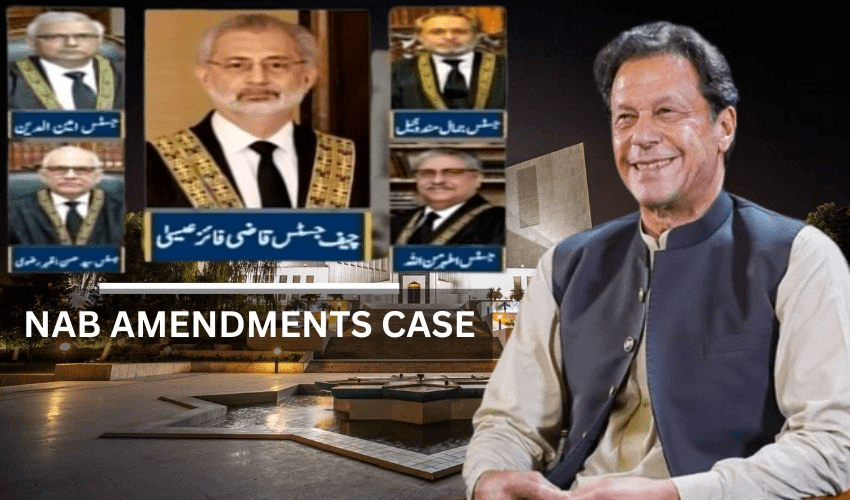
Pakistan Tehreek-e-Insaf (PTI) founder Imran Khan appeared before court in intra-court appeal against the Supreme Court’s decision regarding the National Accountability Bureau (NAB) amendments, one of the main parties in the case, appearing from Adiala Jail through a video link.
A five-member larger bench of the Supreme Court, headed by Chief Justice of Pakistan Qazi Faez Isa, heard the case. Unlike many previous proceedings in significant cases, Thursday’s hearing was not aired live on TV and social media channels.
NAB amendment case:
On October 17th of the previous year, the federal government took an important step by filing an appeal against the decision that nullified the amendments made to the NAB (National Accountability Bureau) Act. The appeal sought to reverse the ruling that declared the NAB amendments void.
The appeal named several parties, including the federation, NAB, and the Chairman of the Pakistan Tehreek-e-Insaf (PTI). This legal action came in response to the decision handed down regarding the NAB amendments.
Adding to the legal complexity, petitioner Zubair Ahmed Siddiqui filed an appeal against the decision on the NAB amendments under the Practice and Procedure Law. Siddiqui’s appeal aimed to challenge the ruling and urged for the reinstatement of the amendments nullified by the court.
Imran Khan Challenges NAB Amendments:
The amendments to the NAB Act were challenged by the founder of Pakistan Tehreek-e-Insaf, Imran Khan, during the tenure of the former Prime Minister Shehbaz Sharif in 2022. The matter was heard by a bench led by former Chief Justice Umar Atta Bandial.
NAB Amendments: A Brief Overview
The NAB Amendment Bill 2022 aimed to limit NAB’s powers, removing several matters from its jurisdiction, including corruption cases involving less than Rs 50 crore. The bill also withdrew the President’s authority to appoint Accountability Court judges and extended the tenure of the Prosecutor General NAB by three years.
PDM govt amend NAB law:
The PDM government introduced 27 amendments to the NAB Act in May 2022, which were passed by the National Assembly and Senate. However, former President Arif Alvi declined to sign the bill, leading to a joint session of the National Assembly and Senate in June 2022, where the amendments were approved.
Key changes included:
Limiting NAB’s jurisdiction over certain matters
Exempting corruption cases involving less than Rs 50 crore from NAB’s investigation
Transferring the President’s authority to appoint Accountability Court judges to the federal government
Extending the Prosecutor General NAB’s tenure by up to three years
Allowing cases to be tried in the Accountability Court of the same area where the offense was committed
Withdrawal of NAB’s power to supervise with the help of the High Court
Excluding federal, provincial, and local tax matters from NAB’s purview
Preventing other government agencies from assisting in investigations
Requiring the accused to be informed of charges against them
Extending the maximum remand period from 14 to 30 days

Author

Khudayar Mohla, Managing Partner Mohla & Mohla, Founder of the Law Today Pakistan,

Managing Partner at Mohla & Mohla - Advocates and Legal Consultants, Islamabad, Founder of The Law Today Pakistan (TLTP) Newswire Service. Former President Press Association of Supreme Court of Pakistan with over two decades of coverage of defining judicial moments - including the dissolution and restoration of Chief Justice Iftikhar Muhammad Chaudhry, Asif Ali Zardari NAB cases, Syed Yousaf Raza Gillani contempt proceedings, Panama Papers case against Mian Nawaz Sharif, matters involving Imran Khan, and the high treason trial of former Army Chief and President Pervez Musharraf. He now practises law and teaches Jurisprudence, International Law, Civil and Criminal Law. Can be reached at: mohla@lawtoday.com.pk

More From Author

Leave a Reply

Your email address will not be published. Required fields are marked *

You May Also Like

FCC Super Tax verdict, Federal Constitutional Court Pakistan, Super Tax on high earners, Parliament taxing powers Pakistan, Section 4C Income Tax Ordinance, Super Tax legality Pakistan, Chief Justice Amin-ud-Din Khan, income tax law Pakistan, high income earners tax, oil and gas sector Super Tax, tax exemptions Pakistan, mudarabah Super Tax exemption, mutual funds tax exemption, unit trust funds Pakistan, retrospective taxation Pakistan, double taxation challenge, Supreme Court Super Tax case, High Courts Super Tax ruling, constitutional amendments Pakistan, 26th Constitutional Amendment, 27th Constitutional Amendment, revenue generation Pakistan, Rs310 billion revenue, Pakistan tax litigation, business community tax challenge, banks Super Tax Pakistan, corporate taxation Pakistan, federal budget Super Tax, economic stabilisation measures Pakistan, Operation Zarb-e-Azb levy, internally displaced persons fund, tax policy Pakistan, constitutional bench Pakistan, Khudayar Mohla

FCC Validates Parliament’s Legislative Competence To Levy Super Tax

ISLAMABAD: While dismissing all pleas challenging legality of the Super Tax on high-income earners, the…

Khudayar Mohla, Islamabad High Court, IHC, Islamabad Local Government elections, local government election petitions, Election Commission of Pakistan, ECP, presidential ordinance, Islamabad Capital Territory, ICT local government, Jamaat-e-Islami, JI, Mohammad Nasrullah Randhawa, Advocate Chaudhry Shoaib Ahmed, local bodies term, constitutional obligation, local government election delay, Islamabad LG polls, ICt Local Government Amendment Ordinance 2026, President Asif Ali Zardari, Articles 17, 32, 89, 140-A, election schedule withdrawal, court adjournment, bench unavailability, deferred hearing, joint petitions, Markazi Muslim League

IHC Adjourns Islamabad LG Election Pleas After Court Roster Cancelled

ISLAMABAD:  A scheduled hearing for the Islamabad Local Government (LG) election petitions was deferred Tuesday…

Khudayar Mohla, Section 4-C, Super Tax Pakistan, Income Tax Ordinance 2001, ITO 2001, Finance Act 2022–23, high-income taxpayers, Federal Board of Revenue, FBR Pakistan, Federal Constitutional Court, FCC Pakistan, government appeals, Hafiz Ahsaan Ahmad Khokhar, constitutional validity, judicial review Pakistan, taxation authority, double taxation, retrospective tax, separation of powers, Pakistan tax law, federal revenue

Levy of Super Tax Within Parliament’s Exclusive Taxing Power, Govt Lawyers Argue Before FCC

ISLAMABAD: A three-member bench of the Chief Justice Federal Constitutional Court Justice Amin-ud-Din Khan is…