

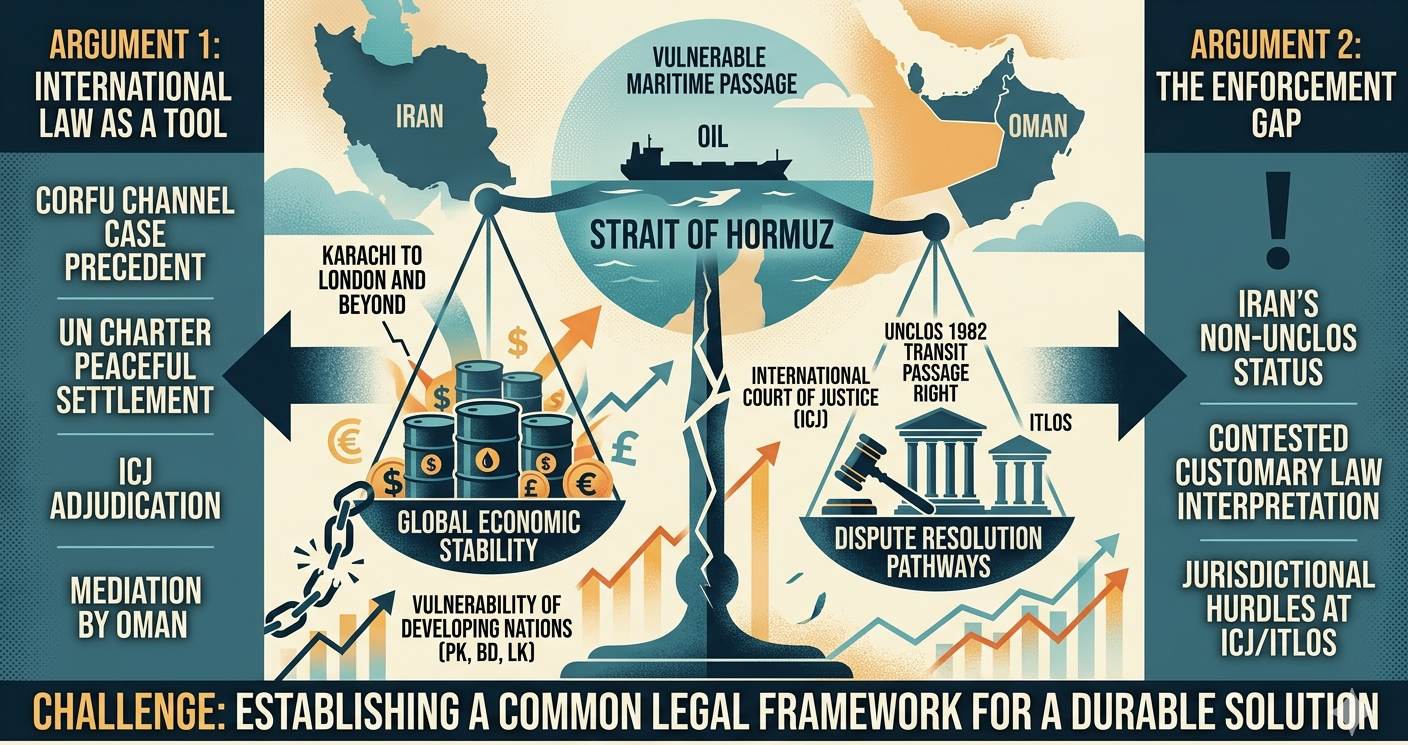
ISLAMABAD: While endorsing ongoing diplomatic efforts, young Islamabad lawyers urged US and Iranian leaders to consider international legal remedies including ICJ and ITLOS adjudication for the Strait of Hormuz dispute, warning that continued military posturing and unilateral action are pushing the world toward irreversible economic catastrophe, though dissenters flagged Iran’s non-UNCLOS status as a critically underplayed enforcement gap demanding transparency.
The Strait of Hormuz, a narrow waterway of merely 33 kilometres connecting the Persian Gulf to the Gulf of Oman, is not merely a geographic passage – it is the jugular vein of the global economy. Approximately 20 percent of the world’s total oil supply and nearly one-third of global liquefied natural gas (LNG) transits through this strait daily.
Any disruption, deliberate or otherwise, instantaneously triggers a chain reaction across global energy markets, commodity prices, transportation costs, and ultimately the household budgets of ordinary citizens from Karachi to London and from Nairobi to New York.
The world witnessed this reality painfully during previous episodes of tension in the strait. Oil prices surge. Shipping insurance premiums skyrocket. Supply chains fracture. Inflation rises. Developing nations, already struggling under the weight of debt and currency depreciation, are disproportionately devastated. Pakistan, along with dozens of other oil-importing developing economies, stands particularly vulnerable to every escalation around the Strait of Hormuz.
The question therefore is not merely one of geopolitics or military strategy. It is a question of international law, global economic survival, and the responsibility of powerful nations toward the rest of the world.
The current tensions are rooted in a fundamental disagreement between Iran and the international community over sovereign rights and freedom of navigation. Iran, sharing the northern coastline of the strait with Oman, has repeatedly threatened to close the waterway in response to Western sanctions and perceived military encirclement.
The United States, United Kingdom, and Gulf Cooperation Council (GCC) states have responded through naval deployments, maritime coalitions, and escalating economic sanctions against Iran. This cycle of action and reaction has created a persistent and dangerous deadlock that serves no party’s long-term interest and threatens devastating consequences for the global community.
What International Law Says
The primary legal framework cited by the first lawyers’ group is the United Nations Convention on the Law of the Sea (UNCLOS 1982). Articles 37 to 44 of UNCLOS establish the doctrine of transit passage, which guarantees all ships and aircraft – regardless of nationality, flag, or cargo – an uninterrupted right of navigation through internationally recognised straits. Bordering states are legally prohibited from suspending, hampering, or otherwise interfering with this right.
Proponents further argue that even under customary international law, which binds all states including non-UNCLOS parties, freedom of navigation through internationally recognised straits is a firmly established principle. The International Court of Justice (ICJ) affirmed this in the landmark Corfu Channel Case (UK v. Albania, 1949), ruling that states have no right to obstruct innocent passage through international straits in times of peace. Article 2(3) and Article 33 of the UN Charter further impose a binding obligation upon all member states to settle disputes through peaceful means including negotiation, mediation, arbitration, and judicial settlement.
The Dissenting Legal View: Iran’s Non-UNCLOS Status Cannot Be Sidelined
However, a dissenting group of young Islamabad lawyers has raised pointed objections to what they describe as an overly optimistic reading of the legal landscape. Their central concern is both straightforward and consequential – Iran has never ratified UNCLOS and does not recognise it as binding upon itself. To construct a resolution strategy primarily around a convention that the most critical party to the dispute explicitly rejects is, in their view, to build on unstable legal ground.
“Invoking UNCLOS as the primary framework without adequately addressing Iran’s non-party status is not just a legal oversight – it risks misleading policymakers and the public about how readily enforceable these remedies actually are,” a representative of the dissenting group said, adding that this gap deserves far more prominent treatment in any serious legal analysis of the crisis.
The dissenting group acknowledges that customary international law offers a parallel basis for freedom of navigation claims but argues that even this route is contested. Iran has historically maintained its interpretation of transit rights through the strait, asserting greater coastal state authority than UNCLOS permits.
Without Iran’s acceptance of the invoked legal framework, any ICJ or ITLOS proceeding faces immediate jurisdictional hurdles that could delay or entirely obstruct meaningful resolution. The ITLOS provisional measures route similarly depends on establishing a jurisdictional link that becomes considerably harder to sustain when the respondent state does not accept the underlying treaty framework.
Available Legal Remedies – and Their Limits
Despite these reservations, both groups broadly agree that legal and diplomatic channels must be exhausted before any other option is considered. The first group advocates strongly for ICJ adjudication, ITLOS provisional measures, a UN Security Council resolution under Chapters VI and VII of the UN Charter, and engagement through the International Maritime Organization (IMO) to adopt emergency measures protecting vessel safety and establishing communication protocols between Iran and international shipping interests.
Oman, maintaining constructive diplomatic relations with both Iran and Western states, is identified as uniquely positioned to serve as a trusted mediator. Switzerland and Qatar are equally highlighted as credible facilitators of back-channel negotiations and confidence-building measures pending formal legal resolution.
The dissenting group does not oppose these avenues but insists they must be pursued with clear-eyed realism about their limitations. Any durable resolution, they argue, must involve direct negotiation with Iran on terms Iran finds legitimate – meaning genuine engagement on sanctions relief, security guarantees, and recognition of its coastal state interests alongside navigation rights.
The Human and Economic Cost of Inaction
Both groups are united on the human cost of continued inaction. When oil prices rise due to Hormuz tensions, fuel costs climb. When fuel costs climb, food prices follow. Nations such as Pakistan, Bangladesh, Sri Lanka, and Kenya – already navigating debt crises, currency depreciation, and post-pandemic economic stress – bear the sharpest consequences. Foreign exchange reserves deplete. Governments are forced into austerity. Millions of working families lose purchasing power.
These are not abstract geopolitical stakes. They are lived economic realities that demand urgent, legally grounded, and diplomatically honest leadership from all parties.
A Call for Responsible and Realistic Leadership
Both groups urged the leadership of the United States and Iran to recognise that their responsibilities extend far beyond their bilateral rivalry. Iran was urged to engage constructively with international legal institutions and present its legitimate grievances through proper legal channels.
The United States and allied states were equally urged to champion multilateral legal processes while genuinely addressing Iran’s legitimate security concerns alongside their own navigation rights.
Where the two groups part ways is on expectations. The first sees international law as a clear and immediately available roadmap. The second sees it as a necessary but incomplete tool — one that can only succeed if inconvenient legal realities, including Iran’s rejection of UNCLOS, are acknowledged honestly and addressed directly at the negotiating table.
The rule of law must ultimately prevail over the law of force. But as the dissenting lawyers caution, the rule of law is only as strong as the willingness of all parties to accept its jurisdiction — and that willingness, in this case, remains very much in question. History will judge today’s leaders not by the warships they deployed but by the legal wisdom and moral courage they demonstrated in choosing law over conflict.