

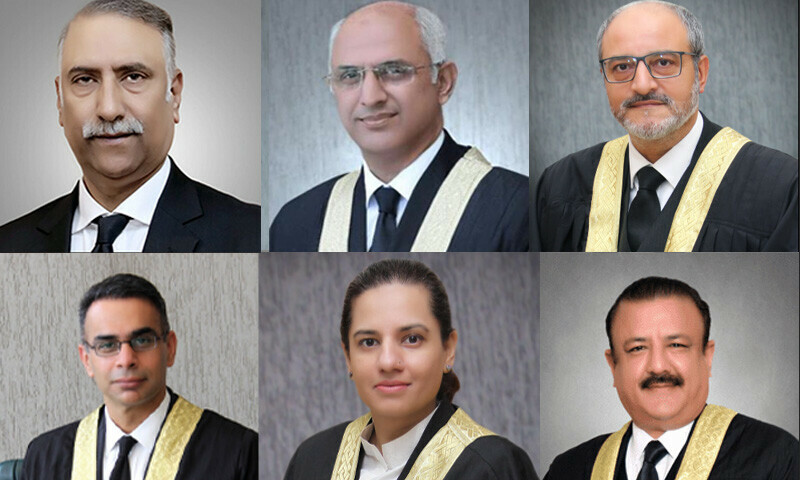
Invoking jurisdiction of the apex court on Thursday as many as five sitting judges of the Islamabad High Court sought justice with a stay order plea to restrain incumbent Acting Chief Justice of the High Court Justice Sardar Mohammad Sarfraz Dogar from carrying out duties as the acting IHC Chief Justice.
It has been largely reported that development is the latest in the row affecting the IHC after the transfers of new judges to the high court that led to a shakeup of the seniority list. The matter arose after the Ministry of Law and Justice issued a notification on February 01, transferring three sitting judges — Justice Dogar, Justice Khadim Hussain Soomro and Justice Muhammad Asif from their respective high courts to the IHC.
Justice Dogar was transferred from the Lahore High Court (LHC), Justice Soomro from the Sindh High Court (SHC) and Justice Asif from the Balochistan High Court (BHC). The controversy centred around the alteration of the seniority list following these transfers.
Five IHC judges including Justice Mohsin Akhtar Kayani, Justice Tariq Mehmood Jahangiri, Justice Babar Sattar, Justice Sardar Ejaz Ishaq Khan and Justice Saman Rafat Imtiaz had filed a representation, contending that under the Constitution, a high court judge must take a new oath upon transfer to a different high court, which should affect their seniority ranking.
It has been reported that the five judges also did not attend Justice Dogar’s oath taking ceremony as the acting IHC Chief Justice. The five judges filed a petition in the Supreme Court today under Article 184(3) of the Constitution and mentioned the president, Federation of Pakistan through the law secretary, secretary of the Judicial Commission of Pakistan (JCP), the registrars of the SC and four high courts, Justice Dogar, Justice Soomro and Justice Asif as respondents.
Article 184(3) of the Constitution sets out the SC’s original jurisdiction and enables it to assume jurisdiction in matters involving a question of “public importance” with reference to the “enforcement of any of the fundamental rights” of Pakistan’s citizens.
Seeking stay order in the matter, the petitioners requested the top court to restrain Justice Dogar from performing functions as the acting IHC Chief Justice – also restrain the other transferred judges from performing any of their judicial and administrative functions as IHC judges.
The judges also urged the apex court to declare that the president did not have the “unfettered and unbridled discretion” to transfer judges from one high court to another under Article 200(1) of the Constitution without a manifest public interest, and in a manner that “hampers the principles of independence of judiciary and separation of powers”. They further urged the Supreme Court to declare that the president’s exercise of powers under Article 200(1) was to be read alongside Article 175A, without subsuming the powers of the JCP to appoint judges to a particular high court.
The judges further requested the top court to declare that the transfer notification for the new judges as “unconstitutional and illegal for not being able to disclose any public interest terming it liable to be set aside”.
The petitioner also said that the transferred judges could not be considered the IHC justices until they took oaths pursuant to Article 194 read together with the Third Schedule of the Constitution.
They also requested the top court to declare that the seniority of the transferred judges would be determined from the date they take oath as IHC justices and would consequently be lower in the seniority list to the petitioners, along with orders to the IHC registrar to issue a new seniority list in line with the SC’s declarations.
The petitioner also urged the apex court to declare that the decision by the former IHC Chief Justice on the representation of the five judges was “illegal, unconstitutional and in violation of the settled law pronounced by this court” and thus liable to be set aside.
The five judges also requested the Supreme Court to declare that the JCP had “wrongfully considered a defective list of judges of the IHC” in its meeting held on February 10 by wrongfully considering Justice Dogar for elevation to the apex court, to declare that the notification for Justice Dogar as the acting IHC Chief Justice was contrary to the law and to set it aside and lastly, to declare that the reconstitution of the IHC’s Administration Committee and Departmental Promotion Committee was “contrary to law, established conventions and common sense” and to set it aside.