

Categories Courts

PA Speaker Clamps Down: suspends reserved seat MPs’ membership after SC ruling 

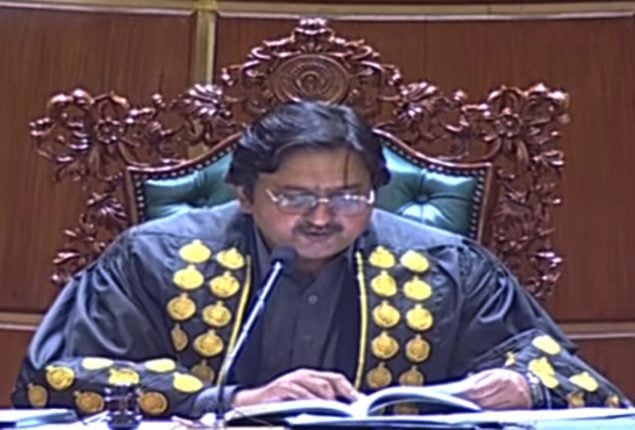
Days after the top court suspended Peshawar High Court decision denying Sunni Ittehad Council reserved seats for women and minorities, Punjab Assembly Speaker Malik Ahmad Khan suspended membership of 27 MPAs of ruling coalition who were elected on reserved seats in the provincial Assembly.

The move follows a decision by a three-member bench of the Supreme Court, which suspended a previous order by the Peshawar High Court (PHC) regarding the allocation of additional reserved seats to various political parties in national and provincial legislatures earlier this week in response to plea of Sunni Ittehad Council (SIC).

The development came as a three-member bench – headed by Justice Mansoor Ali Shah and including Justice Muhammad Ali Mazhar and Justice Athar Minallah – took up an SIC appeal against the PHC order. The Supreme Court on Monday took up a petition filed by the SIC- the new home for PTI lawmakers-elect – against the denial of reserved seats for women and minorities.

During the Punjab Assembly session on Thursday, Malik Aftab, a member of the Sunni Ittehad Council (SIC), which mainly consists of Pakistan Tehreek-e-Insaf (PTI) members, raised objections and read out the Supreme Court’s decision regarding the members elected on reserved seats.

Speaker Malik Ahmad Khan validated the opposition member’s point of order and ordered the suspension of the membership of the nominated members on the reserved seats of the ruling alliance immediately.

Members of the Sunni Ittehad Council lauded the speaker’s decision by thumping the table. Following the speaker’s ruling, 24 women’s seats and three minorities’ seats became vacant in the Punjab Assembly, resulting in the ruling coalition’s membership decreasing to 200. Meanwhile, the Sunni Ittehad Council holds 106 seats, and the PPP has become the third-largest party with 15 seats.

In addition to the aforementioned parties, the PML-Q has 11 seats, the Istehkam-e-Pakistan Party (IPP) has 7 seats, while the PML-Z, Majlis-e-Wahdatul Muslimeen (MWM), and Tehreek-e-Labaik Pakistan (TLP) each hold one seat in the Punjab Assembly.

Among those suspended from reserved minority seats are Tariq Masih Gul, Waseem Anjum, and Basruji. This development stems from a previous decision by the Election Commission of Pakistan (ECP) on December 22, 2023, which stripped the PTI of its election symbol due to irregularities in its intra-party elections. The Supreme Court later upheld the ECP’s order, leading the party to field its candidates as independents in the February 8 general elections.

Subsequently, independent candidates supported by the PTI joined the SIC and applied to the ECP for allocation of seats reserved for women and minorities in the national and provincial legislatures.

However, on March 4, the ECP dismissed the request, citing the SIC’s failure to submit a priority list of candidates for reserved seats prior to the polls. The SIC challenged the order in the PHC, which on March 14 upheld the ECP’s decision. The SIC later appealed to the Supreme Court, which suspended the PHC ruling in favour of PTI.



Author

Shirin Ebadi,Kiana Rahman, Ali, Oslo, Editor, Kurdish woman Mahsa Jina Amini, Human Rights Activist Narges Mohammadi, Nobel Prize Committee, Woman, Life, Freedom, Nobel Peace Prize Award 2023

Ashi Asif is an Advocate of the High Court and has been associated with TLTP News Wire Service as a correspondent since 2020. She has covered major international events, including the Nobel Peace Prize Ceremony in Norway in 2022, and continues her global journalistic engagement with coverage of the Nobel Peace Prize Ceremony 2025 in Oslo. She can be reached at ashi@lawtoday.com.pk

More From Author

Leave a Reply

Your email address will not be published. Required fields are marked *

You May Also Like

FCC Super Tax verdict, Federal Constitutional Court Pakistan, Super Tax on high earners, Parliament taxing powers Pakistan, Section 4C Income Tax Ordinance, Super Tax legality Pakistan, Chief Justice Amin-ud-Din Khan, income tax law Pakistan, high income earners tax, oil and gas sector Super Tax, tax exemptions Pakistan, mudarabah Super Tax exemption, mutual funds tax exemption, unit trust funds Pakistan, retrospective taxation Pakistan, double taxation challenge, Supreme Court Super Tax case, High Courts Super Tax ruling, constitutional amendments Pakistan, 26th Constitutional Amendment, 27th Constitutional Amendment, revenue generation Pakistan, Rs310 billion revenue, Pakistan tax litigation, business community tax challenge, banks Super Tax Pakistan, corporate taxation Pakistan, federal budget Super Tax, economic stabilisation measures Pakistan, Operation Zarb-e-Azb levy, internally displaced persons fund, tax policy Pakistan, constitutional bench Pakistan, Khudayar Mohla

FCC Validates Parliament’s Legislative Competence To Levy Super Tax

ISLAMABAD: While dismissing all pleas challenging legality of the Super Tax on high-income earners, the…

Khudayar Mohla, Islamabad High Court, IHC, Islamabad Local Government elections, local government election petitions, Election Commission of Pakistan, ECP, presidential ordinance, Islamabad Capital Territory, ICT local government, Jamaat-e-Islami, JI, Mohammad Nasrullah Randhawa, Advocate Chaudhry Shoaib Ahmed, local bodies term, constitutional obligation, local government election delay, Islamabad LG polls, ICt Local Government Amendment Ordinance 2026, President Asif Ali Zardari, Articles 17, 32, 89, 140-A, election schedule withdrawal, court adjournment, bench unavailability, deferred hearing, joint petitions, Markazi Muslim League

IHC Adjourns Islamabad LG Election Pleas After Court Roster Cancelled

ISLAMABAD:  A scheduled hearing for the Islamabad Local Government (LG) election petitions was deferred Tuesday…

Khudayar Mohla, Section 4-C, Super Tax Pakistan, Income Tax Ordinance 2001, ITO 2001, Finance Act 2022–23, high-income taxpayers, Federal Board of Revenue, FBR Pakistan, Federal Constitutional Court, FCC Pakistan, government appeals, Hafiz Ahsaan Ahmad Khokhar, constitutional validity, judicial review Pakistan, taxation authority, double taxation, retrospective tax, separation of powers, Pakistan tax law, federal revenue

Levy of Super Tax Within Parliament’s Exclusive Taxing Power, Govt Lawyers Argue Before FCC

ISLAMABAD: A three-member bench of the Chief Justice Federal Constitutional Court Justice Amin-ud-Din Khan is…