


Categories Courts

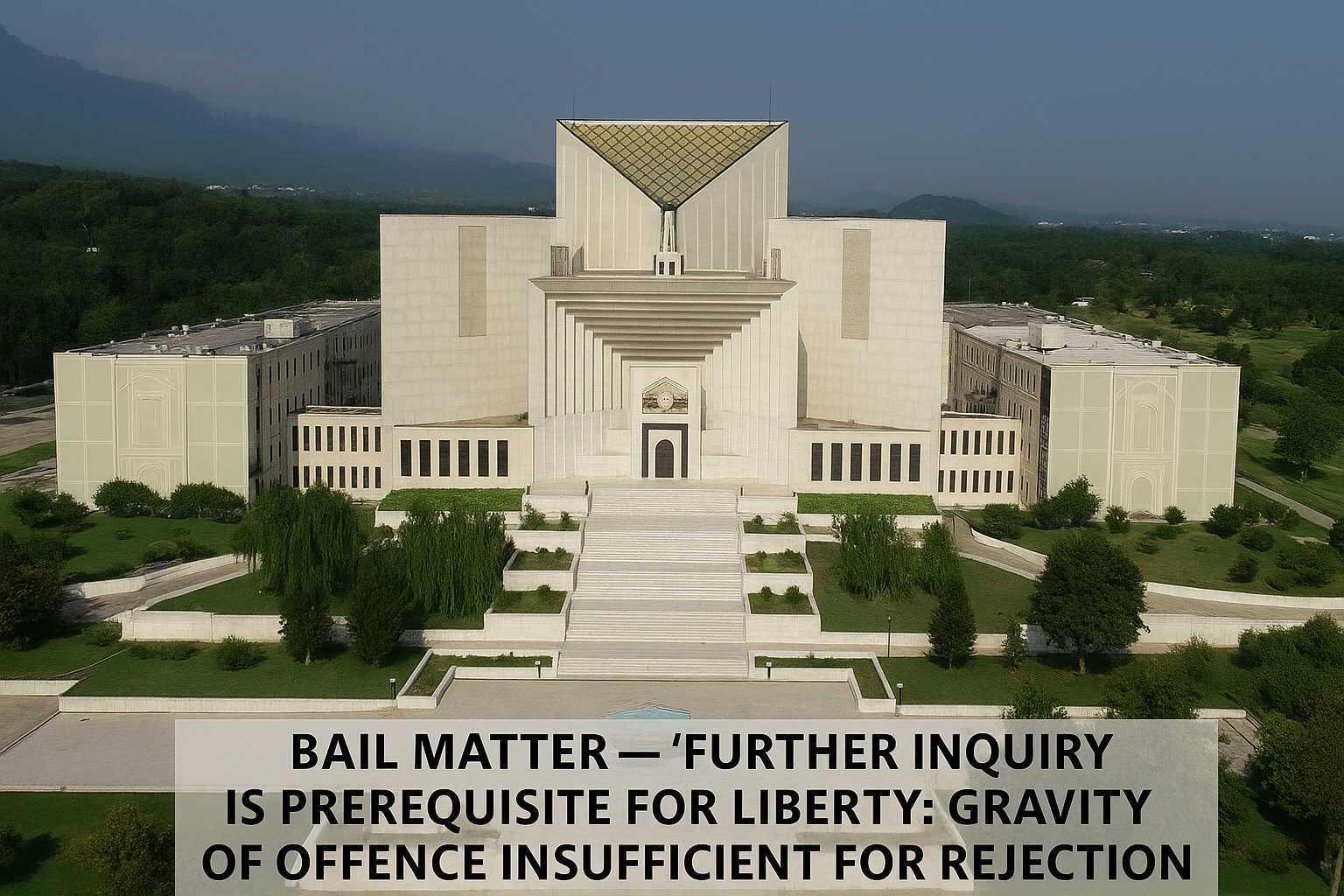
SC Affirms Post Arrest Bail Standard: ‘Further Inquiry’ is Prerequisite for Liberty; Gravity of Offence Insufficient for Rejection

ISLAMABAD – While reinforcing fundamental principles of criminal jurisprudence, the Supreme Court has accepted post-arrest bail in a matter and ruled where a tentative assessment of the evidence indicates the prosecution’s case requires further inquiry, the benefit of bail may not be withheld as a punishment to the accused.

A three-member bench comprising Justice Muhammad Ali Mazhar, Justice Syed Hasan Azhar Rizvi, and Justice Aqeel Ahmed Abbasi announced the decision which establishes a crucial safeguard against the unnecessary curtailment of an individual’s liberty when the evidence supporting the charge remains questionable or requires deeper investigation.

The petition stemmed from a criminal case involving the recovery of a large quantity of Clonazepam tablets concealed within a container designated for export. The petitioner, who was arrested near the container, was introduced as an employee of the exporting pharmaceutical company. He sought post-arrest bail, arguing that he was neither the exporter, shipper, nor financier, and lacked conscious knowledge of the illicit consignment. The petitioner also highlighted that key co-accused, including the exporter and directors of the company, had already been granted bail or were not arrested.

In its analysis, the Supreme Court unequivocally set out the following standards for granting bail under Section 497 of the Criminal Procedure Code (Cr.P.C.):

Firstly, the Court clarified the standard for “further inquiry,” holding that where a tentative assessment reveals a reasonable ground to believe that the prosecution’s case requires deeper investigation, the benefit of bail should not be withheld as a punishment to the accused. The Court noted that the doctrine of “further inquiry” involves a notional and exploratory assessment that may create doubt regarding the accused’s precise involvement in the crime.

Secondly, the bench strongly affirmed the rule of consistency or doctrine of parity in bail matters. This principle mandates that where the incriminated role ascribed to an accused is the same as that of a co-accused, the benefit extended to one should be extended to the other, embodying the principle that “like cases should be treated alike” after a careful evaluation of the co-offender’s role.

Finally, the Court addressed the role of the charge’s severity, holding that while considering applications for enlargement on bail, the atrociousness, viciousness, and/or gravity of the offence are not, by themselves, sufficient grounds for the rejection of bail. This is particularly true when the nature of the evidence produced in support of the indictment creates some doubt as to the veracity of the prosecution’s case against the petitioner.

In conclusion, the ruling reinforces the core constitutional right to liberty, stipulating that bail should be granted if the facts require further inquiry, if a co-accused with a similar role has been released, and that the gravity of the offence cannot be the sole basis for denying the relief when the evidence is dubious.

Author

Khudayar Mohla, Managing Partner Mohla & Mohla, Founder of the Law Today Pakistan,

Managing Partner at Mohla & Mohla - Advocates and Legal Consultants, Islamabad, Founder of The Law Today Pakistan (TLTP) Newswire Service. Former President Press Association of Supreme Court of Pakistan with over two decades of coverage of defining judicial moments - including the dissolution and restoration of Chief Justice Iftikhar Muhammad Chaudhry, Asif Ali Zardari NAB cases, Syed Yousaf Raza Gillani contempt proceedings, Panama Papers case against Mian Nawaz Sharif, matters involving Imran Khan, and the high treason trial of former Army Chief and President Pervez Musharraf. He now practises law and teaches Jurisprudence, International Law, and Civil and Criminal Law. Contact: mohla@lawtoday.com.pk

More From Author

Leave a Reply

Your email address will not be published. Required fields are marked *

You May Also Like

Judicial Commission of Pakistan, JCP, Justice Miangul Hassan Aurangzeb, Supreme Court, permanent judge, majority decision, Justice Zafar Ahmed Rajput, Sindh High Court Chief Justice, Justice Kamran Mullahkhail, Balochistan High Court Chief Justice, superior judiciary appointments, 27th Amendment, Federal Constitutional Court, FCC, Justice Munib Akhtar opposition, Justice Mohsin Akhtar Kayani, Swat royal family, Miangul Jahan Zeb, last Wāli of Swat, Miangul Aurangzeb, Governor, legal education, University of Wales, Lincoln's Inn, SJC rules committee, Justice Jamal Mandokhail, institutional reforms, JCP rules panel, constitutional bodies, judicial accountability,Khudayar Mohla

JCP Votes to Elevate Justice Miangul Hassan Aurangzeb as Permanent SC Judge

ISLAMABAD – The Judicial Commission of Pakistan (JCP), apex body responsible for appointing justices to…

Judge With Command Over Law and Facts Is ‘Never Under Stress’, Says LHC’s Justice Jawad Hassan

LAHORE – While underscoring dire need for civil courts to examine and decide the maintainability…

Punjab Judicial Academy, Justice Aalia Neelum, Lahore High Court, PJA Board Meeting, first female Chairperson PJA, judicial training Punjab, judicial reforms Pakistan, Punjab Judicial Academy Act 2007, Section 4 PJA Act, judicial officers training, court personnel training, court management training, case management Punjab, delay reduction techniques, alternate dispute resolution training, judgment writing training, judicial administration Punjab, legal education Pakistan, Sardar Ahmed Naeem, Justice Sajid Mehmood Sethi, Justice Jawad Hassan, Amjad Iqbal Ranjha, Lahore news, judicial capacity building, Federal Judicial Academy collaboration, legal research Punjab, judicial ethics training, law and development Punjab, legislative drafting training, PJA conferences seminars workshops.

Chief Justice LHC Justice Miss Aalia Neelum Chairs PJA Board Meeting, Marks Historic First for Academy

LAHORE – Days ago the Punjab Judicial Academy marked a significant milestone when Chief Justice…