

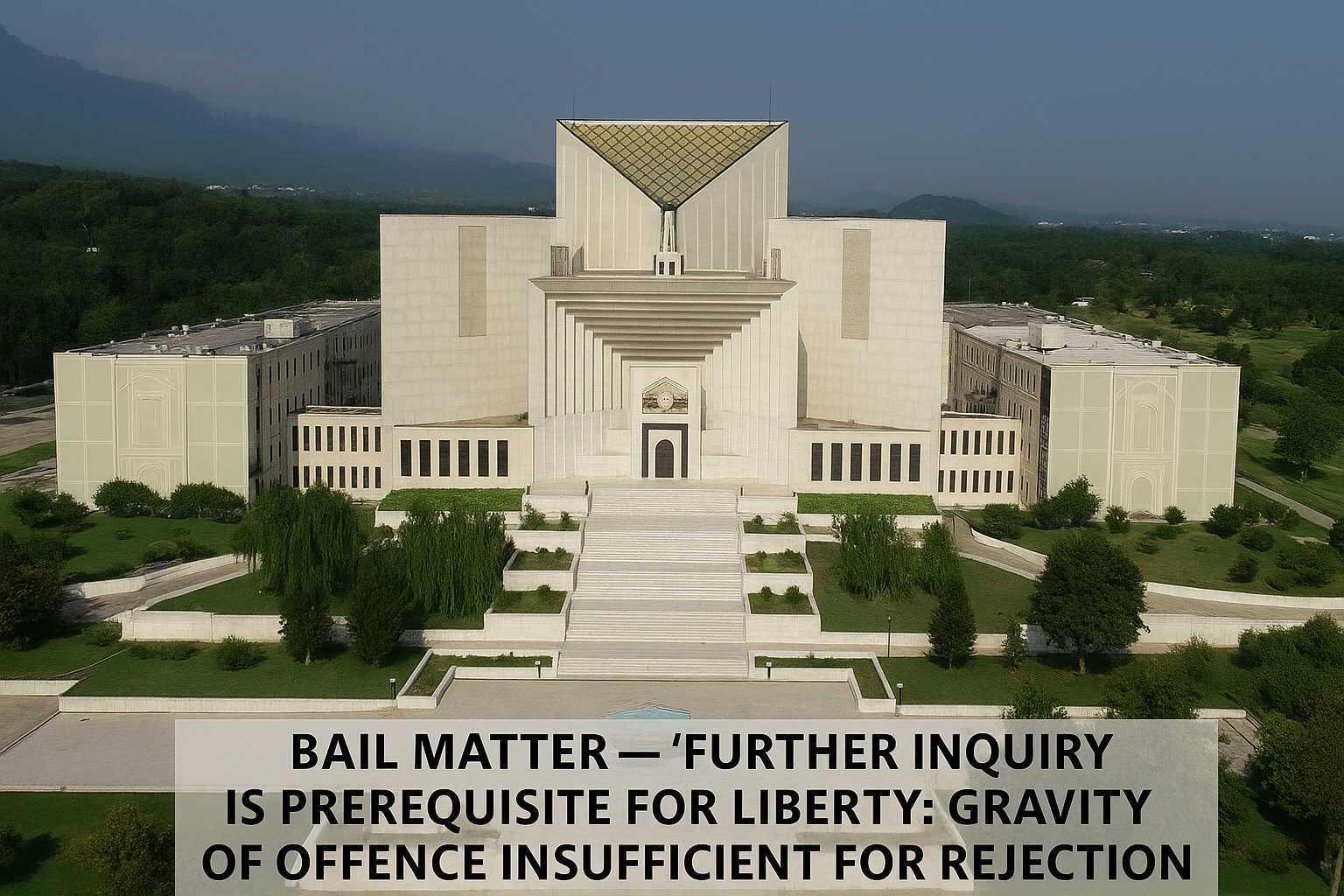
ISLAMABAD – While reinforcing fundamental principles of criminal jurisprudence, the Supreme Court has accepted post-arrest bail in a matter and ruled where a tentative assessment of the evidence indicates the prosecution’s case requires further inquiry, the benefit of bail may not be withheld as a punishment to the accused.
A three-member bench comprising Justice Muhammad Ali Mazhar, Justice Syed Hasan Azhar Rizvi, and Justice Aqeel Ahmed Abbasi announced the decision which establishes a crucial safeguard against the unnecessary curtailment of an individual’s liberty when the evidence supporting the charge remains questionable or requires deeper investigation.
The petition stemmed from a criminal case involving the recovery of a large quantity of Clonazepam tablets concealed within a container designated for export. The petitioner, who was arrested near the container, was introduced as an employee of the exporting pharmaceutical company. He sought post-arrest bail, arguing that he was neither the exporter, shipper, nor financier, and lacked conscious knowledge of the illicit consignment. The petitioner also highlighted that key co-accused, including the exporter and directors of the company, had already been granted bail or were not arrested.
In its analysis, the Supreme Court unequivocally set out the following standards for granting bail under Section 497 of the Criminal Procedure Code (Cr.P.C.):
Firstly, the Court clarified the standard for “further inquiry,” holding that where a tentative assessment reveals a reasonable ground to believe that the prosecution’s case requires deeper investigation, the benefit of bail should not be withheld as a punishment to the accused. The Court noted that the doctrine of “further inquiry” involves a notional and exploratory assessment that may create doubt regarding the accused’s precise involvement in the crime.
Secondly, the bench strongly affirmed the rule of consistency or doctrine of parity in bail matters. This principle mandates that where the incriminated role ascribed to an accused is the same as that of a co-accused, the benefit extended to one should be extended to the other, embodying the principle that “like cases should be treated alike” after a careful evaluation of the co-offender’s role.
Finally, the Court addressed the role of the charge’s severity, holding that while considering applications for enlargement on bail, the atrociousness, viciousness, and/or gravity of the offence are not, by themselves, sufficient grounds for the rejection of bail. This is particularly true when the nature of the evidence produced in support of the indictment creates some doubt as to the veracity of the prosecution’s case against the petitioner.
In conclusion, the ruling reinforces the core constitutional right to liberty, stipulating that bail should be granted if the facts require further inquiry, if a co-accused with a similar role has been released, and that the gravity of the offence cannot be the sole basis for denying the relief when the evidence is dubious.