

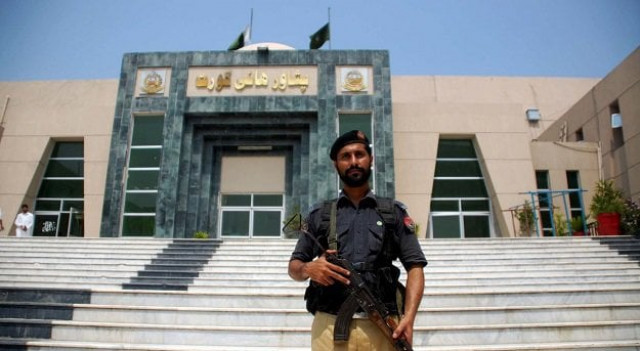
PESHAWAR: While hearing a civil revision petition in a matter relating to prolonged daily load shedding in a vicinity of Kohat district, the Peshawar High Court (PHC) has held that civil courts have no legal authority to intervene in matters about electricity load shedding or the administrative policies of the Peshawar Electric Supply Company (PESCO).
Residents of Jangal Khel vicinity in Kohat invoked the revision jurisdiction of the PHC, challenging what they described as prolonged and discriminatory daily load shedding, allegedly stretching up to 18 hours. The petitioners contended that such excessive and unequal power outages were not only a source of immense hardship for the local population but also a direct violation of their fundamental rights guaranteed under the Constitution of Pakistan.
The residents argued that civil courts were competent to hear such cases under Section 9 of the Code of Civil Procedure (CPC), maintaining that the provision of basic utilities, including electricity, is a fundamental state responsibility. They further contended that arbitrary and discriminatory power outages infringe upon citizens’ constitutional rights, thereby warranting judicial intervention by civil courts.
However, a single-member bench comprising Justice Waqar Ahmad ruled against the petitioners, holding that the National Electric Power Regulatory Authority (NEPRA) Act grants exclusive jurisdiction to the Authority over all such disputes. In its detailed verdict, the bench highlighted Section 45 of the NEPRA Act, which gives its provisions an overriding effect over all other conflicting laws. The court further noted that the law already provides dedicated and accessible forums for electricity consumers to lodge complaints and seek timely redressal of their grievances, making recourse to civil courts legally untenable.
It is pertinent to mention that the lower courts, including both the civil court and district court in Kohat, had already dismissed the original suit on the grounds of lack of jurisdiction and absence of merit, a position now firmly upheld by the high court.
Representing PESCO in the proceedings, Barrister Asadul Mulk raised a legal objection, asserting that all matters concerning electricity generation, transmission, and distribution fall exclusively under the domain of NEPRA. Established under the NEPRA Act 1997, NEPRA functions as an independent regulatory body vested with special statutory powers to handle consumer complaints and regulatory matters across the power sector.
Citing various Supreme Court precedents, the PHC reaffirmed the well-established principle of special jurisdiction, whereby when a statute designates a specific forum or regulatory body for particular matters, ordinary civil courts are expressly barred from interfering in such proceedings.
The court emphasised that decisions regarding load shedding schedules, power distribution policies, and PESCO’s administrative functions are inherently technical and regulatory in nature, lying solely within NEPRA’s exclusive purview. The judgment serves as a significant legal reminder that aggrieved electricity consumers must seek relief through the proper regulatory channels rather than approaching civil courts, which lack the requisite jurisdiction to adjudicate such specialised matters.