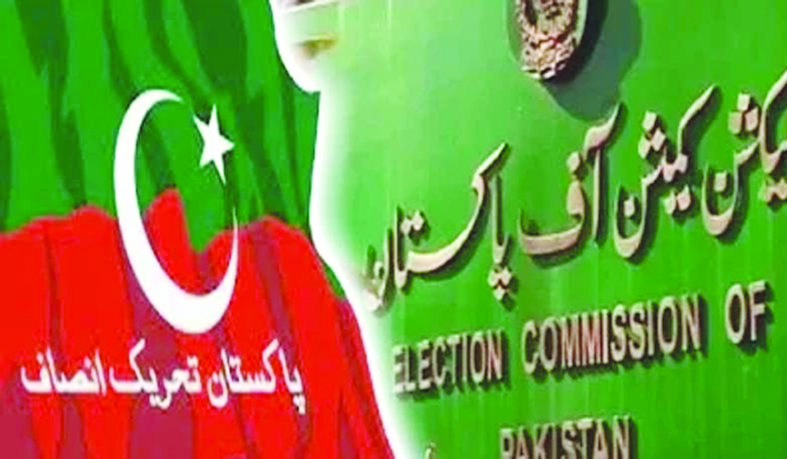

For the success and growth of democracy, free and fair elections are a sine qua non. The progress of democracy is endangered when the political parties are ousted from participating in the electoral exercise and the citizens are deprived of exercising their fundamental right to elect representatives of their choice to Parliament.
The Constitution of Pakistan 1973 has ensured that every citizen in Pakistan has the right to form or be a member of a political party subject to reasonable restrictions imposed by law in the interest of sovereignty or integrity of Pakistan. However, the citizens’ right to vote for a political party of their choice has suffered a major setback with the controversial ruling of the Supreme Court of Pakistan which has deprived the PTI, the most popular political party in the country, of its election symbol on technical and flimsy grounds.
The ruling of the Supreme Court will have disastrous consequences for beleaguered democracy in Pakistan. It has made the general elections due on February 8 controversial as the most popular political party has been knocked out of the electoral race. Such a decision has the potential of affecting the future of the country as it is the fundamental principle of jurisprudence that the courts while interpreting the constitutional and law provisions cannot ignore the political consequences of their decisions.
The Election Commission of Pakistan, being an impartial and neutral body to organize and conduct free and fair elections in the country, has also lost its credibility by continuously targeting and discriminating against the PTI and its leadership. Both the Supreme Court and the ECP have caused severe damage to the democratic process through their fallible, fanciful and controversial decisions. The contention of the ECP, upheld by the three-judge bench of the Supreme Court, that the PTI has failed to hold intra party elections in accordance with the party’s own constitution involved a question of fact as well as law which could have been decided by a court of law after appraising the evidence.
Neither the Constitution nor the Election Act, 2017 contain any explicit provision which gives the ECP power to deny a political party its election symbol on the bases of contested intra-party elections, but the Supreme Court has affixed its stamp on the illegal decision of the ECP without quoting any provision of the law.
It is pertinent to mention here that the ECP has specifically placed reliance on sections 208, 209 and 215 of the Election Act, 2017. Under section 208, if the political party fails to conduct intra party elections within stipulated time period of the constitution, the ECP can only impose fine on that party to the tune of Rs 20,000 and it does not confer any jurisdiction on the electoral watchdog to probe into the irregularities of the party election. Similarly, section 209 makes it incumbent on the political party to submit a certificate signed by its office bearers authorized by the party head, within seven days from the completion of the intra-party election to the ECP to the effect that the elections were held in accordance with the constitution of the political party and the Act. Section 215 contains a non- obstante clause which reads as follows:
(1) “Notwithstanding anything contained in another law, a political party enlisted under this Act shall be eligible to obtain an election symbol for contesting elections for Majlis-e-Shoora (Parliament), Provincial Assemblies or local government on submission of certificates and statements referred to in sections 202, 206, 209 and 210.
“(2) A combination of enlisted political parties shall be entitled to obtain one election symbol for an election only if each party constituting such combination submits the certificates and statements referred to in sections 202, 206, 209 and 210.
“(3) An election symbol already allocated to a political party shall not be allocated to any other political party or combination of political parties.
“(4) Where a political party or combination of political parties, severally or collectively, fails to comply with the provision of section 209 or section 210, the Commission shall issue to such political party or parties a notice to show cause as to why it or they may not be declared ineligible to obtain an election symbol.
“(5) If a political party or parties to whom show cause notice has been issued under sub-section fail to comply with the provision of section 209 or section 210, the Commission may after affording it or them an opportunity of being heard, declare it or them ineligible to obtain an election symbol for election to Majlis-e-Shoora (Parliament), Provincial Assembly or a local government, and the Commission shall not allocate an election symbol to such political party or combination of political parties in subsequent elections.”
The Supreme Court through its controversial ruling has deprived millions of voters of their constitutional right to vote for the political party of their choice. Like many controversial rulings in the past, this decision will also haunt the judiciary.
From plain reading of the above section it becomes crystal clear that the ECP power to declare a political party ineligible to obtain an election symbol will come into play if it fails to hold elections. In the case of PTI, an election certificate duly signed by office bearers authorized by Chairman Barrister Gohar Ali Khan was filed with the ECP, which was bound to allot PTI its election symbol but the electoral body has transgressed its mandate by denying the party its symbol.
The question whether the intra party elections were held in accordance with the constitution cannot be decided by the ECP for being not a court of law. The Supreme Court in Sardar Bahadar Khan Bangulzai case has held that “where the question relates to inbuilt organizational structure disputes of the political party involved, in that event the Election Commissioner may ask the parties to get the question resolved through civil proceedings”.
The Supreme Court through its controversial ruling has deprived millions of voters of their constitutional right to vote for the political party of their choice. Like many controversial rulings in the past, this decision will also haunt the judiciary.
—-
The writer is a legal practitioner and columnist. He holds an LLM in constitutional law and can be reached at mianrauf2171@gmail.com




Your article helped me a lot, is there any more related content? Thanks!