
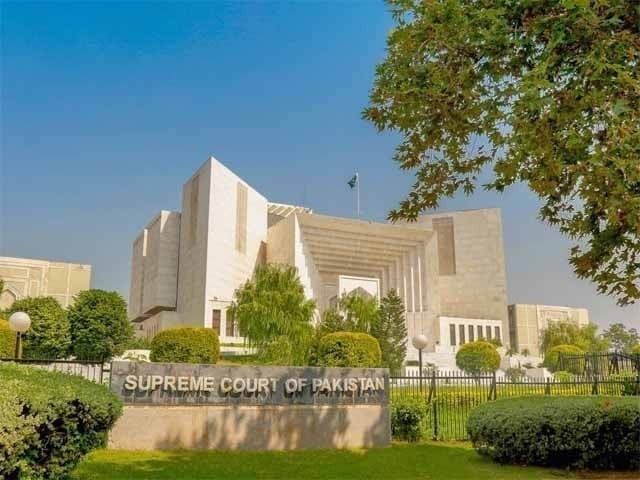
While hearing plea of Sunni Ittehad Council seeking dismissal of electoral watchdog decision relating to the reserved seats for women and minorities allocation in Parliament, top court’ Justice Athar Minallah observed Election Commission of Pakistan (ECP) has wrongly interpreted the Supreme Court verdict on PTI’s intra-party polls saying it is not duty of court to rectify felony committed by the Commission.
During a full court hearing of the reserved seats case, the SC judge said if it is not an endorsement of the mistake when it is not corrected. He said that if the Supreme Court avoids rectifying its mistake, won’t it be reviving the doctrine of necessity.
One of the full court member Justice Mansoor Ali Shah observed that the court cannot shut its eyes when it moves to absolute justice. As many as 84 candidates received votes for their association with the PTI, said the judge, adding, “Should we be blindfolded?”
Justice Munib Akhtar remarked that political parties are the bedrock of parliamentary democracy, adding huge number of independent candidates returned as MNAs after the Feb 8 vote. He held the ECP’s mistake responsible for such a situation. He observed that the ECP interpreted the SC verdict wrongly which led to the problem. He added that things should be corrected if alternatives are available.
Justice Ayesha Malik also remarked that the entire mess was created due to the wrong interpretation of the SC verdict by the ECP.
Delivering arguments during hearing on Tuesday, Attorney General for Pakistan (AGP) submitted the parliamentary party of every political party, which wins seats, receives reserved seats. He informed that the parliamentary party comes into being after the process of oath-taking by the elected members of the house. He argued that SIC was not a parliamentary party nor could it get reserved seats.
Responding to the court query, the AGP submitted saying if the SIC members win the by-polls they could form the parliamentary party but the independents could not join the SIC parliamentary party. He argued that the reserved seats could not remain vacant and he presented the details of reserved seats in the previous elections.
The AGP explained that as per the Constitution, only political parties could secure the reserved seats, not independents. He added that political parties would also be eligible for reserved seats if they win at least a single seat. He cited the examples of various court verdicts, saying that the SC could invoke its authority when the matter is under-trial in the court.
The top court is hearing the appeal against the PHC verdict and the court has to decide the appeal. “Article 187 can only be applied on cases which are under-trial. By applying Article 187, no new proceedings could be started,” said the AGP.
Justice Mansoor Ali Shah pointed out it is not a land dispute case that the court would limit to the appeal.
Chief Justice Qazi Faez Isa remarked everyone needs justice, adding one can be in favour of capital punishment and the other can be against it but the true justice is commensurate with the law and the Constitution. “Here, the justifications for ratifying martial laws were given. When there was a need to hang the Constitution, other avenues were open,” said the CJP, adding, it is called the doctrine of necessity.
Justice Athar Minallah remarked, “Shall we overlook the visible deviation from the Constitution.” Justice Mansoor Ali Shah said the case is the first of its kind. The matter of independents never came in the court in the past, said the judge, adding the tally of independent candidates is high this time.
Justice Munib Akhter observed if it is not a contradiction on the part of the ECP as the electoral watchdog was not accepting SIC as a political party in the first place while it issued a notification of its parliamentary party.
The Chief Justice inquired as to what the status of this notification is. Justice Mandokhel inquired from the AGP under what law the ECP issued the notification.
Justice Munib Akhter remarked it is being said the ECP is the Constitutional institution and has an authority to take decisions on its own. On the other hand it is said that there is no status of ECP’s notification.
Concluding his arguments, the AGP submitted if the matter of ECP’s denial to independents from joining the PTI had come into the court, the matter could have been considered. However, the matter of independents’ joining the PTI is not being heard at the moment.
Later, the court adjourned the hearing of the case till next Tuesday with consensus of all parties of the case.