

Categories Courts

FCC Reserves Verdict on Govt Appeal Challenging LHC Directives on India Import Ban

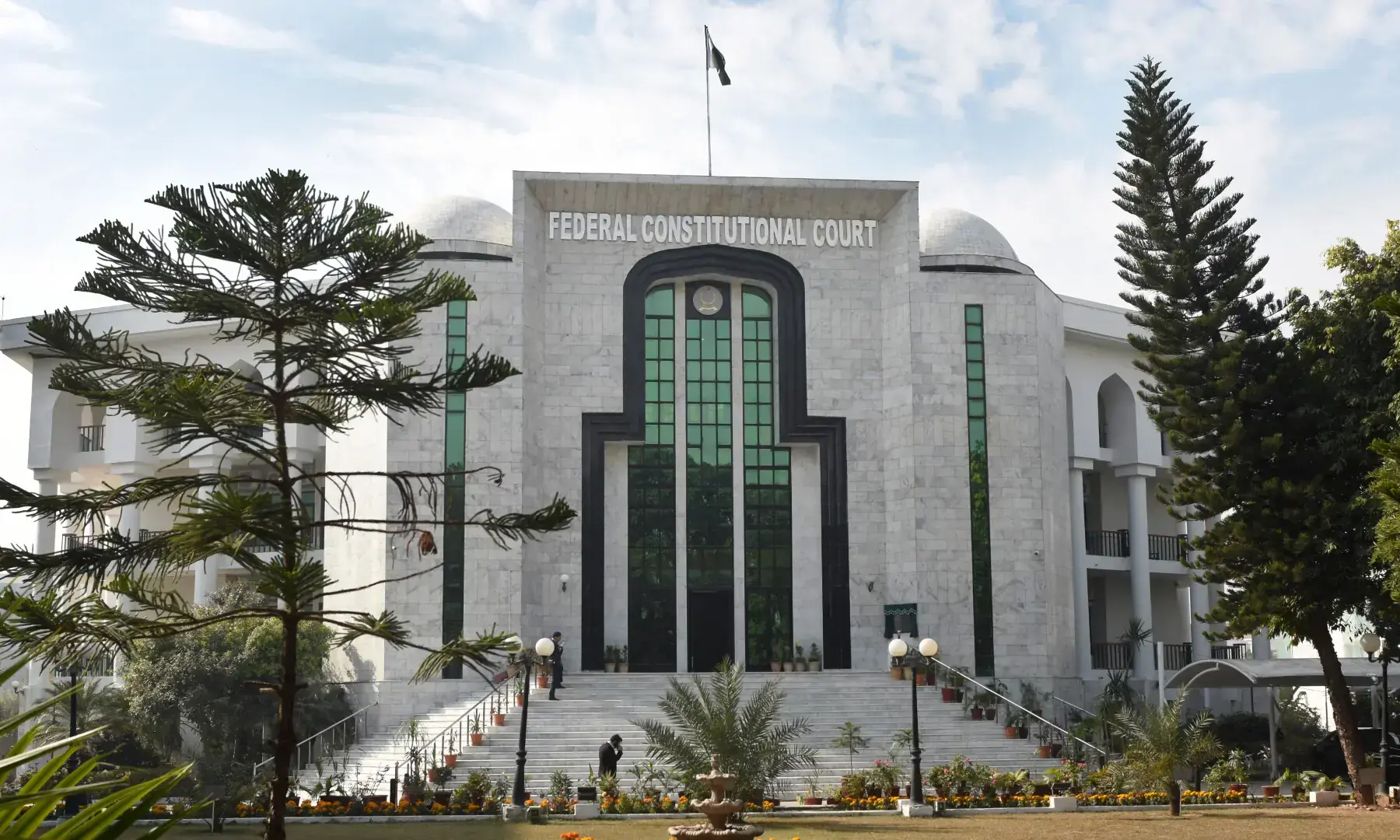
ISLAMABAD: Upon hearing extensive arguments from Advocate Hafiz Ahsaan Ahmad Khokhar, the Federal Constitutional Court (FCC) on Wednesday reserved its judgment on a government appeal. The appeal challenges a series of directives issued by the Lahore High Court (LHC) regarding the ongoing prohibition on imports from India.

A three-member bench of the Justice Aamer Farooq, also comprising Justice Ali Baqar Najafi and Justice Rozi Khan Barrech took up an appeal of commerce ministry against Jan 26, 2024 of the LHC judgement in the matter.Earlier, the appeal was filed before the Supreme Court but after passage of the 27th Amendment, the matter was transferred to the FCC for hearing.  Federal government under its constitutional and statutory authority issued order to impose ban i through Statutory Regulatory Orders (SROs) Nos 927 and 928(I)/2019, reflecting considerations of foreign policy, national security and sovereign discretion.

Through these SROs, imports from and exports to India were banned for all kinds of goods, including books and journals. The controversy arose when the SROs were challenged before the LHC with the contention that these regulatory orders, to the extent of banning the import of books from India, were ultra vires the Constitution.

Validity of SROs upheld

Although the LHC upheld the va­­lidity of the SROs by declaring them intra vires the Constitution and the relevant statutory framework, it nonetheless issued certain directions to the federal government. The LHC directed the federal government to appoint an officer to consider a review or revision of the policy. It also ordered the federal government to ensure that it considered and decided the officer’s recommendations.One of the directions suggested that the officer should be appointed within the next two months by the commerce ministry and that the appointment should be posted on its website. The petitioners, if so advised, were to file their reviews thereafter.

These directions, despite affirming the legality of the policy, were challenged before the FCC as being beyond the permissible scope of judicial review. In its petition, the federal government pleaded before the FCC that it was competent to ban one or all go­­ods, or a class of goods, from any one country or from worldwide sources. It also argued that India was neither an authority in any field of knowledge nor enjoyed a monopoly over wisdom.It added that as such, banning imports from India, including books or journals, did not infringe any fundamental rights of the respondents. The petition also stated that the suspension of trade with India was taken in the context of Pakistan’s national interest and its longstanding stance on Kashmir.

‘Judicial overreach’

Khudayar Mohla,ederal Constitutional Court, FCC Pakistan, Lahore High Court, LHC judgment, import ban from India, India Pakistan trade ban, SROs 927 and 928 2019, commerce ministry appeal, ban on Indian imports, books import ban, judicial overreach, separation of powers, foreign policy Pakistan, national security trade restrictions, statutory regulatory orders Pakistan, constitutional jurisdiction, executive domain, judicial review limits, Pakistan India trade relations, Kashmir policy Pakistan, Supreme Court Pakistan appeal transfer, 27th Constitutional Amendment, Justice Aamer Farooq, Justice Ali Baqar Najafi, Justice Rozi Khan Barrech, Advocate Hafiz Ahsaan Ahmad Khokhar, Additional Attorney General Aamir Rehman, non-justiciable matters, import export regulation Pakistan, federal government policy decisions
Advocate SC Hafiz Ahsaan Ahmad Khokhar

Appearing on behalf of the revenue division secretary, Advocate Hafiz Ahsaan Ahmad Khokhar argued that the Jan 26, 2024 LHC judgement was legally unsustainable to the extent that it issued directions after upholding the validity of the SROs. He contended that once the policy decision embodied in the SROs had been affirmed, any further directions amounted to judicial overreach and encroachment upon the executive domain. The counsel argued that matters relating to trade restrictions, import prohibitions and regulation of commerce with hostile or adversarial foreign states fell squarely within the exclusive domain of the executive under the constitutional scheme. He emphasised that issues touching upon foreign policy and external relations were traditionally regarded as non-justiciable, and that courts were required to exercise judicial restraint unless a clear violation of the Constitution or fundamental rights was established.

The counsel further contended that constitutional courts were mandated to adjudicate legality and constitutionality, not to issue directions requiring the federal government to revisit, reconsider or reformulate policy decisions. Such directions, he argued, violated the doctrine of separation of powers enshrined in the Constitution and blurred the constitutionally demarcated boundaries between the judiciary and the executive.

Additionally, Additional Attorney General Chaudhry Aamir Rehman, appearing on behalf of the federation, submitted that the impugned judgement was not legally sustainable. He stated that the LHC had gone beyond its jurisdiction by interfering in policy matters, which courts were constitutionally barred from doing so. He added that allowing such directions would amount to judicial encroachment into the executive domain, rendering the judgement legally unsustainable. After hearing arguments from both sides, the FCC reserved its judgement.

Author

Khudayar Mohla, Managing Partner Mohla & Mohla, Founder of the Law Today Pakistan,

Managing Partner at Mohla & Mohla - Advocates and Legal Consultants, Islamabad, Founder of The Law Today Pakistan (TLTP) Newswire Service. Former President Press Association of Supreme Court of Pakistan with over two decades of coverage of defining judicial moments - including the dissolution and restoration of Chief Justice Iftikhar Muhammad Chaudhry, Asif Ali Zardari NAB cases, Syed Yousaf Raza Gillani contempt proceedings, Panama Papers case against Mian Nawaz Sharif, matters involving Imran Khan, and the high treason trial of former Army Chief and President Pervez Musharraf. He now practises law and teaches Jurisprudence, International Law, Civil and Criminal Law. Can be reached at: mohla@lawtoday.com.pk

More From Author

Leave a Reply

Your email address will not be published. Required fields are marked *

You May Also Like

International Arbitration Pakistan, New York Convention Pakistan, Rana Rizwan Hussain, Dispute Resolution Journal, High Court Jurisdiction Pakistan, Recognition and Enforcement Act 2011, Foreign Arbitral Awards, Section 4 of 2011 Act, Civil Court Jurisdiction CPC, Vienna Convention on the Law of Treaties, ARSIWA State Responsibility, Legal Certainty for Foreign Investment, Pakistan Legal News, Constitutional Law Pakistan, Judicial Predictability, Commercial Dispute Resolution, Lahore High Court Arbitration, Islamabad High Court Jurisprudence, International Law Interpretation, Sovereign Legal Commitments, Khudayar Mohla

Study Urges Stronger High Court Role in Enforcing International Arbitration to Safeguard Pakistan’s Global Commitments

ISLAMABAD: The quest for judicial predictability in the enforcement of international arbitration agreements has emerged…

Lahore High Court Rawalpindi Bench, PLGA 2025 suspension, Punjab Local Government Act 2025, Justice Jawad Hassan order, urban area declaration case, Maple Leaf Cement Factory petition, Daud Khel Pacca urban notification, Punjab demarcation rules 2025, urban classification legal challenge, revenue estate urban status dispute, LHC interim stay order, Punjab government urban demarcation case, Section 6(3) PLGA interpretation, rural versus urban classification Punjab, Tehsil Council Mianwali jurisdiction, constitutional petition urban area notification, 26th Constitutional Amendment jurisdiction limits, Kakakhail Traders case reference, environmental rights urbanization case, right to clean environment Pakistan, agricultural land urban conversion dispute, flood risk urban planning case, Advocate General Punjab response order, LHC constitutional jurisdiction ruling, Punjab demarcation classification litigation, local government law judicial review, urban planning legal dispute Punjab, LHC notices to respondents 2026, maintainability of constitutional petition Pakistan, interim relief urban demarcation case, Khudayar Mohla

LHC Suspends Punjab Local Govt Act 2025 Operation

ISLAMABAD: The Lahore High Court’s Rawalpindi Bench has suspended the implementation of Punjab Local Government…

Peshawar High Court, PHC verdict, KP Police Amendment Act 2024, Khyber Pakhtunkhwa Police law, police autonomy Pakistan, Justice SM Atiq Shah, PHC Chief Justice judgment, police appointments constitutional ruling, police transfers and postings authority, Inspector General of Police powers, IGP KP authority, chief minister powers police appointments, unconstitutional police amendments KP, police command structure ruling, political interference in police, police independence constitutional principles, KP governance law ruling, law enforcement autonomy Pakistan, police discipline command structure, constitutional framework police autonomy, fundamental rights police independence, right to fair trial policing, equality before law policing, PHC constitutional judgment KP, administrative supervision policy guidance, police reform legal challenge KP, KP government police amendment case, judicial review police law Pakistan, police autonomy fundamental rights protection, PHC strikes down police amendments, KP law and order administration ruling

PHC Declares KP Police Amendment Act 2024 Unconstitutional

PESHAWAR:  While issuing a detailed verdict of 28- page relating to Khyber Pakiunkhwa Police Amendment…