

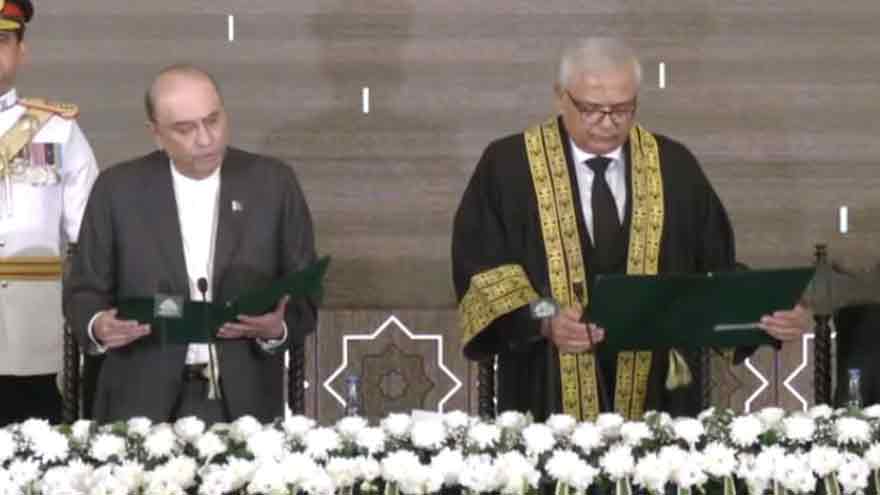
ISLAMABAD – A day after enactment of the 27th Constitutional Amendment, Justice Aminuddin Khan Friday took oath as the first Chief Justice of the newly established Federal Constitutional Court (FCC) as a result of the Amendment.
A private television reported that the oath-taking ceremony took place at the President’s House in Islamabad, where President Asif Ali Zardari administered the oath to Justice Khan. Prime Minister Shehbaz Sharif, Chief of Army Staff (COAS) Field Marshal Asim Munir, heads of the Pakistan Air Force and Navy, and several other senior officials attended the cermony. Among the distinguished guests were Chief Justice of the Supreme Court Muhammad Yahya Afridi, Chairman Senate Yousuf Raza Gilani, National Assembly Speaker Sardar Ayaz Sadiq, Chairman of Pakistan Peoples Party Bilawal Bhutto Zardari, as well as various federal ministers and members of parliament.
Pertinently mention that a day ago on Thursday, Justice Aminuddin Khan was officially appointed as head of the Federal Constitutional Court following consultations between Prime Minister Shehbaz Sharif and President Asif Ali Zardari.
The appointment followed the 27th Constitutional Amendment, which was recently ratified by Parliament and signed by the President. The Amendment clarified the procedures for appointing the Chief Justice of Pakistan, stating that the position will be held by the most senior among the Chief Justices of the Supreme Court or the Federal Constitutional Court.
Justice Aminuddin was previously due to retire on 30 November, but the constitutional changes have paved the way for his continuation in service as the head of the Constitutional Court.
The Amendment also allows the President, on the recommendation of the Prime Minister, to appoint judges to the Federal Constitutional Court. Supreme Court judges are expected to attend the oath-taking ceremony, which will be held at the Chief Justice’s House.
Who is Justice Aminuddin Khan?
Justice Amin-ud-Din Khan was born on 1st December 1960 at Multan. He belongs to a very noble family of a famous lawyer of the time Khan Sadiq Muhammad Ahsan, Advocate (Late). He received his education from Kinder Garten Muslim School Multan. He completed Secondary School Education from Government Muslim High School, Multan in the year 1977. He secured his Bachelor Degree in subjects of Philosophy in the year 1981 and completed his LL.B from University Law College, Multan in 1984 and diploma in Taxation Law.
According to SC website, Justice Amin-ud-Din Khan started practice as Junior with his father and obtained the license to practice in Lower Courts in the year 1985. He enrolled as an Advocate of the Lahore High Court in 1987. Some years later, he was enrolled as an Advocate of the Supreme Court in 2001. He joined Zafar Law Chambers at Multan in the year 2001, till elevation remained there. He practiced in civil side mainly from trial court up to August Supreme Court and appeared in August Supreme Court in famous and important cases relating to the property, pre-emption and matters of inheritance, also these subjects remained the favourite subjects.
Justice Amin-ud-Din Khan was elevated to the Bench on 12.5.2011. During his career as a Judge, Justice Amin-ud-Din Khan decided thousand oldest cases of civil nature at Bahawalpur Bench, Multan Bench and at Principal Seat, Lahore and most judgments were upheld by the August Supreme Court of Pakistan. Justice Amin-ud-Din Khan represented Pakistan as Boy Scout in Asian Jambury Iran in the year 1977 and was awarded sash by the President of Pakistan.
Justice Amin-ud-Din Khan remained Examiner and Lecturer in various subjects in University Law College, Multan. As Judge of the Lahore High Court remained Member of Syndicate of various Universities including University of Engineering and Technology, Lahore. Justice Amin-ud-Din Khan elevated as Judge, Supreme Court of Pakistan on 21.10.2019.