
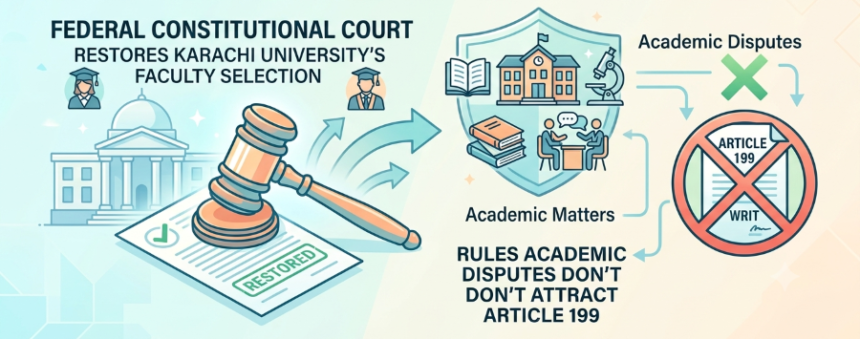
ISLAMABAD: Announcing an 18-page verdict in response to a University of Karachi plea on Wednesday, the Federal Constitutional Court (FCC) set aside a Sindh High Court (SHC) judgment, declaring the university’s faculty selection process legal and ruling that an unsuccessful candidate cannot invoke constitutional jurisdiction merely by alleging unfairness in an academic selection.
A two-member bench comprising Justice Syed Hasan Azhar Rizvi and Justice Muhammad Karim Khan Agha announced the verdict in response plea of University of Karachi against the SHC’s judgment of June 13, 2025. The SHC had partly allowed a petition filed by Dr. Feroz Alam Jafri, an Assistant Professor who challenged his non-selection for the posts of Professor and Associate Professor in the university’s Food Science and Technology Department.
Responding to question of maintainability, the FCC held that Dr. Jafri’s constitutional petition was not maintainable under Article 199 of the Constitution. It ruled that a statutory body and statutory service rights are not the same thing, and that an unsuccessful candidate cannot approach the High Court merely because he considers himself more suitable than selected candidates. The Court found no patent illegality, mala fide, bias, or breach of natural justice on record sufficient to attract constitutional jurisdiction.
Deciding a legal question about Rule 6(4) of the University’s First Statutes, which bars a Selection Board member from participating in proceedings concerning a post for which they are themselves a candidate, the FCC ruled that no violation occurred. It found that Dr. Shahina Naz, who was a candidate for the post of Professor, did not participate in the Board’s proceedings relating to that post, and joined only when the Board considered the post of Associate Professor, for which she was not a candidate. The Court held that the rule’s bar is post-specific and does not disqualify a member from the entire meeting.
Likewise on Rule 6(5) of the First Statutes, which requires the Selection Board to consult three subject experts, the FCC ruled that this requirement stood satisfied once three experts were consulted, regardless of whether their reports were unanimous or favourable. It held that consultation means seeking opinion or advice, not concurrence, and that the rule does not require all expert reports to support a candidate.
On the remaining grounds of bias, lack of reasons, and non-consideration of objections, the FCC ruled that these did not disclose any patent illegality or jurisdictional defect sufficient to vitiate the selection process. It found no material showing that Dr. Shahina Naz influenced the Board’s decision-making, and noted that she was never made a party before the High Court despite allegations against her. The Court also held that no provision required the Board to issue detailed reasons for every unsuccessful candidate, and that the Syndicate’s approval could not be set aside merely because one member recorded objections.
Bench of the FCC cautioned that constitutional jurisdiction under Article 199 is not meant to convert every grievance of an unsuccessful candidate into a constitutional cause. It held that such jurisdiction applies only where a defect is patent, substantial, and affects the legality of the process itself, and that a wider approach would risk turning the Court into an appellate forum over academic selections.
The FCC converted the petition into an appeal, allowed it, set aside the High Court’s judgment, and restored the Selection Board’s recommendations of December 21, 2023, as approved by the Syndicate on April 5, 2024.