
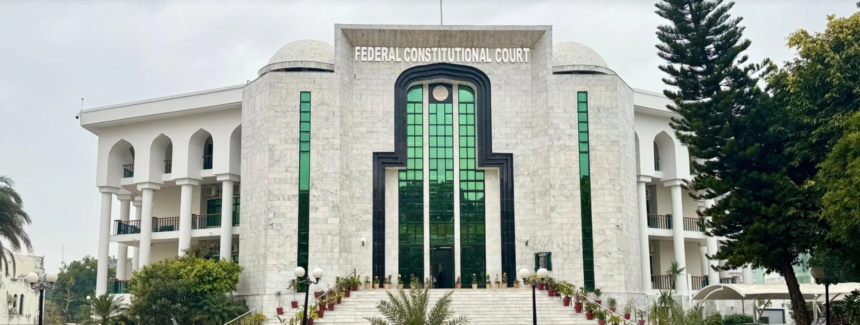
ISLAMABAD: The Federal Constitutional Court (FCC) has held that children of a predeceased brother cannot claim a share in their uncle’s estate under Section 4 of the Muslim Family Laws Ordinance, 1961. The court dismissed a petition over a Model Town Extension property and refused leave to appeal with costs.
A bench headed by Chief Justice Amin-ud-Din Khan and including Justice Ali Baqar Najafi announced a 15-page verdict in response to a plea challenging a March 18, 2026 Lahore High Court order that had dismissed the petitioners’ writ petition in the matter.
The dispute
The case concerned succession to House No. 15-L, Model Town Extension, Lahore, owned by Ijaz Ahmed Rana, who died without children on December 31, 2018. The petitioners, sons of his predeceased brother, claimed a right of inheritance under Muslim law.
They said they were first named as parties in a declaratory suit but were removed through an amended plaint without their knowledge, after which an ex-parte decree was passed for the respondents. They learned of the decree, they said, when the Lahore Development Authority issued an NOC to the respondents. Their application under Order IX, Rule 13 of the Code of Civil Procedure to set aside the decree was dismissed by the trial court, the Additional District Judge and the High Court.
Section 4 held inapplicable
Section 4 of the Ordinance lets children of a son or daughter who dies before the propositus receive, per stirpes, the share their parent would have received. The court said it applies only where the predeceased heir is a son or daughter of the propositus.
It held that the provision cannot be extended by analogy to nephews and nieces. Because the petitioners stand in a collateral rather than lineal relationship to the deceased, the court said the foundational condition of Section 4 was missing. It added that the result may seem harsh, but that “neither sentiment nor perceived hardship” can create an heir the law does not recognise.
Hanafi law hierarchy
The petitioners also argued that, as Hanafi Muslims, they were entitled to inherit equally with the respondents. The court rejected this, explaining that Hanafi law divides heirs into sharers, residuaries and distant kindred, who inherit only when neither of the first two classes exists. It held that the petitioners fall among distant kindred and are therefore excluded by the surviving sharers and residuaries. “Parity of personal law is not parity of entitlement,” the judgment observed.
Limitation
The court also found the challenge time-barred. The petitioners were plaintiffs in the original proceedings, and the trial court’s judgment of May 5, 2023 was announced in the presence of their counsel. Yet they moved the application only in 2025. The court said a claim that they never signed the plaint could not explain the delay, since they did not deny engaging counsel who appeared for them throughout.
The court held that the petitioners failed on both procedural and substantive grounds and that no sufficient cause for condoning the delay had been shown.