

By Khalid Hasnain
The total cost of free electricity units being used by the state-owned entities in the country’s power sector alone ranges between Rs22 billion and Rs25bn per annum whereas the allowances being given to other government departments’ employees from grade 1 to 22 are also worth billions, leaving the government with no option but to pass on such a huge financial impact to consumers.
However, highly-placed sources don’t see this impact as a big one compared to huge capacity payments, which have now reached Rs2 trillion and are liable to be paid to the independent power producers (IPPs) by the end of this year.
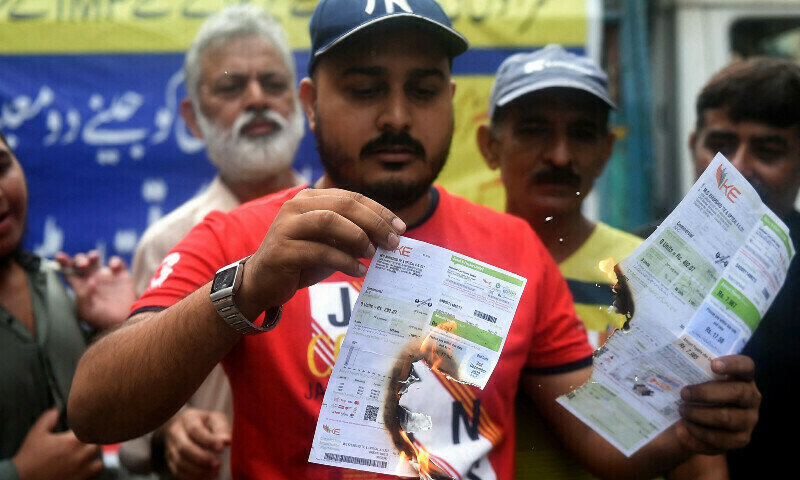
Due to taxes and line losses amounting to billions of rupees, the cumulative financial impact is also being passed on to end-power consumers gradually in the form of inflated bills.
“No one is thinking about the main issues bringing consumers under immense financial stress due to inflated bills,” says a former chief executive officer of a power distribution company (Disco), referring to the capacity payments. “The free units to power sector employees is a very petty matter, as capacity payments have surged to Rs2 trillion…technical & commercial losses and a number of taxes also caused a massive surge in the per unit rate,” he added.
According to him, a number of employees (120,000 approximately) of state-owned organisations in the power sector are being provided electricity partially or fully according to their pay scales. These departments include nine Discos, National Transmission and Despatch Company, Wapda, K-Electric, various state-owned generation companies (Gencos), Central Power Purchasing Agency (CPPA), Pakistan Electric Power Company (Pepco), the Ministry of Energy, and other respective companies.
While calculating the power sector subsidies for employees of state-owned companies, the former official said they were approximately using 300 free units (each) on an average monthly. Suppose, the cost appears to be Rs50 to Rs55, the monthly expenses in this regard would be nearly Rs2 billion.
So the annual expense would be Rs24 billion more or less. “I want to tell also that the units being given to the employees, especially those working in Wapda, Discos and Gencos are said to be a built-in facility for these employees. After joining in any grade, the employee is allotted an employee code number under which the number of free units allowed is put into the computerised record of the employee’s bill/electricity connection sheet.
“If an employee uses 200 units, 100 more than the allowed ones, they are billed for 100 additional units only. But the situation in the organisations involved in power generation is different, as the employees there, probably, are being given almost unlimited units. Most of these employees are living in the employees’ colonies of generation plants — Tarbela, Mangla etc. and Gencos using gas and diesel for power generation,” he maintained. He said the budget for free units is always included in the annual budget of the aforementioned organisations.
Talking about the free electricity to other departments, he said the Discos billed to all as per law. “But the payment for this is given by the departments concerned to its employees in the form of allowance. For example, if a judge uses 2000 units, the respective Discos will serve them the bill. The officer is supposed to pay the bill. And after payment, they claim this from their departments. Or the payment of bills in the form of a lump-sum amount is made part of such officers’ salary,” he added.
The ex-official, however, was unaware of the allowances being given to the officers of the armed forces in this regard. “As far as I know, the defence-related institutions procure electricity in bulk from Discos. And then they, themselves supply this to their colonies, formations etc.?”
The officer said the only way to provide electricity to the people, especially the poor ones, is to renegotiate agreements and convince IPPs to bring down the percentage of the capacity charges, eliminate power theft (commercial losses), strengthen power distribution and transmission system (11kV to 500kV transmission lines and grid stations) to reduce technical losses, stop power theft, revisit the free-units policy to the extent of senior officers and more and more use of hydel power generation.
The impact of hydel power generation will start appearing once three major ongoing projects— Basha, Dasu and Mohmand are commissioned gradually by 2030. “I think if the IPPs agree alone to revise the capacity charges-related agreements in the public interest, Discos succeed in controlling line losses and the government reduce taxes, the unit rate including taxes would considerably reduce, giving a big relief to the consumers,” he suggested. “I would also recommend to also revisit the decision related to units-use slabs, as this is also enhancing the bills,” he added.
Discos perks
When contacted, a Lesco spokesman said the impact of free units (being used by the power sector employees in the public sector) would not be more than 0.2 per cent. He added distribution companies, including Lesco, provide the free unit facility to their employees from their own budget. “Each company gets a distribution margin, such as Lesco which receives Rs2 or so per unit. From this amount, the companies meet all of their expenditures. Free units, if withdrawn, will not give any relief to consumers, in fact it would rather decrease employees’ efficiency.
He said another issue, which has caused a massive increase in bills is the revised slab system introduced recently. Earlier consumers were being charged for each unit as per the rates of each slab. “Under the previous system, if you used 600 units in total, you were being charged separate unit rates as per each slab. But now, if someone has even crossed 200 units, entering the second slab even with a couple of units, they will be as per the rate of the slab of 300 units which is three times more than the 200 unit slab after taxes,” he explained.
To a question, the spokesman said the Discos in Punjab had been bearing the load of other Discos, including Sepco, Qesco, Pesco and Tesco, whose total recovery was not more than 50 per cent, adding that Punjab-based companies, including Lesco, had 95pc recovery rate. The official also suggested the government charge consumers of the Discos facing massive line losses and poor recovery with the tariff more than those companies making considerable recovery with low line losses.
“In this way, the government can reduce the unit cost, giving considerable relief to the consumers at large,” he said.
Published in Dawn, September 4th, 2023