

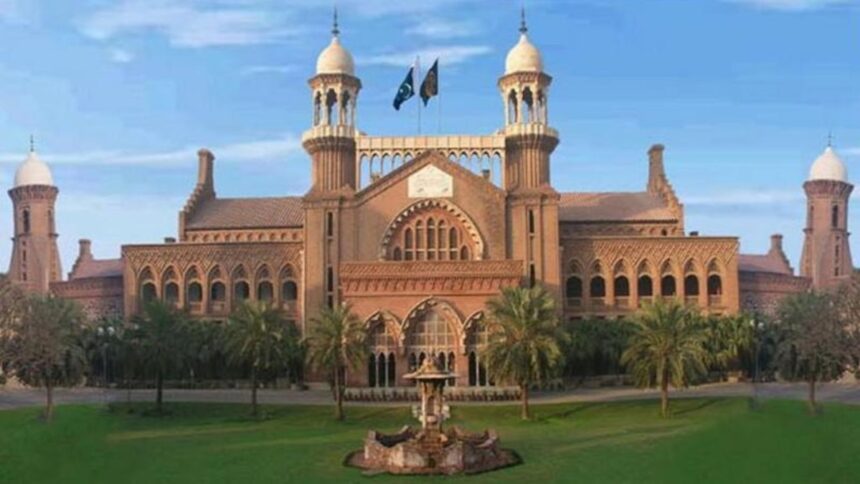
LAHORE: Seeking enforcement of Article 202-A of the Constitution of Pakistan in letter and spirit, Judicial Activism Panel (JAP) chairman Azhar Siddique urged the Lahore High Court (LHC) to seize administrative staff’s authority to screen pleas on issues of maintainability, jurisdiction, locus standi and alternative remedies before the fixation of a case, claiming such a matter falls solely within a judge’s purview rather than ministerial staff discretion.
Invoking jurisdiction of the LHC, Azhar Siddique submitted saying despite of the enactment of 26th Amendment in 2024, constitutional benches have yet to be established in the Lahore, Islamabad, Peshawar, and Balochistan High Courts.
JAP head has made the federation, the Law and Justice Commission of Pakistan, and the National Judicial (Policy-Making) Committee (NJPMC), among other federal and provincial authorities as respondents.
Currently, only the Sindh High Court has substantially implemented the framework envisaged under Article 202-A. According to the petition, Article 202-A uses mandatory language, stipulating that constitutional benches must be constituted and that only these specialised benches may exercise jurisdiction under Article 199.
The petitioner further submitted that the persistent failure to establish these benches has created an unequal two-track system of constitutional justice. While litigants in Sindh have direct access to specialised constitutional benches, litigants in the rest of Pakistan must still have their constitutional cases heard by ordinary benches. Given the lack of any other effective or speedier remedy, the petitioner moved the LHC under its extraordinary constitutional jurisdiction in the public interest.
The petition also challenges the long-standing practice of the LHC’s case-filing branch raising preliminary objections, such as maintainability, jurisdiction, locus standi, and the availability of alternative remedies, before a petition is formally heard.
The petitioner argues that these are exclusively judicial questions that cannot legally be decided by administrative staff. Such administrative screening acts as an unconstitutional barrier to justice, violating Articles 4, 9, 10A, and 25 of the Constitution.
Legal precedents from Pakistan, India, and the UK, alongside international principles on judicial independence, dictate that maintainability must always be decided by judges rather than registry officials.
Between November 2025 and June 2026, the petitioner submitted as many as 14 detailed representations to the president, prime minister, provincial authorities, and the NJPMC requesting the implementation of Article 202-A and filing reforms. However, no reasoned response was received, save for a solitary letter from the NJPMC forwarding one representation to the LHC Registrar.
The petition highlights a severe crisis in the judiciary, noting that 76 out of 200 sanctioned high court judges’ posts across Pakistan remain vacant. This understaffing has allegedly encouraged excessive administrative screening instead of proper judicial case management. The crisis is particularly acute at the LHC, which alone faces a backlog of 198,005 pending cases, accounting for roughly 56.8pc of all pending high court litigation nationwide.
JAP chairman has prayed the court to direct the respondents to decide the pending representations through detailed, reasoned speaking orders within 30 days. Besides, he urged the court to declare that vague or non-speaking communications do not satisfy constitutional requirements.
He also sought the court directives for respondents’ compliance reports to ensure the swift implementation of Article 202-A and the permanent removal of administrative barriers to litigation which is one of the major impediments for genuine remedy seekers.