

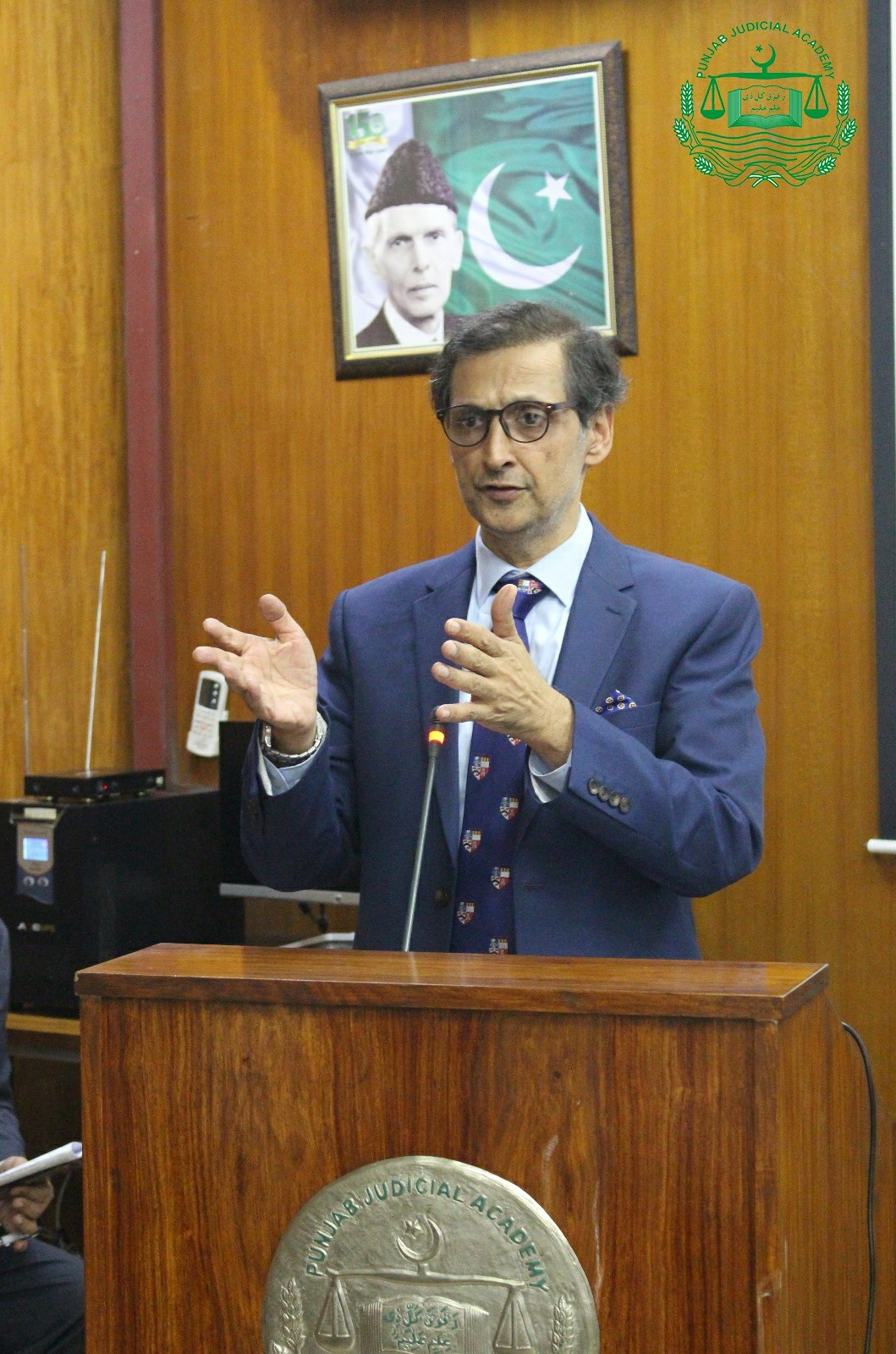
LAHORE – While underscoring dire need for civil courts to examine and decide the maintainability of a plaint at the first hearing, Lahore High Court Judge Justice Jawad Hassan observed that no presiding officer can be said to be under stress if he has command over the legal and factual aspects of the matter before him for adjudication.
He was addressing concluding ceremony of the training and refresher courses for district judiciary judges, which the Punjab Judicial Academy Lahore conducts regularly to enhance the capacity of incumbent presiding officers and align them with contemporary approaches in judicial decision-making for the administration of justice. Speaking about stress-management methodology, Justice Jawad Hassan said that if a judge has command over the facts of a case and the relevant legal framework, there would be no stress for him. He added that making decisions with clarity of mind enables smooth performance in the administration of justice.
Referring to his own professional experience, Justice Hassan said that he has handled highly important and challenging cases but has never been under any kind of mental pressure. Describing various decisions he has rendered as a judge, he stated that he has decided numerous socially and politically significant matters without taking “a single shot of stress.” He apprised the participants that if a presiding officer develops the habit of examining a case a day before adjudication and gains full grip over the law and facts, he would be competent to manage pressure – resulting in “the stress shifting to the other side.”
Citing a classic judgment of the Supreme Court (PLD 1962 SC 62) which strengthens a presiding officer to question the plaintiff on the maintainability of a plea, Justice Hassan advised members of the judiciary to ask the plaintiff at first hearing of the case – on what legal grounds the matter is maintainable. Justice Hassan further highlighted the objective of Order VII Rule 11 of the Code of Civil Procedure, 1908, noting that the provision is self-explanatory: a plaint must be rejected if it discloses no cause of action. He added that this power should ideally be exercised at the first hearing of the case – something possible only when the presiding officer asks the basic question of whether the plaint is maintainable.
Sharing his experience regarding adjudications under the Negotiable Instruments Act, 1881, Justice Hassan disclosed that as many as 90 percent of suits for recovery filed under Order XXXVII CPC are baseless, with many relying on documents annexed with the plaint—including First Information Reports. He questioned how it was plausible that an individual would issue a cheque (a negotiable instrument) to an enemy. Issuing decrees in such litigation, he cautioned, leads to unnecessary delays in resolving matters.
Justice Hassan also emphasized the importance of public confidence in the judiciary, stating that a strong and transparent judicial system is built on the trust of the people. Therefore, he stressed the essential requirement for judges to announce their judgments in open court so that judicial proceedings remain transparent in the public eye. He further shared that new and modern training courses on “Judge Crafting” are being introduced at the Judicial Academy to enhance the skills of judges according to contemporary needs. The Punjab Judicial Academy, he noted, carries the significant responsibility of training the district judiciary of Pakistan’s largest province.
On the occasion, he lauded the steps taken by the Chief Justice of the Lahore High Court, Justice Aalia Neelum, for improving the capacity of the district judiciary and for the welfare of both judges and judicial staff. Justice Hassan also noted that the training and capacity-building of judicial staff is equally important, as they serve as a fundamental pillar of the judicial system. The ceremony was attended by Civil Judges, Senior Civil Judges, and Additional Sessions Judges who completed a five-day training program at the Punjab Judicial Academy on the interpretation of revenue documents, stress-management techniques, and the use of artificial intelligence in judicial work.