

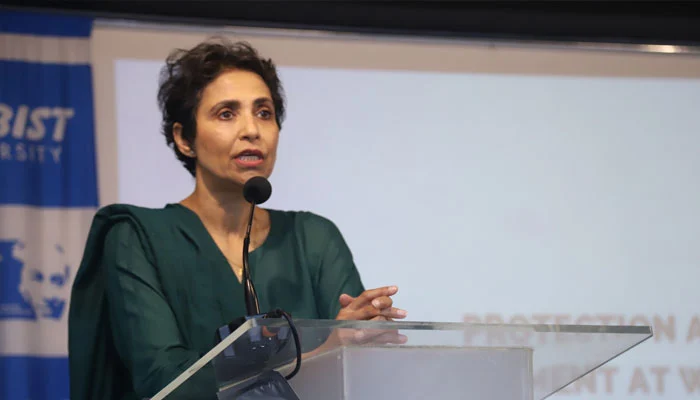
LAHORE: The Federal Ombudsperson for Protection Against Harassment of Women at the Workplace (FOSPAH) Fauzia Viqar ruled that the State Bank of Pakistan subjected a male employee to gender-based discrimination by denying him paternity leave, imposing a fine of Rs. 500,000 on the bank while directing it to grant the employee thirty days of paternity leave on full pay.
The Ombudsperson held the State Bank of Pakistan solely liable for the discriminatory act, even though the complaint had also named the Managing Director SBP BSC , Zulfiqar Khokhar, Head HRMD SBP, and Tariq Riaz, Chief Manager SBP BSC. The order noted that Managing Director SBP BSC and Tariq Riaz were employees of SBP BSC, and Zulfiqar Khokhar was an employee of SBP, and that all three remained bound to follow policies formulated by SBP as the parent company, placing ultimate responsibility on the State Bank itself.
Of the Rs. 500,000 penalty, the Ombudsperson directed that Rs. 400,000 be paid to the complainant, Syed Basit Ali, and the remaining Rs. 100,000 be deposited into the government exchequer within thirty days.
Basit Ali, serving as OG-1 in the Banking Services Corporation (BSC), a subsidiary of SBP, had applied for thirty days’ paternity leave under Section 4 of the Maternity and Paternity Leave Act, 2023, following the birth of his son on April 4, 2025. SBP declined his request on the ground that no such leave existed under its prevailing policy.
He subsequently pursued internal remedies, including a complaint before SBP’s Grievance Committee and a representation to the Governor SBP, before approaching the Ombudsperson’s office.
The complainant argued that while maternity leave continued to be granted to female employees under the 2023 Act, denial of paternity leave to male employees under the same statute amounted to gender-based discrimination under Section 2(h)(ii) of the Protection Against Harassment of Women at the Workplace Act, 2010.
SBP and its co-accused contested the complaint’s maintainability, arguing that SBP BSC, established under its own 2001 Ordinance, functioned as an autonomous statutory body not under the administrative control of the Federal Government, and that the 2023 Act therefore did not apply to it.
The Ombudsperson rejected this argument after examining the State Bank of Pakistan Act, 1956, and the SBP Banking Services Corporation Ordinance, 2001, along with the Rules of Business, 1973. The order found that SBP’s capital is held exclusively by the Federal Government, that the Governor and non-executive Directors are appointed by the President on the Federal Government’s recommendation, and that SBP BSC operates as a subsidiary under SBP’s administrative control.
The Ombudsperson also cited SBP’s own submissions in a prior writ petition before the Lahore High Court, in which the bank had claimed federal government control to seek property tax exemption.
The order further held that the 2010 Act’s definition of “organization” is broad and inclusive, extending to autonomous and semi-autonomous bodies, and that the Act carries overriding effect over other laws under Section 6.
The Ombudsperson concluded that SBP could not selectively deny statutory paternity leave benefits under the 2023 Act while continuing to grant maternity leave to female employees.
Citing precedent, including the Supreme Court’s ruling in Nadia Naz v. President of Islamic Republic of Pakistan, along with comparative jurisprudence from South Africa and the United States, the Ombudsperson held that parental leave is a matter of equality rather than gendered privilege, and that denying paternity leave reinforces stereotypical caregiving roles in violation of constitutional guarantees under Articles 25 and 37 of the Constitution of Pakistan 1973.
The Ombudsperson also directed SBP BSC to amend its existing Leave Policy No. LP/HRMD/2016 to bring it into full conformity with the Maternity and Paternity Leave Act, 2023.
