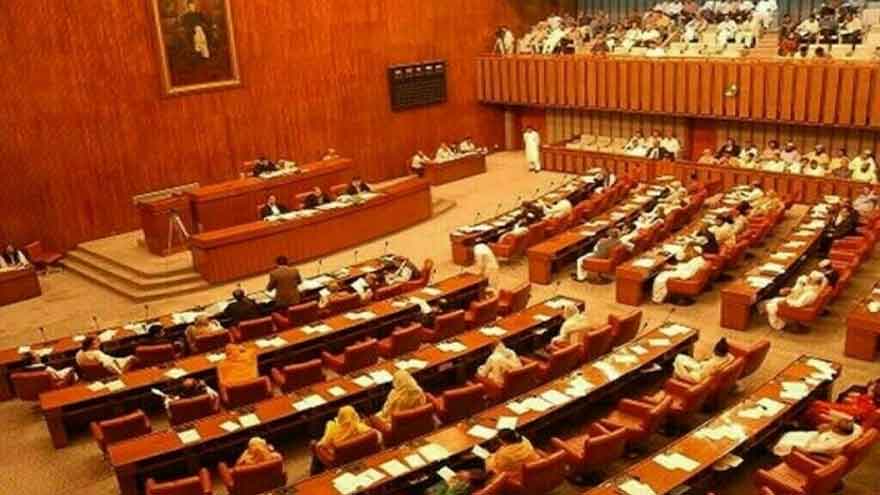
Upper House on Tuesday passed an amendment to the Anti-Terrorism Act (ATA), 1997, reinserting powers that allow law enforcement agencies and the armed forces to detain individuals for up to three months. The move, which follows the National Assembly’s passage of the same amendment last week, faced strong opposition uproar.
Minister of State for Interior and Narcotics Control, Muhammad Tallal Badar, introduced the Anti-Terrorism Amendment Bill 2025 to the Senate. According to Dawn, the amendment, which seeks to modify the Anti-Terrorism Act (ATA), allows the government or armed forces to issue orders for the preventative detention of any person for a period not exceeding three months, provided they record their reasons for doing so. This change was made to sub-section (1) of Section 11EEEE of the ATA.
Any person suspected of activities against national security or safety will be detained, according to the bill, adding that persons involved in target killing, kidnapping for ransom, extortion can be detained for three months.
The bill also added that it applies “against whom sufficient grounds exist of his having been so concerned, for purpose of inquiry”. The bill available described the detention of a person arrested under Section 11EEEE, including detention exceeding three months, would be subject to the provisions of Article 10 (safeguards as to arrest and detention) of the Constitution.
If a detention order is issued by the army or civil forces, the investigation will be conducted by a joint investigation team, according to the bill. “The inquiry will be conducted by no police officer below the rank of Superintendent of Police, Intelligence agencies, civil armed forces, armed forces, and other law enforcing agencies,” the bill added. JUI-F Senator Kamran Murtaza moved certain amendments to the bill but the House rejected them with majority of votes, APP added.
The house passed the bill through clause by clause reading. The statement of objects and reasons of the bill said that the current security situation requires a robust response that goes beyond the existing legal framework. “The erstwhile amendment of Section 11EEEE of the Act ibid are required to re-inserted to empower the government, Armed Forces and Civil Armed Forces with the necessary authority to detain individuals who pose a significant threat to national security,” it added.
This provision would allow for the preventive detention of suspects based on credible information or reasonable suspicion, thereby disrupting terrorist plots before they can be executed. This will also provide law enforcement enforcement agencies with the legal backing to conduct more effective operations against terrorism. It would facilitate the use of joint interrogation teams (JITs), composed of members from various law enforcement and intelligence agencies to conduct comprehensive inquiries and gather actionable intelligence.
Earlier, responding to various points raised by lawmakers in the Senate, Law Minister Azam Nazeer Tarar said: “Currently the country is facing menace of terrorism and amendments proposed by Syed Naveed Qamar have already been incorporated to make it more effective.” The bill has also already passed judicial scrutiny tests saying a three years sun-set clause has also been added in it.
Tarar said that under Clause 2 of the amendment, the detainee would have presented before the Magistrate within 24 hours. Barrister Syed Ali Zafar of Pakistan Tehreek-e-Insaf (PTI) said that they were also against the menace of terrorism and wanted to curb it. However, he added saying “some of its clauses are against the law and constitution so the bill should be referred to the committee”.
Speaking on the occasion, PML-N Senator Irfanul Haque Siddiqui emphasised that no leniency should be shown toward terrorism. “We do not want terrorists roaming freely while innocent people are slaughtered in different provinces, on passenger trains like the Jaffar Express, or in targeted attacks. These acts weaken our federation and create mistrust between the people and the state,” he observed.
Siddiqui urged lawmakers to view anti-terrorism legislation in its proper spirit as we have lost nearly 100,000 lives to the menace of terrorism. “We must either surrender to militants or legislate to resist them. Such laws can prevent crime and also curb forced disappearances and arbitrary detentions,” he said.
Senator Siddiqui urged all parties to take anti-terrorism legislation in good faith rather than perceiving it as a tool against political opponents. He said that the government and opposition must ensure transparent communication with the public and media regarding legislative measures, according to the APP. PPP’s Senator Sherry Rehman in her speech said that her party has not passed the bill without an “extensive review” of all the clauses.
“Our legislative committee noted that it was the same bill all parties had passed through a multi-parties conference after the Army Public School attack. It was in effect for two years,” she noted. She further said preventive detention is not a matter to be taken lightly. “Many of us have personally experienced cases of missing persons. “I request our law minister to clarify, for the civil society and opposition alike — including in press conferences — the definitions within this law and how they will be applied,” she added.
Section 11EEEE of the ATA was amended in 2014, providing the government and authorised armed forces and civil armed forces with the authority to conduct preventive detention of individuals suspected of involvement in terrorism-related activities. However, this amendment was subject to a sunset clause, limiting its validity to two years, which expired in 2016.
In November 2024, the government quietly introduced the bill in the NA, seeking to grant military and civil armed forces the authority to keep individuals facing terrorism charges in ‘preventive’ detention for up to three months. The Human Rights Commission of Pakistan (HRCP) had also expressed concern over passage of the bill.