
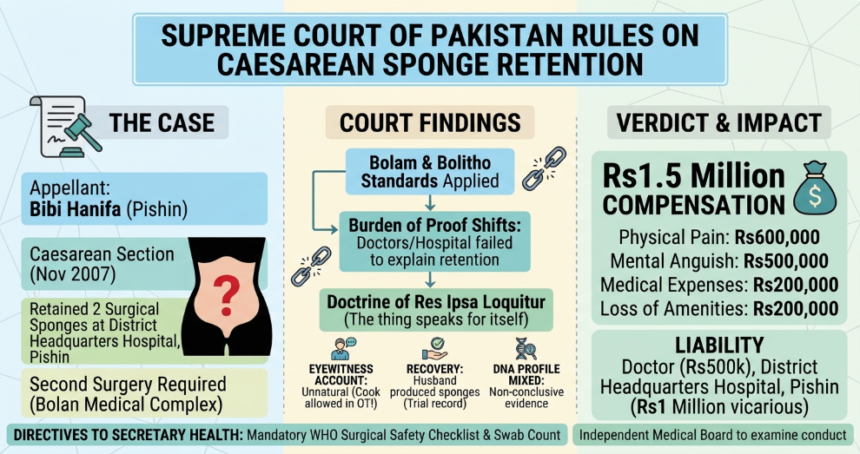
ISLAMABAD: Top court has ordered Rs 1.5 million in compensation for a case of medical negligence where surgical sponges were left inside a patient’s abdomen during a Caesarean section. Ruling on a civil appeal for damages, the Supreme Court held that both the operating doctor and the hospital failed to explain the lapse, and directed concerned authorities to submit a comprehensive report within three months in the matter.
A three-member bench comprising Chief Justice of Pakistan Justice Yahya Afridi, Justice Irfan Saadat Khan and Justice Shakeel Ahmed heard the matter on 7 July 2026. Justice Irfan Saadat Khan authored this 23-page judgement ,approved for reporting, with the assistance of Judicial Law Clerks Arshad and Zainab Qazi.
Syed Imdad Ali Shah, ASC, appeared for the petitioner through video-link from Quetta. Tahir Iqbal Khattak, Additional Advocate General Balochistan, appeared for the government, and Sardar Muhammad Ghazi, ASC, appeared for the respondent doctor.
The appeal and a connected civil petition were filed by Bibi Hanifa against the judgment of the High Court of Balochistan, Quetta, dated 27 November 2017. She had gone to District Headquarters Hospital, Pishin, to deliver her eighth child, and a Caesarean Section was performed on 20 November 2007 under the care of two consultant gynaecologists.
After the operation she complained of pain and fever, but was told these were minor complications that would resolve soon. On the advice of the hospital’s doctors she obtained an ultrasound from a private clinic, which detected “something” in her abdomen.
She was then taken by ambulance to Bolan Medical Complex Hospital, where a second ultrasound showed the same, and a further surgery recovered two sponges and over a litre of foul-smelling discharge. She remained under treatment there for a month and a half.
Her suit for Rs10 million was decreed by the trial court on 31 October 2009, which awarded Rs1.5 million against the doctors and a hospital staff member. The High Court allowed the appeal of the hospital and the doctors, holding that she had left the hospital against medical advice and that the sponges were not produced.
The Supreme Court found that this observation overlooked the record, as the patient’s husband had produced the sponges before the trial court during his examination.
On the preliminary objections, the Court condoned a delay of five days in the civil appeal, noting that both matters arose from the same High Court order and that the connected petition was filed within time. It also rejected the objection that the suit was barred by the Medical Tribunal Act, 2020, holding that the suit was filed in 2008, when neither that Act nor the Balochistan Healthcare Commission Act, 2019 existed.
The Court further held that the Tribunal’s jurisdiction is disciplinary rather than compensatory, and that a suit in tort for medical negligence is properly triable by a civil court.
Turning to the merits, the Court observed that the term “medical negligence” is not defined in the statute law of Pakistan, and examined its meaning through the Bolam and Bolitho standards and the provincial healthcare commission laws. It held that the Bolam principle protects professional judgment actually exercised and does not create a judgment that was never made.
The Court applied the doctrine of res ipsa loquitur and held that the burden passed to the doctor and the hospital to show that the sponges were left deliberately to control bleeding or otherwise without negligence, which they failed to do.
It noted that the respondents’ written statement denied that any sponge was left at all, a position contradicted by the independent surgeon who removed them.
The Court also found that a cook, who was appointed to the hospital as such, had been permitted into the operation theatre during the surgery, and observed that this reflected on the standard of care exercised.
The Court rejected the plea that the patient had left against medical advice, holding that her pain and deterioration began immediately after the operation, before any question of leaving arose.
It held that where a patient has no choice but to leave because a life-threatening condition remains unaddressed, the hospital cannot rely on that departure as a defence. Applying the civil standard of balance of probabilities, the Court concluded that the evidence favoured the patient.
On compensation, the Court stated that damages in such cases are not punitive and are meant to restore the injured party, so far as money can, to her former position.
It assessed Rs200,000 for medical and re-operative expenses, Rs600,000 for physical pain, suffering and surgical trauma, Rs500,000 for mental anguish and emotional distress, and Rs200,000 for loss of amenities and bodily integrity, a total of Rs1.5 million.
The treating doctor was held personally liable for Rs500,000, and the hospital was held vicariously liable for Rs1 million. Each amount is to be paid within sixty days, failing which it will be recovered under the land revenue laws. The patient was also held entitled to costs.
The Court set aside the High Court judgment, allowed Civil Appeal No. 244 of 2018, and converted Civil Petition No. 788 of 2018 into an appeal, disposing of it in the same terms.
The Court also issued directions to the Secretary, Health Department. Within thirty days, he must issue binding instructions to all public and private hospitals requiring the WHO Surgical Safety Checklist and a documented count of swabs, gauze, mops, needles and instruments before the operation, before closing and after closing, signed by the scrub nurse, the circulating nurse and the operating surgeon.
If the count is incorrect, the surgeon shall not close until the items are accounted for. Only trained and specialised staff may be present in operation theatres. Retained surgical items, wrong-site surgery and wrong-patient procedures must be reported within twenty-four hours.
An independent medical board is to examine the conduct of the doctors and the hospital in the present case. Disciplinary proceedings are to be initiated against the doctors and staff concerned and referred to the Pakistan Medical and Dental Council and the Balochistan Healthcare Commission, while the hospital faces action under the applicable licensing law. The patient is to be provided free corrective treatment, with the State at liberty to recover the cost from those found responsible.
The Court further directed regular and surprise inspections of operation theatres, an accessible and time-bound complaints mechanism with a grievance desk in every hospital, maintenance of operation notes, anaesthesia records and count sheets, and periodic training for doctors and nursing staff. A compliance report is to be filed through the Registrar within ninety days.