

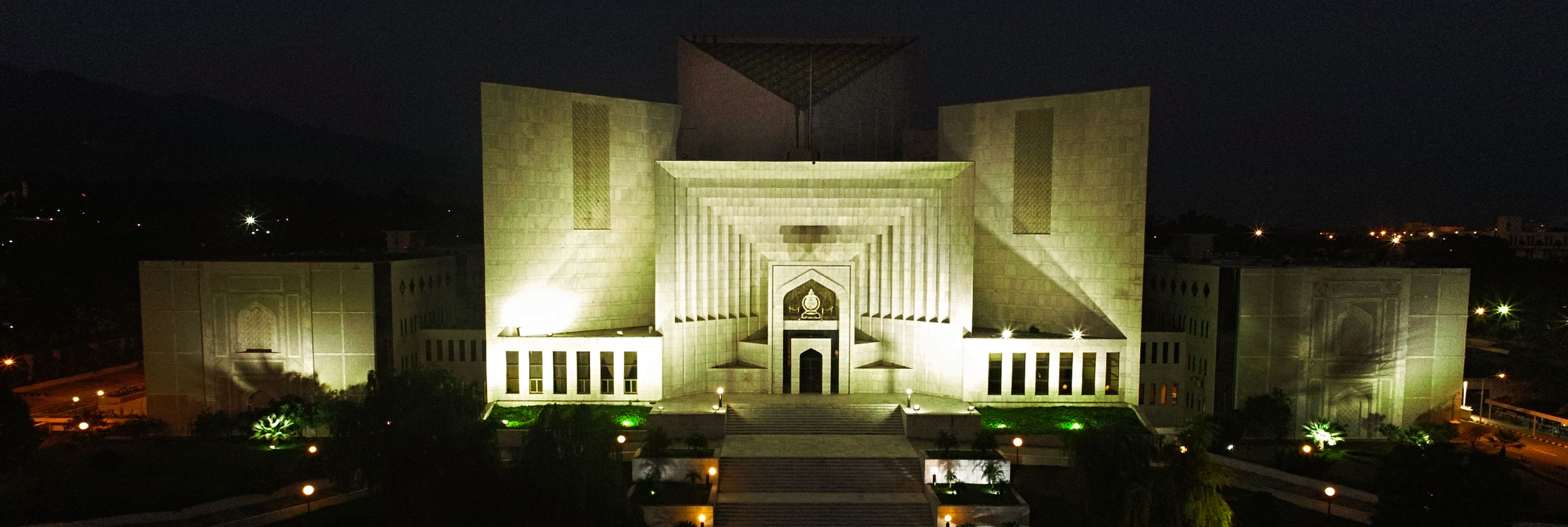
Resuming the hearing of presidential reference seeking guidelines of the Supreme Court (SC) for holding the upcoming Senate elections through an open ballot, the top court on Wednesday observed if democracy had persisted in the country, money would not have flowed in politics.
A five-member larger bench led by the Chief Justice Gulzar Ahmed asked the Attorney General for Pakistan (AGP), Khalid Javed Khan, whether people do vote for the party or its manifesto.
Responding to the chief justice’s query, the AGP said that in principle both the party and the manifesto should get votes, but most people vote for the ‘charismatic’ personality of the leader. He said that people had voted for the founder of Pakistan when inspired by his personality.
Chief Justice Gulzar asked the attorney general whether people voted for PTI for the best personality and good attire, whereas a member of the bench Justice Ijazul Ahsan remarked that voters cast their vote to a party and not to an individual.
Justice Ijazul Ahsan observed legally it was mandatory to publish the party manifesto, saying the people used to ask political parties during the elections how many pledges the party has fulfilled. Another member of the bench Justice Umar Ata Bandial asked the AGP whether the procedure for election of speaker and deputy speaker is there in the rules, adding whether the election of speaker is conducted under rules instead of the Constitution.
Responding to the question, the AGP submitted that the Election Commission of Pakistan (ECP) does not hold elections for the speaker and the deputy speaker. He further submitted that the opposition parties have asked as to why the election of chairman of the Senate is not conducted through an open ballot, saying if there is a judicial opinion on the presidential reference, then in the light of it, the election of the chairman of the Senate could also be considered through an open ballot.
The AGP said that no action could be taken against the party voter, adding falling in the eyes of the people is a great failure of a politician. Citing the recent release of a video of the Senate election a day ago, the AGP submitted that there was no way to distribute bags full of currency notes.
The Chief Justice asked whether the framers of the Constitution knew about the Senate election. The AGP claimed that buying and selling of open votes was not as widespread as it is today, adding that when the Constitution was drafted in 1973, it would not be known that people would bring bags of currency notes.
To which addressing the AGP, the CJP said that the situation was not as simple as the AGP was describing whereas Justice Ijazul Aassan remarked if democracy had persisted in the country, perhaps money would not have flowed in politics.
Justice Ahsan asked the AGP whether a voter will become dishonest if votes against the party, to which the AGP said he will not be dishonest, adding, if anyone intended to vote against the party, he should do so openly. The AGP further said that the Constitution describes political parties that are regulated by law.
However, he pointed out that being mentioned in the Constitution does not mean that political parties should be formed under the Constitution saying Article 226 of the Constitution does not mention that all elections are held by secret ballot and according to this Article only elections under the Constitution will be held by secret ballot.
Later, asking the AGP to conclude arguments on Thursday (today) the bench adjourned the hearing of the matter till February 11.