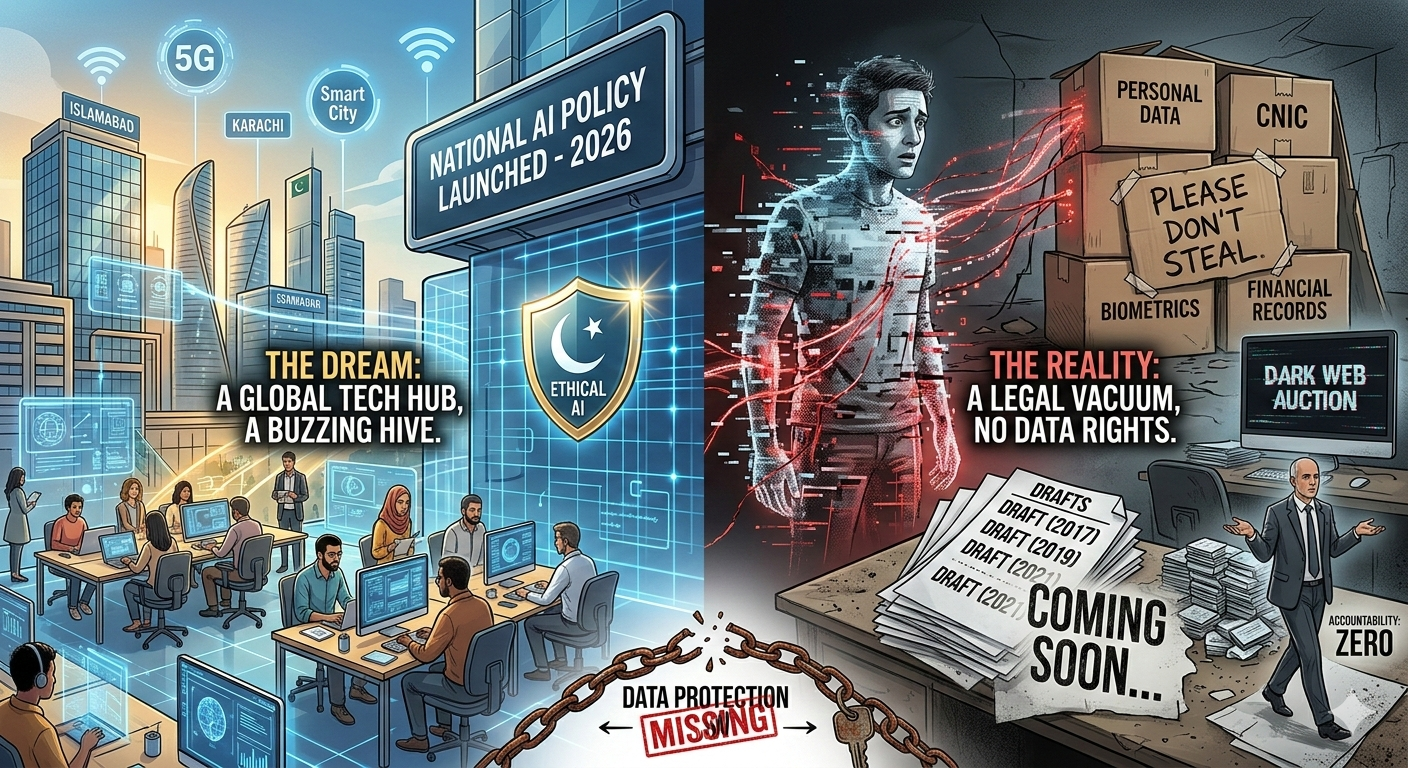
It’s 2026, and if you listen to the digital discourse in Islamabad or Karachi, you would think that we have finally cracked the code. We are a nation of 120 million internet users. We are the world’s buzzing hive for freelancers. We have just launched our first National AI Policy, complete with dreams of smart cities and automated governance.
But look closer at the “Digital Pakistan” we’re building.
Despite the apps, the hype and the 5G towers, the Pakistani citizen in 2026 is still a digital ghost – someone who generates immense value but owns none of it. We are living through a massive, silent contradiction. We are sprinting towards an AI-driven future while standing in a legal vacuum where the word “privacy” has no teeth.
Think about your digital footprint over the last 24 hours. You booked a ride, ordered biryani on an app, swiped your card at a pharmacy, and maybe scanned your thumb for a government service. Each of these moments left a “digital breadcrumb”. Your precise location, your CNIC, your biometrics, and your habits. In 2026, this data isn’t just “info”, it’s the new gold. It’s more valuable than oil. Yet, in Pakistan, this gold is being stored in a cardboard box with a “Please Don’t Steal” sign taped to it. When your most private details end up on a Dark Web auction block today, who do you hold accountable? Under current laws like PECA, the state can chase the hacker. But what about the multi-billion rupee company that didn’t bother to encrypt your data? Currently, they walk away. You are the victim, yet you have zero legal standing to demand a penalty. Without clear rules, AI is being trained on you without your consent. This isn’t just about targeted ads for lawn suits; it’s the gateway to sophisticated deepfakes that can ruin reputations in seconds and invasive surveillance that tracks your every move. You cannot have “Ethical AI” if you don’t have legal data rights.
If the human rights argument doesn’t move the needle, perhaps the economic one will. Pakistan wants to be a global tech player, but we are playing a game with no rules. International tech giants and major investors don’t just look at “user numbers”, they look for “Data Adequacy”. They want to know that information is handled with the same rigour in Lahore as it is in any city in Europe. By dragging our feet on this law, we aren’t just risking our secrets; we are sabotaging our own GDP. We are missing out on billions in digital trade because global partners don’t trust our digital “Wild West”.
We’ve seen draft after draft of the Data Protection Bill since 2017. It is now 2026, and it’s still “coming soon”. The delay usually boils down to three points. Firstly, how much “national security” access should the government have to your private chats? Secondly, should companies be forced to keep all data inside Pakistan? And lastly, whether the Data Protection Authority would be truly independent. Every day we wait for a “perfect” bill is another day the average Pakistani is left completely defenceless.
In the world of 2026, a Data Protection Law isn’t a luxury; it’s a survival kit for every citizen with a smartphone. It’s the only thing that gives you the right to ask a corporation, “What do you have on me?” The right to say “Delete it”, and the right to be compensated when they fail to protect you.
It is time to stop the “drafting” and start the “defending”. Give the Pakistani citizen a shield. Pass the law.
—