
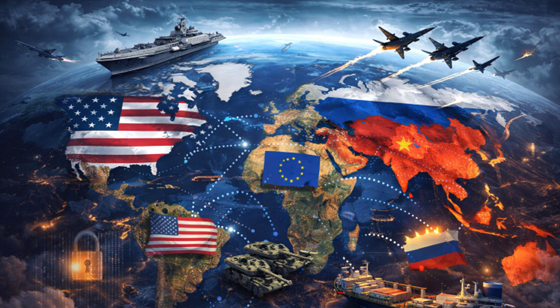
In the grand chessboard of global affairs, the pieces are moving faster than ever before, and the rules themselves are shifting beneath the feet of nations. The multipolar world order refers to the evolving global system of power, governance, and authority that emerges after major geopolitical shifts, aiming to reshape the rules of global cooperation and conflict.
The early 20th century witnessed a multipolar world order. The emergence of World War II, the Great Depression, and the Cold War then led to a bipolar one, and the dissolution of the Soviet Union gave birth to a unipolar order dominated by the USA. Yet the landscape of international politics is constantly changing, driven by shifts in the global balance of power, transformations in the global economic structure, and a decline of unipolarity. The emergence of a multipolar world order offers benefits to global politics while simultaneously posing threats and causing conflicts.
The opportunities
One of the most promising opportunities in world politics is the check on hegemony that comes from reducing the dominance of a single power. The US–China competition is balancing global trade policies and restraining the unilateral tendencies of the United States. Moreover, multipolarity ensures inclusivity in global decision-making, as seen in the African Union’s inclusion in the G20, which gives Africa greater institutional weight.
It also enhances the strategic autonomy of middle powers, coupled with complex multilateral diplomacy. The Ethiopia–Somalia Ankara Declaration (December 2024), followed by high-level diplomatic engagements, epitomizes improved diplomacy under a multipolar framework. Furthermore, a decentralized world order yields economic diversification and global innovation. Competition in areas such as mineral resources, clean energy, and artificial intelligence fosters both innovation and resilience.
The challenges

While multipolarity presents a range of opportunities for global cooperation and strategic autonomy, it also brings complex challenges that states must navigate carefully. Firstly, the multipolar world order triggers conflicts and increases the risk of miscalculation. Tensions in the Taiwan Strait show how differing interpretations of “red lines” could trigger a crisis. Secondly, in the aftermath of multipolarity, accelerated military buildups and arms races threaten global peace and deepen ideological polarization. Thirdly, trade protectionism, such as tariffs, sanctions, and export controls, is undermining the rules of free and fair trade. US tariffs on Chinese goods and the imposition of 100% duties on Chinese electric vehicles depict the darker side of a multipolar world order. Furthermore, fragmented global governance, proxy wars, and power struggles are undermining the rightful share of citizens in peace and well-being. Lastly, the emerging world order is increasingly characterized by grey-zone threats. Cyberattacks on critical infrastructure, such as the Stuxnet cyber operation, highlight the perils of modern power rivalry.
The way forward
To address these challenges, concrete and pragmatic measures must be set in motion at both national and international levels. To begin with, nations must strengthen multilateral diplomacy by encouraging cooperation through institutions such as the United Nations, the G20, and BRICS, along with coordinated climate action under the Paris Agreement. Moreover, it is high time for nations to promote strategic stability by fostering economic interdependence, as evident from Africa–China trade and infrastructure projects that create mutual stakes in stability.
To conclude, the multipolar world order, marked by shifting poles of power, acts as a double-edged sword, offering both opportunities and threats to global politics. It therefore demands a measured and strategic approach.
—-
The writer is a lawyer and columnist from Muzafarabad AK. She can be reached at sannaabbasi@yahoo.com