
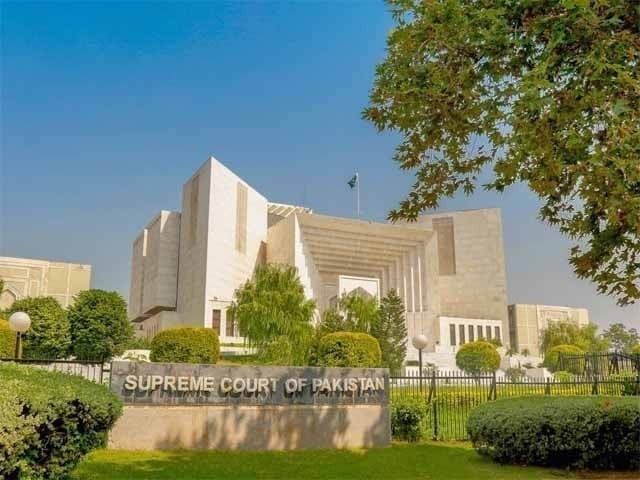
Top court on Tuesday reserved verdict in response to identical pleas challenging denial of reserved seats in Parliament to the Sunni Ittehad Council (SIC) party as the Council has urged the court to set aside Peshawar High Court and Election Commission of Pakistan decisions which resulted denial of reserved seats for women and non-Muslims to the Council.
Chairman of the SIC has invoked the Supreme Court (SC) jurisdiction challenging denial of reserved seats to the party and their distribution to other parties that formed the Prime Minister Shehbaz Sharif-led ruling coalition after Feb. 8 general elections. A 13-member full court of the SC, led by Chief Justice Qazi Faez Isa has initiated hearing of the pleas during last month.
Arab News reported, “Supreme Court of Pakistan has reserved the decision on reserved seats quota petition”, to be announced later,” Khan’s Pakistan Tehreek-e-Insaf (PTI) party said in a message to reporters.
Weeks before the national election, the PTI was stripped of its iconic election symbol of the cricket bat on technical grounds, and all its candidates had to contest polls as independents. After the election in which Imran Khan-backed independents won the most seats overall, they joined the SIC party to claim a share of reserved seats in parliament for women and religious minorities.
According to the Election Commission of Pakistan (ECP) rules, political parties are allotted reserved seats in proportion to the number of parliamentary seats they win in the election. This completes the National Assembly’s total strength of 336 seats.
After the elections, the ECP ruled in March that the Khan-backed SIC party was not eligible for extra reserved seats in the legislature, dealing a blow to the embattled group’s governing prospects and proving to be a major setback for Khan, who has been in jail since last August.
The election regulator’s decision was upheld by the Peshawar High Court but the Supreme Court overruled the verdict, followed by the ECP suspending 77 lawmakers from Sharif’s ruling coalition. which lost its two-thirds majority in the National Assembly, with its numerical strength decreasing to 209 from 228. In the 336-member National Assembly, the figure to attain two-thirds majority is 224, without which the government cannot push through constitutional amendments.
Sharif formed a weak coalition with other parties after February general elections produced a hung Parliament. The PML-N’s 79 and the PPP’s 54 seats together made a simple majority in parliament to form a government and they also roped in smaller parties in the coalition. Candidates backed by Khan won the most seats, 93, but did not have the numbers to form a government.
Khan and his party have rejected the results of the elections, alleging widespread rigging, which the ECP denies, Arab News concluded.
As to why court reserves verdict in a case:
When it is said that judgment is reserved, it means that the judge or judges, after hearing final arguments from both sides, adjourns case without setting a specific date. The judge/s records ‘the matter is reserved for judgment’, indicating that they will start writing the judgment for the case. This means that we can expect the judgment to be announced soon, which will resolve the case. There will be no further proceedings except for waiting for the judgment.