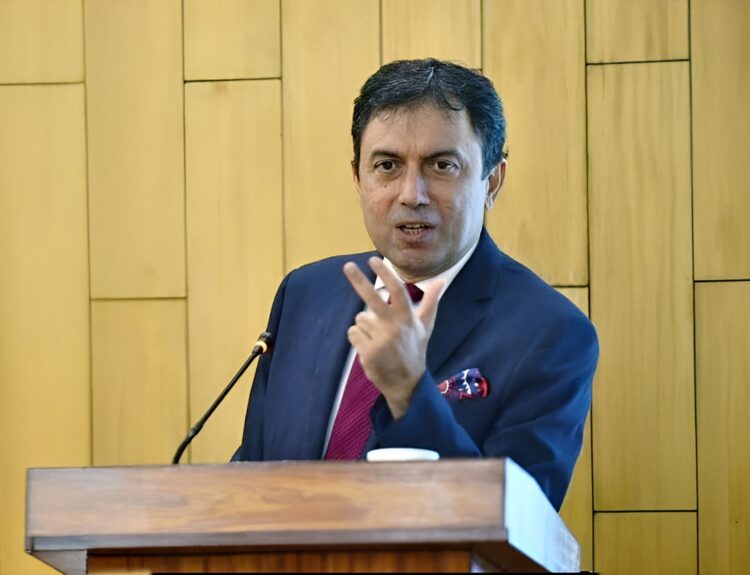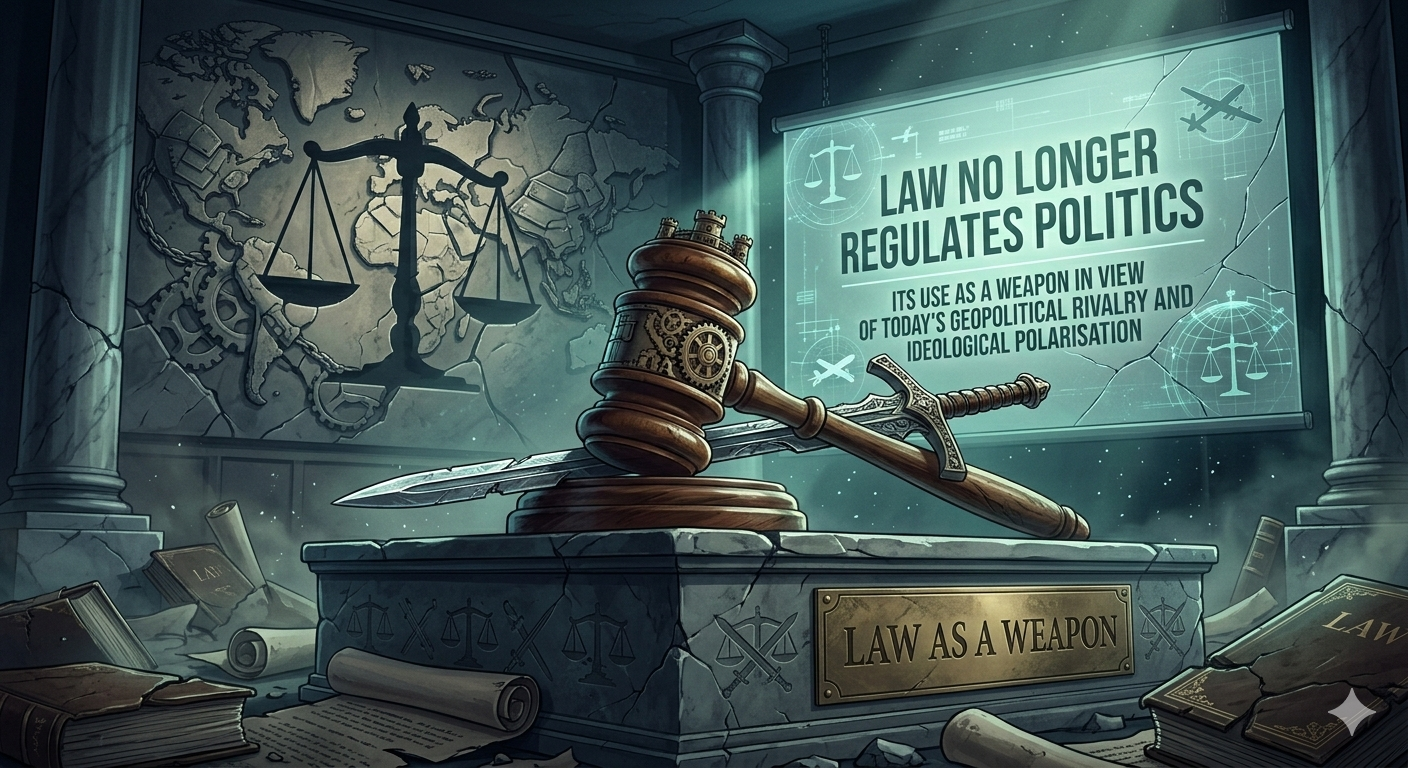
KARACHI: Former director general of the Federal Investigation Agency Dr Sanaullah Abbasi has said law no longer regulates politics and its use as a weapon has become essential to understand in view of today`s geopolitical rivalry and ideological polarisation.
Dawn News reported that he said this while delivering an insightful lecture on the evolving concept of `Law as a Weapon`, widely known as lawfare, here at the Hamdard School of Law. Addressing students and faculty member s, Dr Abbasi explore d how law, traditionally viewed as a mechanism for justice and order, can also be strategically used as an instrument of power by states, institutions and individuals. He referred to the book Pakistan: A Hard Country by Anatol Lieven, which describes Pakistan as a `negotiated state`, where authority often operates through compromise, pressure and power dynamics rather than strictly through formal legal frameworks.
Explaining that lawfare mani-fests in multiple forms, he said at international level weaker states frequently resort to legal forums and tribunals to challenge stronger adversaries. Through litigation and multilateral engagement, they may impose reputational damage, financial burdens, or diplomatic constraints without direct confrontation. About domestic manipulation, he said conversely, authoritarian regimes may manipulate domestic legal systems to silence dissent, fabricate charges and maintain power under the guise of procedural legitimacy.
Speaking about economic influence, he said economically dominant states can leverage financial systems, sanctions and regulatory mechanisms to extend influence beyond theirborders. The use of global trade systems and financial restrictions often illustrates how legal and economic tools intersect in modern geopolitical strategy. On the domestic front, Dr Abbasi observed that litigation has increasingly become a political tool. `Political actors may use court proceedings and legal threats to gain partisan advantage, influence policy decisions, or silence opponents, all while maintaining an appearance of legality.
Such practices, he warned, stand in contrast to the classical ideal of the rule of law, which demands transparency, predictability and impartiality.Discussing the post-World War II international system grounded in the United Nations Charter, he noted that while the rules-based international order aims to foster cooperation and collective security, critics argue that it sometimes reflects the interests of powerful states. Increasing great-power competition and selective adherence to international norms have placed this order under significant strain, he said.
The former FIA chief also addressed the ethical dimensions of lawfare and emphasised that legal strategies may serve justice when used to empower marginalised groups or hold powerful actors accountable. `When exploited to suppress opposition or exhaust adversaries through prolonged litigation, they erode public trust and weaken institutional legitimacy. Concluding his lecture, Dr Abbasi remarked that in today`s era of geopolitical rivalry and ideological polarisation, understanding lawfare has become essential.
`Law no longer merely regulates politics; it has emerged as one of its most powerful instrumentsshaping conflicts at domestic, international, and even digital levels. The session concluded with an interactive question-and-answer segment, where students engaged in thoughtful discussion on the future implications of lawfare in Pakistan and beyond.