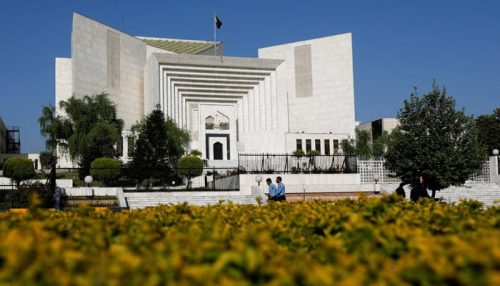
While issuing an 8-page order on Friday top court’ Chief Justice Umar Ata Bandial led five member larger bench suspended government notification till May 31 and issued stay order against proceeding of a three-member judicial panel to probe into audio leaks, viral on social media over past few months.
“In the circumstances, till the next date of hearing, the operation of the impugned notification No.SRO.596(I)/2023 dated 19.05.2023 issued by the Federal Government is suspended as is the order dated 22.05.2023 made by the Commission and in consequence thereof proceedings of the Commission are stayed,” the top court said in its order.
During last week, exercising its powers under Section 3 of the Inquiry Commission Act 2017, federal government formed a 3-member Judicial Commission under the chair of top court’s puisne judge Justice Qazi Faez Isa. The Commission was given mandate to probe into over half-a-dozen leaked audio clips allegedly involving some current and former members of the superior judiciary and their family members to determine their veracity and impact on the independence of the judiciary.
Other members of the Commission were Chief Justices of Balochistan High Court and Islamabad High Court namely Justice Naeem Akhtar Afghan and Justice Aamer Farooq respectively. However, challenging the formation of the Commission, Supreme Court Bar Association (SCBA) President Abid Zuberi invoked the jurisdiction of the top court terming the panel formation as sheer violation of Articles 9, 14, 18, 19, and 25 of the Constitution.
Subsequently, Chief Justice of Pakistan (CJP) Umar Ata Bandial formed a five-judge larger bench to take up identical pleas assailing formation of the Commission. Apart from the CJP as the head, the bench included Justice Ijazul Ahsan, Justice Munib Akhtar, Justice Syed Hasan Azhar Rizvi and Justice Shahid Waheed.
In its order, the larger bench of the Supreme Court said no judge of the apex court can be made a part of the Commission without the consent of the Chief Justice, adding inclusion of high courts’ chief justices in any commission is also subject to the approval of the Chief Justice of Pakistan.
Appearing before the larger bench on Friday at the outset of the hearing, Attorney General for Pakistan (AGP) Mansoor Awan raised objections over the constitution of the larger bench, particularly he objected to the inclusion of the CJP himself in the bench.
“I wish to bring the 6th Amendment to the court’s attention,” the AGP submitted , which pertains to the retirement of Chief Justices of the SC and high courts. However, the court proceeded to express its dismay over the government’s decision to proceed with the nomination of judges in the Commission probing the audio leaks.
The AGP urged the CJP Bandial to recuse from the bench but he refused to do so, saying that the government did not approach the Chief Justice for nomination of judges for inquiry commission as there were several judgments to support these points.
“The government cannot choose judges of its liking to sit on a bench,” remarked CJP Bandial. “It is the CJP’s domain to nominate judges for a Commission,” remarked CJP Bandial, adding that “it is not necessary that the CJP includes himself in the Commission and nor is the CJP bound by the wishes of the government.”
“We respect the government completely,” he remarked, but regretted that it had “rushed through laws to regulate the CJP’s powers”. “We had raised an issue [with the government] that Article 184 posits that at least five judges must be included in the bench,” he continued, “had you consulted us, we would have guided you better on this.”
“Respected AGP, this is a matter of the independence of the judiciary,” he exclaimed, questioning “how could the government pick judges to serve its own purposes?” “I am sorry to say this, but the government has caused a rift between the judges,” responded CJP Bandial.
“Enough is enough,” CJP Bandial said, telling AG Awan to “sit down” and to “request the government to respect the constitutional traditions”. AGP Awan insisted that he could “clarify the issue”, but the CJP told the government to “bear quarters in mind”.
“The government nominated the judges for the inquiry commission itself,” he said, observing that “previously the government had issued three different notifications nominating judges which were later taken back.”
“The 2017 Act has not been challenged,” argued the AGP. “We will return to this issue later,” responded CJP Bandial. However, AGP Awan insisted that he was prepared to argue this point “right away”.
The court maintained its reservations about the constitution of the inquiry position, stating that the move stood in violation of the tracheotomy of powers and was a breach of Article 209. “This is not an issue of egos,” the CJ said, “we speak of the constitution here”. Justice Munib Akhtar also observed that “it appears as though the Supreme Judicial Council’s powers have been granted to the Commission”.
“According to Article 209, a reference can be filed with an executive head after any information is received,’ he further said, “but how can a misconduct case be handed over from the council to a commission?” “Even if the judges agree to it, this simply cannot be done,” he added.
“It seems like the constitutional principle of the division of powers has been gravely breached,” the judge added. He also regretted that the government failed to order the media regulatory authority, PEMRA from broadcasting the alleged audio leaks. The AGP also joined him in lamenting the lack of action to the extent of PEMRA. Later, the bench issued notice to all parties of the case and adjourned hearing of the matter till May 31.